


Table of content
WAIS IQ Test: What It Measures and How It Works
What is the WAIS IQ test? Learn its subtests and index scores, how it is given and scored, how it differs from online IQ tests, and its limits.
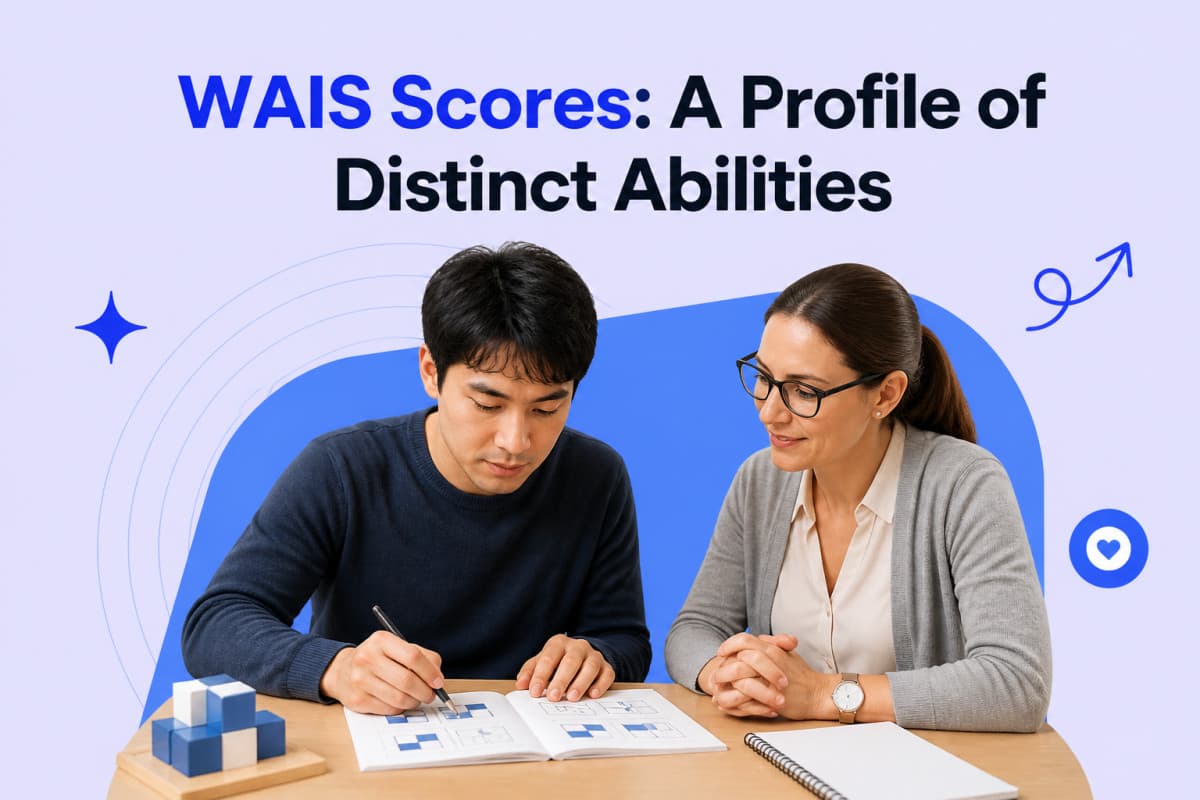
The WAIS (Wechsler Adult Intelligence Scale) is the most widely used clinical IQ test for adults and older adolescents. A trained examiner gives it one-on-one, and it produces a Full Scale IQ plus separate index scores for verbal reasoning, visual and fluid reasoning, working memory and processing speed.
This guide explains where the test came from, what each part measures, how it is given and scored, how it compares with online IQ tests, and where its limits lie.
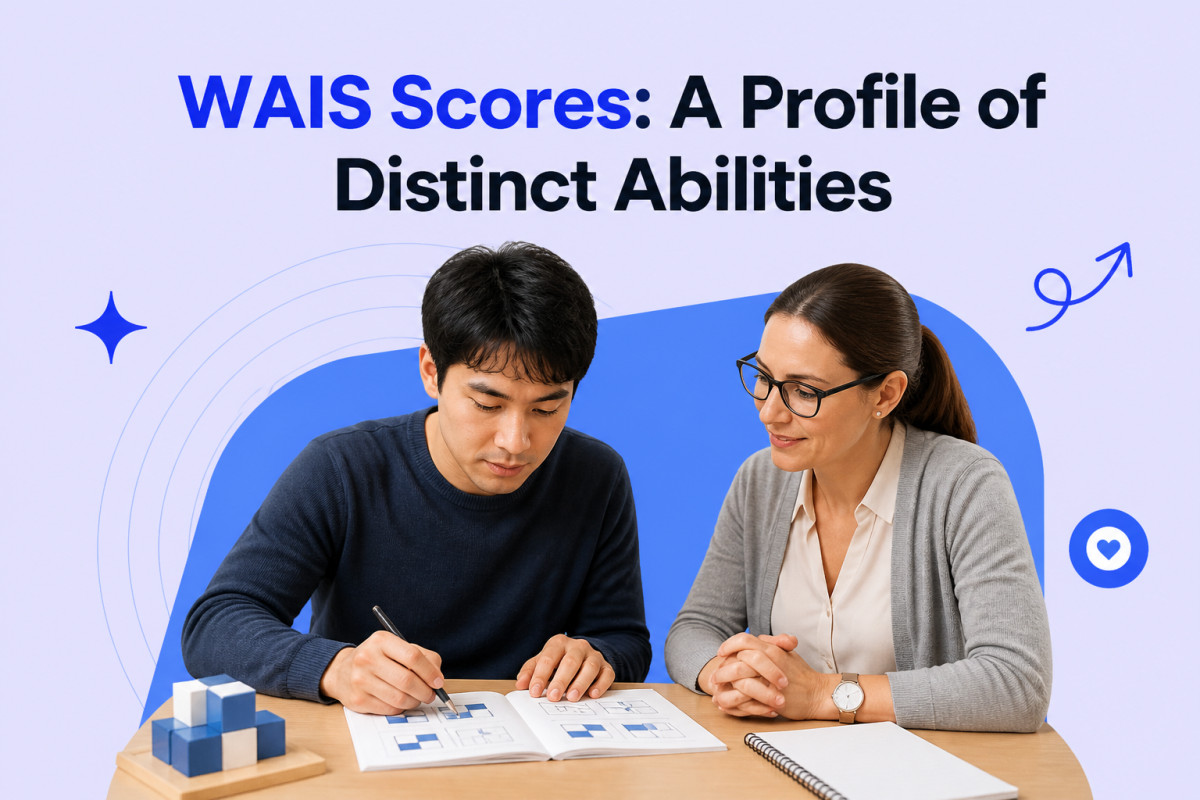
The WAIS: Origins and Current Edition
The WAIS was created by psychologist David Wechsler, and its current version is the fifth edition (WAIS-5), released by Pearson in 2024.
- Wechsler's view of intelligence: Wechsler described intelligence as "the global capacity of a person to act purposefully, to think rationally, and to deal effectively with his environment." He saw it as a set of related abilities that could each be isolated and measured.
- The original WAIS: Wechsler was chief psychologist at Bellevue Hospital in New York from 1932 to 1967. He published the original WAIS in February 1955 as a revision of the Wechsler-Bellevue Intelligence Scale from 1939.
- The current edition: WAIS-5 replaced the WAIS-IV (2008) and is used to assess adults and older adolescents in clinical, educational and research settings. For other options, see this guide to the best IQ tests.
Test Architecture
The WAIS turns performance on short cognitive tasks (subtests) into subtest scores, index scores and an overall Full Scale IQ (FSIQ).

In the WAIS-IV, 10 core subtests produce the FSIQ and 5 supplemental subtests can replace or add to them. The WAIS-5, released in late 2024, was normed on a U.S. sample tested in 2023 and 2024 that reflects census data, and it was co-normed with the Wechsler Memory Scale, Fifth Edition.
The biggest structural change in WAIS-5 is that the old Perceptual Reasoning Index is split into two: Visual Spatial and Fluid Reasoning. Seven subtests now make up the FSIQ: Similarities, Vocabulary, Block Design, Matrix Reasoning, Figure Weights, Digit Sequencing and Coding. This mirrors the structure of the WISC-V for children, and the edition also offers a range of ancillary index scores, including the General Ability Index.
Verbal Comprehension Index
The Verbal Comprehension Index (VCI) measures how well a person understands and uses language, reasons with words and draws on acquired knowledge from long-term memory.
| Subtest | WAIS-IV role | What the person does | Abilities measured |
|---|---|---|---|
| Similarities | Core | Explains how two words or concepts are alike | Abstract verbal reasoning, semantic knowledge |
| Vocabulary | Core | Names pictured objects or defines words | Word knowledge, verbal expression |
| Information | Core | Answers general knowledge questions | General knowledge acquired from culture and schooling |
| Comprehension | Supplemental | Answers questions about social situations and common concepts | Understanding of social rules and practical reasoning |
Perceptual Reasoning Index
The Perceptual Reasoning Index (PRI) measures how someone interprets, organizes and reasons with visual information, and it relies more on fluid reasoning than on verbal skill. It replaced the older Perceptual Organization Index in the WAIS-IV.
| Subtest | WAIS-IV role | What the person does | Abilities measured |
|---|---|---|---|
| Block Design | Core | Arranges red-and-white blocks to copy a model within a time limit | Visual-spatial processing, visual-motor construction |
| Matrix Reasoning | Core | Picks the missing piece that completes a pattern | Nonverbal abstract problem solving, inductive reasoning |
| Visual Puzzles | Core | Chooses three pieces that together make a target puzzle | Visual-spatial reasoning |
| Figure Weights | Supplemental (ages 16 to 69) | Chooses the shape that keeps a scale balanced | Quantitative reasoning |
| Picture Completion | Supplemental | Spots the missing part of a picture | Quick perception of visual detail |
Visual Spatial and Fluid Reasoning in WAIS-5
In WAIS-5, visual reasoning is measured by two separate indexes instead of one. The Visual Spatial Index uses Block Design and Visual Puzzles, while the Fluid Reasoning Index uses Matrix Reasoning and Figure Weights, with Set Relations as an additional subtest. The edition also adds Naming Speed Quantity to the processing speed area, a task first used in the WISC-V.
Working Memory Index
The Working Memory Index (WMI) measures how much information you can hold in mind and manipulate at once. Think of it as a mental whiteboard: the score reflects how many details you can keep and rework without losing your place, not how much you know.
- WAIS-IV: Digit Span and Arithmetic are the core subtests, and Letter-Number Sequencing is supplemental.
- WAIS-5: Digit Sequencing and Running Digits form the core of the index. Other tasks, such as Digit Span Forward, Digit Span Backward, Spatial Addition, Symbol Span and Letter-Number Sequencing, can feed an expanded working memory score.
Processing Speed Index
The Processing Speed Index (PSI) measures how quickly and accurately someone scans and handles simple visual information, with a secondary contribution from motor speed.
| Subtest | WAIS-IV role | What the person does | Abilities measured |
|---|---|---|---|
| Symbol Search | Core | Marks whether target symbols appear in a row of symbols | Processing speed, visual scanning |
| Coding | Core | Copies symbols paired with numbers using a key, against the clock | Processing speed, associative memory, fine-motor speed |
| Cancellation | Supplemental (ages 16 to 69) | Finds and marks target shapes among distractors within a time limit | Processing speed, selective attention |
Full Scale IQ and General Ability Index
The Full Scale IQ is the overall score that combines all four index areas, and it is the number most people think of as their IQ. On the WAIS-IV it can range from 40 to 160. It reflects general cognitive ability, which is central to what IQ measures.
The General Ability Index (GAI) combines the three core verbal subtests (Similarities, Vocabulary, Information) with the three core perceptual subtests (Block Design, Matrix Reasoning, Visual Puzzles). Because it leaves out working memory and processing speed, clinicians use it when those areas are affected by conditions such as ADHD or brain injury and would otherwise pull the FSIQ down.
Shorter Testing for Older Adults
For adults aged 70 to 90, the WAIS-IV skips three supplemental subtests (Letter-Number Sequencing, Figure Weights and Cancellation), which shortens the session and reduces fatigue.
Administration and Scoring
The WAIS is given one-on-one by a qualified examiner in a quiet, controlled room, and a full WAIS-IV session usually takes about 60 to 90 minutes.
Qualified Test Administrators
Only qualified professionals can buy and give the WAIS. Pearson sells it to licensed clinical psychologists, school psychologists and neuropsychologists, and graduate trainees may give it under supervision.

Testing Environment and Setup
Testing happens in person. Examiners can use paper materials or Pearson's Q-interactive system, which shows some items on a tablet, but a qualified professional must still be in the room.
Standardized Administration Procedure
Every examiner follows the same scripted instructions, start points and stop rules set out in the manual and stimulus books. This consistency is what makes one person's score comparable with the norm group.
Time Limits
The WAIS-IV puts less weight on speed than earlier editions. Several subtests give fewer bonus points for fast answers, or none at all, although timed tasks such as Block Design still reward speed on harder items.
Raw Score Conversion and Standardized Scaling
Raw scores are converted to scaled scores using age-based norm tables, so each person is compared with people of the same age, as explained in this guide to average IQ by age.
- Each subtest is scaled to a mean of 10 and a standard deviation of 3.
- Index scores and the FSIQ are built from combinations of subtest scores and scaled to a mean of 100 and a standard deviation of 15.
Qualitative Behavioral Observations
Beyond the numbers, examiners note how a person approaches problems, how quickly they respond and how they handle frustration. These observations help explain the scores in the final report.
Authentic Wechsler IQ Test Versus Online Tests
An online IQ test cannot give you a WAIS score. Online tests may show IQ-style numbers, but they do not use the WAIS's standardized administration, item scoring or normative sample, and those norms are what give a WAIS score its meaning.

That does not make online tests useless. A free online IQ test is a quick way to practice reasoning tasks or get a rough sense of your strengths. Clinicians, schools, courts and high-IQ societies have their own rules, though, so check what they accept before relying on any online score.
Practical and Clinical Applications
Clinicians use the WAIS as a primary tool for assessing adult intelligence, and its results feed into diagnosis, treatment planning and educational decisions.
Psychiatric and Differential Diagnostics
The WAIS helps clinicians measure cognitive functioning in people with psychiatric illness, neurological conditions or brain injury. In schizophrenia, for example, working memory and processing speed difficulties are common, and WAIS results can help document these deficits and guide treatment planning.
Educational Accommodations and Giftedness Identification
The WAIS is often part of educational evaluations and can also support giftedness identification.
- Educational evaluation: College students often take the WAIS as part of an assessment for testing accommodations or learning disability services.
- High-IQ societies: Groups such as Mensa, Intertel and the Triple Nine Society may accept WAIS scores as qualifying evidence. Requirements differ, so check each society's current rules before testing.
Psychometric Properties
The WAIS is one of the most thoroughly researched IQ tests, with large normative samples and strong evidence for its structure, although its manuals say less about how well scores predict clinical outcomes.
Standardization and Demographic Stratification
The WAIS-IV was normed on 2,200 people in the United States aged 16 to 90, selected to match U.S. Census proportions for age, sex, education, ethnicity and region. A separate Canadian sample included 688 people in the same age range. To keep the norms clean, researchers screened out older adults who might have early dementia and anyone who showed poor effort during testing.
Construct Validity
Research consistently shows that WAIS subtests group into four cognitive domains: verbal comprehension, perceptual reasoning, working memory and processing speed. Older editions reported a Verbal IQ and a Performance IQ, but decades of factor analysis showed this two-part split did not fit the data well. The WAIS-III introduced index scores based on the four factors, and the WAIS-IV dropped Verbal and Performance IQ altogether.
Concurrent and Criterion Validity
The WAIS-IV correlates well with other cognitive and neuropsychological tests, and its manuals include many tables supporting this. They give less information on criterion validity, meaning how well scores predict a diagnosis or real-world outcome. Without that data, figures that neuropsychologists rely on, such as sensitivity, specificity and likelihood ratios, cannot be calculated directly from the manual.
Limitations and Clinical Considerations
The WAIS is a strong measure of structured reasoning, but it does not capture every kind of intelligence, and some people need a different or adapted assessment.
Noncognitive Interference
Some adults are better served by a specialized battery than by the standard FSIQ. This includes people with limited English, severe depression, active psychosis, or significant motor or sensory impairment. For some of these cases, WAIS-5 offers new Motor-Reduced and Nonverbal indexes.
Wechsler himself stressed non-intellective factors, such as confidence, motivation and fear of failure. These are not part of intelligence, but they can lower or raise a person's score on the day.
Restricted Construct Scope
The WAIS measures specific cognitive abilities, not intelligence as a whole. It does not assess emotional or social intelligence, creativity, motivation, character or wisdom, all of which appear in broader models of the types of intelligence. A WAIS profile shows patterns across measured abilities, but it cannot tell you on its own how those abilities play out in daily life.

Frequently Asked Questions
Is the WAIS-IV or WAIS-5 the current edition?
The WAIS-5 (also written WAIS-V) is the current edition, released in 2024. WAIS-IV scores still appear in older reports and in settings that have not yet switched to the new norms.
How long does the WAIS take?
Pearson estimates about 45 minutes to obtain the WAIS-5 Full Scale IQ and about 60 minutes for the primary index scores. A full assessment with extra subtests, history and feedback takes longer.
How much does a WAIS test cost?
Cost depends on the provider and on whether the WAIS is given alone or as part of a wider neuropsychological evaluation. Insurance may cover testing ordered for a clinical reason, but usually not IQ testing for personal interest, so ask the provider about fees first.
Can you take the WAIS online?
No. The WAIS must be given face-to-face by a qualified examiner using licensed materials, so any website offering the "WAIS online" is not the real test.
What is a good WAIS score?
A score between 90 and 109 is in the average range, 110 to 119 is high average, and 130 or above is very superior. What counts as good depends on the purpose, since disability assessments and gifted programs use specific cutoffs. This IQ score chart shows how each range is classified.
Key Takeaways
The WAIS is most useful when you read it as a profile of distinct abilities rather than a single number.
- Look at the index scores alongside the Full Scale IQ, especially when the indexes differ a lot.
- Keep the reason for testing in view, whether it is diagnosis, accommodations or giftedness.
- Treat the WAIS as one input into a clinical or educational decision, not the decision itself; a good examiner will say so in the report.


DISC Team is a content writing team for tracnghiemtinhcach.vn, focusing on the DISC model, communication styles, and teamwork. The team aims to explain concepts in accessible language, helping readers connect them with situations in their work and everyday lives.
View author profile

Don't Let Your Potential Stay Hidden!
Take the DISC test today and discover your unique 'YOU', with deep insights into your true personality and potential.
 Understand yourself
 Choose the right career
 Suggest effective communication
 Reduce negative emotions
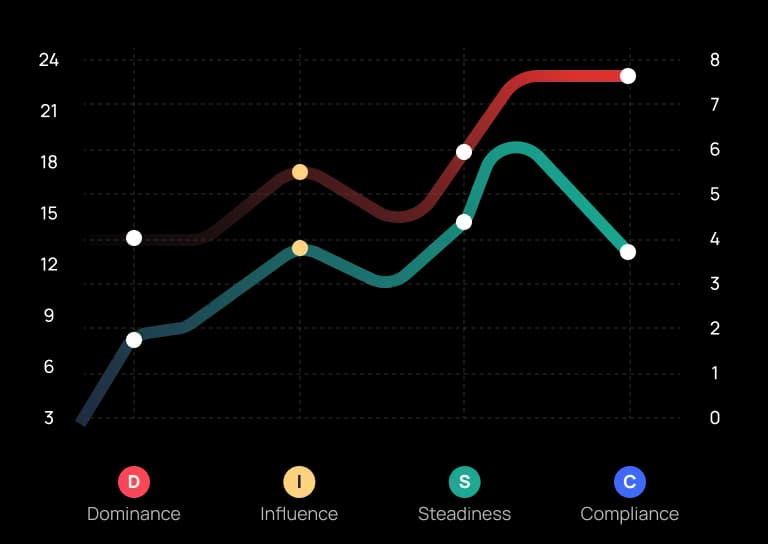
Represents your instinctive behaviors and desires.
Shows the behavioral tendencies you think you should exhibit in specific situations.
Related articles
You may also be interested in
 IQ, EQNov 03, 2026
25 Best Books for Emotional Intelligence
Looking for the best books for emotional intelligence? See 25 top EQ books for work, leadership, relationships and self-awareness, grouped by goal.
 IQ, EQNov 03, 2026
What Happens When an IQ Is Too High?
Can an IQ be too high? See how a very high IQ links to overthinking, perfectionism, anxiety, relationships and neurodivergence, plus coping tips.
 IQ, EQNov 02, 2026
What Is Genius IQ? Score Ranges, Rarity and Meaning
What IQ is considered genius? Learn the 140 benchmark, bell curve odds, and why IQ alone doesn’t make a genius. Take the IQ test.
