


Table of content
What Is Genius IQ? Score Ranges, Rarity and Meaning
What IQ is considered genius? Learn the 140 benchmark, bell curve odds, and why IQ alone doesn’t make a genius. Take the IQ test.
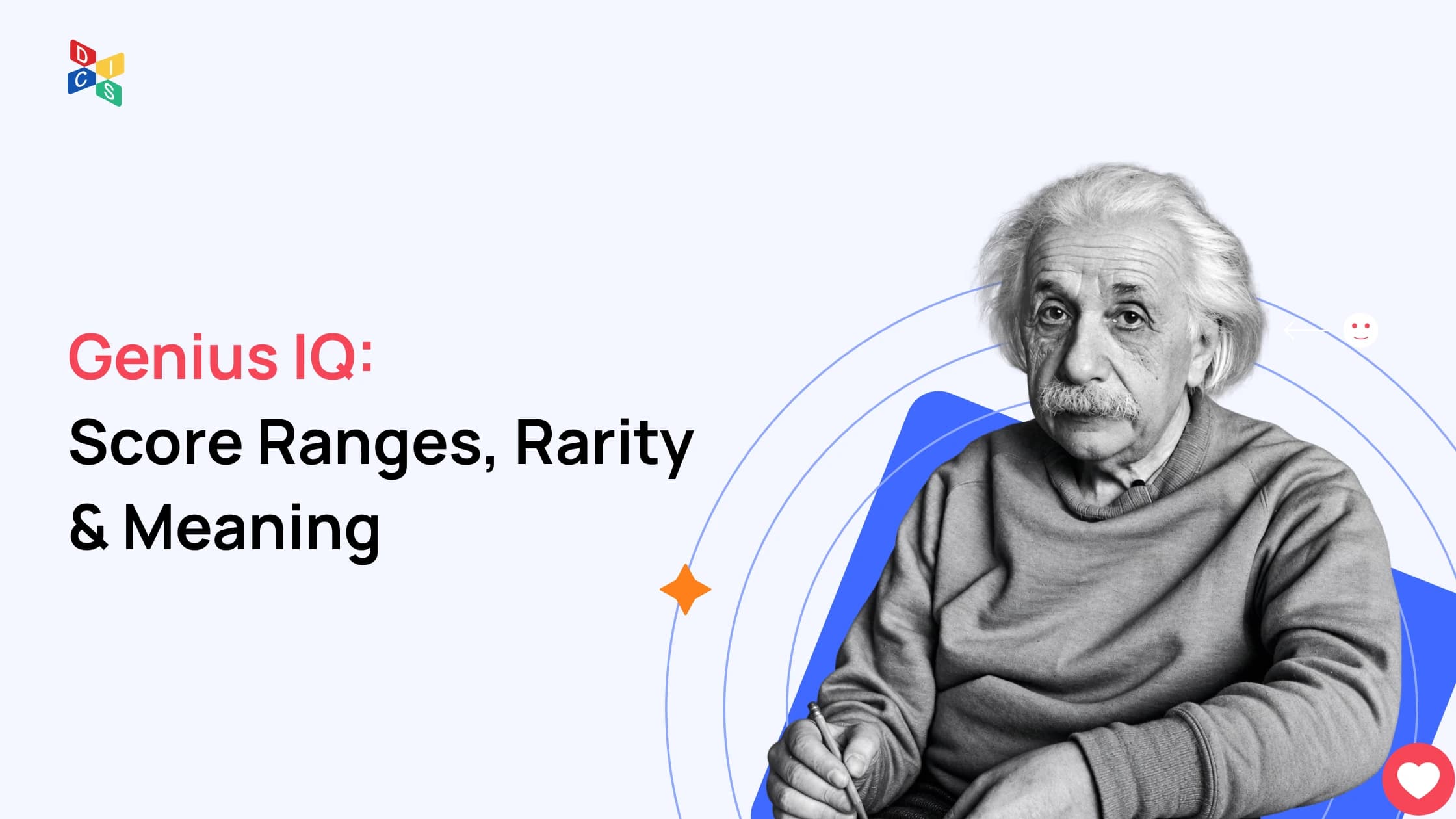
Table of content
What IQ score counts as genius? A genius IQ is generally a score of 140 or higher on a modern intelligence test. That places a person in roughly the top 0.4% of the population, or about 1 in 260 people. Psychologist Lewis Terman used 140 as his “near genius or genius” cutoff in 1916, and the number has stuck ever since. Today, test publishers avoid the word “genius” and use labels like “gifted” or “extremely high” instead. This guide covers the score ranges, how rare each level is, and why 130 is not quite genius. It also explains what an IQ number can and cannot tell you.
What Is Genius IQ?
Genius IQ is an informal label for an intelligence quotient of about 140 or higher, a level reached by roughly 4 in every 1,000 people. It is a popular term, not a clinical category. Modern IQ tests report a standard score and a descriptive band, and none of today’s major tests uses “genius” as an official label.
An IQ, or intelligence quotient, is a standardized score that compares your performance on reasoning tasks with that of people your age. German psychologist William Stern coined the term in 1912. Most modern tests set the average at 100 and the standard deviation at 15, so every 15 points marks one step away from the middle.
When people ask what is genius IQ, they usually mean one of two things. Some want the number that separates genius from gifted. Others want to know whether a high score proves exceptional talent. The short answers are “about 140” and “no.” The rest of this guide explains why.
What IQ Is Considered Genius?
The IQ considered genius is usually 140 or above, based on Lewis Terman’s 1916 classification for the Stanford-Binet test. Some writers set the bar higher, at 145 or 160, because those scores are far rarer. No current test defines genius, so the exact cutoff depends on which scale and which source you follow.
| Classification source | Label for high scores | Score range |
|---|---|---|
| Terman, Stanford-Binet (1916) | Near genius or genius | 140 and above |
| Stanford-Binet Fifth Edition (2003) | Gifted or very advanced | 130 to 144 |
| Stanford-Binet Fifth Edition (2003) | Very gifted or highly advanced | 145 to 160 |
| Wechsler scales (WAIS-IV, 2008) | Very superior | 130 and above |
| Wechsler scales (WISC-V, 2014) | Extremely high | 130 and above |
| Mensa admission standard | Top 2% on an approved test | 130 and above (standard deviation 15) |
| Popular usage | Genius | 140 and above |
Two points stand out. First, the label “genius” survives mainly in popular writing and in older systems documented in the history of IQ classification. Second, the same person can land in different bands depending on the test, the edition and the year it was normed. So the honest answer to what IQ is considered genius is “140 or higher by tradition,” not a fixed scientific line.
What Is Genius Level IQ on the Bell Curve?
Genius level IQ sits at the far right of the bell curve, at least 2.67 standard deviations above the average of 100. On a scale with a standard deviation of 15, a score of 140 is higher than about 99.6% of people. A score of 160 is expected in roughly 1 person out of 31,500.
IQ scores follow a normal distribution, often called the bell curve. About 68% of people score between 85 and 115, and about 95% score between 70 and 130. Each step above 130 becomes dramatically rarer, which is why a genius level IQ is so uncommon.
| IQ score | Percentile | Share scoring this high or higher | Rarity |
|---|---|---|---|
| 100 | 50th | 50% | 1 in 2 |
| 115 | 84th | 16% | About 1 in 6 |
| 120 | 91st | 9.1% | About 1 in 11 |
| 130 | 97.7th | 2.3% | About 1 in 44 |
| 135 | 99th | 1% | About 1 in 100 |
| 140 | 99.6th | 0.4% | About 1 in 260 |
| 145 | 99.87th | 0.13% | About 1 in 740 |
| 150 | 99.96th | 0.04% | About 1 in 2,300 |
| 160 | 99.997th | 0.003% | About 1 in 31,500 |
These are theoretical values from the normal curve. Real test samples contain very few people at the extreme right, so the rarer a score is, the less precisely a test can measure it.
Curious where your own reasoning skills land? The IQ test on discpersonalities.com includes 25 questions with a 30-minute time limit, and you see a basic result as soon as you finish. Treat it as a starting point, then use the table above to put the number in context.
Is 130 IQ a Genius? Gifted vs. Genius
An IQ of 130 is not a genius score under most classifications. Instead, it marks the gifted threshold. A score of 130 is higher than about 97.7% of people, or roughly 1 in 44. It meets Mensa’s top 2% standard when earned on an approved test, but it sits 10 points below the traditional 140 genius benchmark.
| Aspect | Gifted | Genius (popular usage) |
|---|---|---|
| Typical IQ range | 130 to 144 | 140 and above |
| Share of population | About 2.3% at 130+ | About 0.4% at 140+ |
| Used in current test manuals | Yes, as “gifted” or similar labels | No |
| Used by schools | Often, as one criterion for gifted programs | Rarely |
| What it signals | Strong reasoning compared with peers | Rare test performance; real-world genius also needs achievement |
Mensa International, a high-IQ society founded in England in 1946, admits people who score in the top 2% on an approved, supervised intelligence test. That standard equals 130 on a scale with a standard deviation of 15. Many US school districts also use a score near 130 as one of several criteria for gifted programs. In practice, 130 opens the door to “gifted” labels, while 140 remains the traditional genius line.
Where Did the Idea of a Genius IQ Come From?
The idea of a genius IQ came from early 20th-century intelligence testing. Alfred Binet built the first practical test in France in 1905. Lewis Terman adapted it for the US as the Stanford-Binet in 1916 and labeled scores of 140 and above “near genius or genius.” That label shaped popular thinking for a century.
Terman then launched the Genetic Studies of Genius in 1921. It followed more than 1,500 high-scoring California children for decades. Many became successful doctors, lawyers and scientists. Yet two boys who were tested and not selected, William Shockley and Luis Alvarez, later won Nobel Prizes in physics, while no study member did.
In 1926, Catharine Cox, a member of Terman’s team, estimated childhood IQs for 301 eminent historical figures using biographical records. Her work is the root of many famous “estimated IQs” for people who never sat a test.
Early tests also used a ratio IQ: mental age divided by actual age, multiplied by 100. A 6-year-old performing like a 12-year-old scored 200. That math produced huge numbers for precocious children. In 1939, David Wechsler introduced the deviation IQ, which compares you with your age group on a bell curve. Today’s tests use his method, which is why modern scores rarely go above 160.
A genius IQ describes how rare a test score is. Genius itself describes what a person goes on to create.
Does a High IQ Make You a Genius?
A high IQ does not make you a genius on its own. IQ scores predict school performance and success in complex jobs fairly well. Historic breakthroughs, however, also depend on creativity, motivation, years of focused practice and opportunity. Most researchers treat a high IQ as a helpful starting point, not proof of genius.
Psychologist Joseph Renzulli described this in his 1978 “three-ring” model of giftedness. Exceptional output appears where three traits overlap:
- Above-average ability, including reasoning and learning speed
- Creativity, meaning original ideas and flexible thinking
- Task commitment, meaning persistence over months and years
Psychologist Dean Keith Simonton, who studied eminent creators across history, reached a similar view. Genius shows up in productive work over time, not in a single test result. Some studies even suggest that IQ gains matter less for creativity above roughly 120, a pattern called the threshold hypothesis, though later research is mixed.
Social and emotional skills matter too. Turning an idea into impact usually means persuading others, handling setbacks and working in teams. If you want to explore that side of your strengths, the EQ test looks at how you recognize and manage emotions.
How Reliable Are Genius IQ Scores?
Genius IQ scores are less reliable than scores near the average. Most tests are normed on samples with very few people above 145, so a single extra correct answer can move a score several points. This is called the ceiling effect, and it is why claims of an IQ above 200 deserve skepticism.
Professional tests also have hard limits. The WAIS-IV, for example, reports full-scale scores up to 160. Before you trust a genius-level number, check these 5 points:
- Which scale was used? Some tests use a standard deviation of 24 instead of 15. On the Cattell scale, 148 equals 130 on a standard deviation 15 scale, so the same ability can look much higher.
- How old are the norms? Under the Flynn effect, average scores rose about 3 points per decade during the 20th century. A test with outdated norms can inflate results.
- Was it supervised? Clinical scores come from a trained examiner following strict rules. Unsupervised tests can’t control time, help or distractions.
- What is the margin of error? Professional reports give a confidence range, often about 5 points either way.
- Is it a retest? Taking the same test again raises scores through familiarity, not new ability.
What About Famous Genius IQ Claims?
Famous genius IQ claims are mostly estimates, not test results. Albert Einstein never took a modern IQ test, so figures like 160 are guesses. Many celebrity numbers that circulate online, such as a claimed 147 for Snoop Dogg, have no published test record behind them. Treat these figures as trivia rather than data.
| Person | Claimed IQ | Where the number comes from | Verified test score? |
|---|---|---|---|
| Albert Einstein | About 160 | Retrospective estimates | No |
| Leonardo da Vinci | 180 or higher | Biographical estimates (he lived 1452 to 1519) | No |
| Stephen Hawking | About 160 | Media estimates | No published score |
| Marilyn vos Savant | 228 | Childhood test listed by Guinness World Records in the 1980s | Ratio IQ; Guinness later retired the category |
| Snoop Dogg | 147 | Social media and celebrity IQ lists | No published test record |
When you see a viral IQ claim, ask three questions. Who gave the test, and is there a named psychologist or report? Was it a deviation IQ from a modern test, or an old ratio score? Does the number exceed what major tests can measure? If any answer is unclear, the claim is probably a guess.
What Can an Online IQ Test Tell You About Genius IQ?
An online IQ test is a quick indicator of your reasoning skills, not an official genius IQ score. An official clinical score requires a licensed psychologist using a standardized test such as the WAIS or Stanford-Binet. Online results work well for curiosity, practice and self-reflection.
To get the most from an online result:
- Take the test once, rested, in a quiet place, without help or breaks.
- Read your basic result as a range, since a few points either way is normal.
- Compare the score with the bell curve table above to see roughly how rare it is.
- If you need an official score for school, Mensa or clinical reasons, contact a licensed psychologist or an approved testing provider.
- Look at other sides of how you think, such as your emotional skills or thinking style.
A genius IQ is a statement about rarity. A score of 140 or above puts you among about 4 out of every 1,000 people, and it says nothing yet about what you will build, write or solve. The people history calls geniuses paired strong reasoning with curiosity, persistence and years of focused work, and those traits are open to anyone at any score. If you want to know where your reasoning skills stand today, take the IQ test on discpersonalities.com. Read your basic result as a starting point, and use it to plan what you want to get better at next.
Frequently Asked Questions
What IQ is a genius?
An IQ of 140 or higher is the usual genius benchmark. Lewis Terman set that cutoff in 1916, and it represents about the top 0.4% of people. Modern test publishers no longer use the word genius, so scores this high are now described as gifted, very gifted or extremely high.
Is 130 IQ a genius?
No, 130 is usually classified as gifted rather than genius. It sits two standard deviations above the average of 100 and is higher than about 97.7% of people, or roughly 1 in 44. It meets Mensa’s top 2% standard on an approved test, but it falls 10 points below the traditional 140 benchmark.
What is Snoop Dogg’s IQ?
Snoop Dogg’s IQ is not publicly known. A figure of 147 circulates on social media and celebrity IQ lists, but no published test result or psychologist’s report supports it. Like many celebrity IQ numbers online, it should be treated as an unverified claim rather than a real score.
What was Einstein’s IQ?
Albert Einstein’s IQ was never measured. He was already an adult before IQ tests came into wide use, and no record shows he took one. The commonly quoted figure of about 160 is a retrospective estimate based on his work, so it reflects his reputation rather than a test score.
Who has the highest IQ ever recorded?
The answer usually given is Marilyn vos Savant. Guinness World Records listed her with an IQ of 228 in the 1980s, based on a childhood test that used the older ratio IQ method. Guinness later retired the category because extreme scores are too unreliable to compare fairly.
Is an IQ of 200 possible?
An IQ of 200 is not meaningful on modern tests. On a scale with a standard deviation of 15, it would be expected in far fewer than one person on Earth. Major tests such as the WAIS-IV report scores up to 160, so claims of 200 or more usually come from old ratio scores or unverified tests.
Can you raise your IQ to genius level?
Raising an IQ score to genius level is unlikely for most adults. Education helps: a 2018 meta-analysis by Stuart Ritchie and Elliot Tucker-Drob estimated that each extra year of schooling adds about 1 to 5 points. Practicing the same test also raises scores, but that gain reflects familiarity, not new ability.
Is an online IQ test accurate enough to show genius IQ?
An online IQ test gives a useful indicator, not an official score. Results depend on how the test was built and normed, plus your focus on test day. For admissions, Mensa or clinical decisions, you need a supervised test from a licensed psychologist or an approved testing provider.
- Take the test: IQ Test
- Website: DISC Personalities
- Email: admin@discpersonalities.com


DISC Team is a content writing team for tracnghiemtinhcach.vn, focusing on the DISC model, communication styles, and teamwork. The team aims to explain concepts in accessible language, helping readers connect them with situations in their work and everyday lives.
View author profile

Don't Let Your Potential Stay Hidden!
Take the DISC test today and discover your unique 'YOU', with deep insights into your true personality and potential.
 Understand yourself
 Choose the right career
 Suggest effective communication
 Reduce negative emotions
Represents your instinctive behaviors and desires.
Shows the behavioral tendencies you think you should exhibit in specific situations.
Related articles
You may also be interested in
 IQ, EQNov 01, 2026
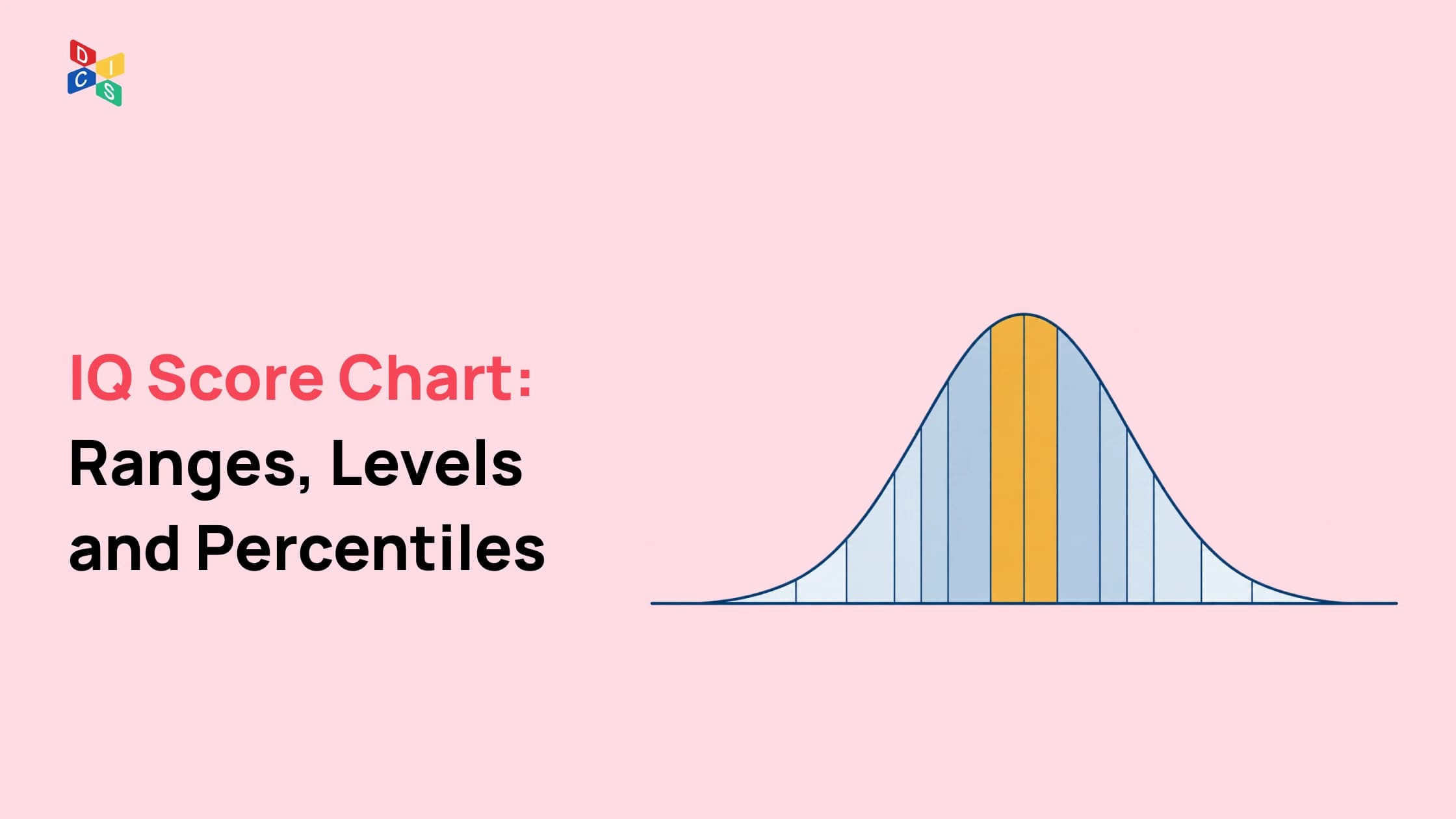
IQ Score Chart: IQ Ranges, Levels and Percentiles
IQ score chart from 55 to 160: levels, percentiles, good scores by age and test scales explained. Check your own score with the free IQ test.
 IQ, EQSep 25, 2026
Why Emotional Intelligence in the Workplace Matters for Leaders
Emotional intelligence in the workplace helps leaders handle difficult conversations, organizational change, employee concerns, collaboration, and conflict.
 IQ, EQSep 22, 2026
Emotional Intelligence and Conflict Resolution: A Practical Guide
Learn how emotional intelligence supports conflict resolution through self-regulation, active listening, empathy, and clear communication.
