


Table of content
10 Best IQ Tests Online Compared for Accuracy
Looking for the best IQ tests online? Compare 10 popular tests by methodology, norms, reliability, pricing, and what their scores actually mean.
Scrutinize an IQ test review as closely as you scrutinize the test.
Choosing the best IQ tests online takes more work than locating one. Search results often lead with a named “winner,” but that page may be a paid press release, an affiliate roundup, or an AI-generated collection of other listicles. If the publisher has a commercial relationship with that winner, you may be reading a placement rather than a review.
Finding an IQ test takes less effort than judging the review behind it.
The search itself is usually simple, but deciding whether the review deserves confidence is harder. Search results often feature a named “winner,” although numerous pages may instead be sponsor-funded press releases, roundup articles earning affiliate revenue, or AI-produced compilations of other listicles. When the publisher has a commercial relationship with that winner, the page can function as a placement instead of a review.
Comparing the Best IQ Tests Online Options
Free access is common across the major platforms. The International IQ Test PDF report costs about $9; full reports from the Mensa Home Test and 123test are $18 and $40, respectively. DesperateMinds' CMIAS costs $19.99, while supervised clinical tests like the WAIS-V generally cost $200, $500.
JobCannon IQ
Four cognitive subscales
JobCannon's IQ test uses 20 questions to assess four areas: reasoning with new information, understanding language, holding information in mind, and processing speed, linking each to possible career paths. You receive a strengths profile rather than a single IQ number stripped of context, and the platform sits within a 50+ test offering.
Difficulty and access
The first items establish your starting point, while later ones push upward to find where the rising difficulty becomes too much. As an IQ test with instant results, the complete test is free and doesn't hide the score behind payment or push a PDF upgrade. It is also an IQ test without registration: there is no pay-to-see-score trick or PDF upsell.
All 20 questions are available without paying.
- Four cognitive subscales, not just a single IQ number
- Career recommendations mapped to cognitive strengths
- Full result on screen
- Clean interface with progress tracking
- Part of a 50+ test platform for broader self-discovery

The short format limits comparison.
- 20 questions is shorter than clinical IQ tests
- Not a replacement for a formal psychologist-administered assessment
123test
Two test formats
123test offers two routes. Its Classical Intelligence Test assesses verbal, numeric, logical, and spatial abilities, while the Culture Fair Intelligence Test uses Raven-style progressive matrices to limit language and cultural bias.
Published explanations
123test has operated since 2003, explaining its subscales and the way its norms are set. Its catalog includes 18 individual IQ and reasoning tests, reports more than 20 years of operation and refinement, and also states that it has operated since 2002. The free versions act as demos; full reports are paid, making it a documented free-test platform with a modest paid tier.
Its library lets you split broad scores from specific abilities in several ways.
- 18 separate IQ and reasoning tests covering different cognitive domains
- Large user base provides solid norming data
- Over 20 years of operation and test refinement
- Free results with optional paid deep-dive reports
You can take separate tests for spatial reasoning, numerical ability, verbal logic, abstract patterns, and more. Choose them individually when you want to see which cognitive areas are strong and which may benefit from development.
123test says its library has built a large norming database since 2002. Free results provide a score and basic reading, while paid reports add percentile comparisons and a fuller cognitive profile.
The tradeoffs are fairly clear.
- Interface feels dated compared to modern platforms
- Paid report upsells after each free test
- Some tests overlap in what they measure
International IQ Test
The International IQ Test reports over 16 million completed tests, giving it one of the largest comparison pools among free assessments. Its 40 progressive matrix-style questions measure fluid reasoning and abstract pattern recognition, then compare your result with that database. The test runs in 30+ languages and takes 20-minute, while the optional $9 PDF adds country comparisons and question-difficulty analysis.
Treat that large sample as a comparison point, not as a validation study. People who choose online tests aren't representative of the whole population, and no public technical manual supports the results. The “average IQ by country” numbers describe an anonymised web sample, not national norms, so the score remains a ballpark estimate.
The free comparison includes several practical features.
- 16M+ completed tests, enormous comparison database
- Progressive matrix format aligned with clinical IQ testing
- Global percentile ranking included in free results
- Available in 30+ languages
The scope remains narrow.
- Only measures fluid reasoning, no verbal, memory, or speed subscales
- PDF report upsell at $9 for full analysis
- 20-minute completion time is longer than casual users may want
Mensa Practice Test
Mensa, the high-IQ society associated with scores in the top 2%, provides a free online practice test called the Mensa Workout. Its 35 questions cover verbal, mathematical, and logical reasoning. Use it to judge whether a paid application seems worthwhile, but remember that membership still requires a proctored assessment.
The questions begin with approachable word problems and progress toward harder abstract reasoning. You get a recognizable sample of the society's format without paying for the practice test.
- Designed by the actual high-IQ society
- Good difficulty progression, challenging but not discouraging
- Completely free with no upsell on the practice test itself
- Mixed question types (verbal, numerical, logical)
The practice test serves a narrow purpose.
- Does not give you an actual IQ score, just a practice indicator
- Cannot be used for Mensa membership qualification
- No subscale breakdown or cognitive profile
- Interface is functional but plain
Mensa labels it “for entertainment purposes only” and cautions that native English speakers may have an advantage. Take it to sample supervised admission-test questions before booking a paid session, but it cannot provide an actual score.
IDRlabs Speedrun IQ
IDRlabs' Speedrun IQ puts the clock at the center, combining processing speed and pattern recognition across 25 questions. That timer makes the exercise feel more like a cognitive challenge than a standard assessment, with speed added to the usual accuracy focus.
You get an estimated IQ score and brief interpretation, then can move into IDRlabs' larger collection of personality and cognitive tests. Personality profiles describe behavioral preferences, whereas cognitive assessments estimate reasoning performance; a best DISC test online can complement rather than replace an IQ test.
Speed is the format's main constraint.
- Fast completion, under 10 minutes
- Timed format captures processing speed, not just accuracy
- Completely free, results stored in your browser
- Part of a large test library for continued exploration
The tradeoffs are equally direct.
- Time pressure may not suit anxious test-takers
- Ad-supported interface with banner ads
- Limited result depth, single score without subscale breakdown
Reasoning and Intelligence Online Test
RIOT describes itself as a professional, scientifically validated online assessment with several subtests, detailed cognitive breakdowns, and stated margins of error.
Its Basic IQ Test uses 5 subtests across 5 cognitive abilities, takes ~13 Minutes, and reports a ±5.6 IQ margin of error.
The Full IQ Test expands to 15 subtests across all cognitive abilities, takes ~52 Minutes, and reports a ±3.7 IQ margin of error.
IQTest.com
IQTest.com has been online for years, pairing accessible general cognitive estimates with paid, full narrative reports.
Free-IQTest.net
Free-IQTest.net offers a short puzzle set for casual entertainment, and it doesn't meet minimum standards for psychometric validity.
MentalUP
MentalUP's gamified exercises for children are educational training tools, not clinical diagnostic instruments, so claims about how to increase your IQ should be separated from developing specific cognitive skills.
DesperateMinds CMIAS
DesperateMinds CMIAS, the Complex Mental & Intellectual Abilities Scale, costs $19.99 and includes 56 questions across roughly 90 minutes. It measures seven dimensions beyond traditional IQ: 20% Novel Problem Solving and Cross-Domain Transfer, 15% each for Question Quality Generation, Assumption Identification, and Uncertainty Calibration, 10% Conceptual Compression & Expansion, and 5% Speed of Updating.
- Novel Problem Solving (20%)
- Cross-Domain Transfer (20%)
- Question Quality Generation (15%)
- Assumption Identification (15%)
- Uncertainty Calibration (15%)
- Conceptual Compression & Expansion (10%)
- Speed of Updating (5%)
Dr. Sarwar Naseer founded the platform and designed the assessment.
Choose CMIAS once you already know your rough IQ and want a profile of your thinking. It focuses more on skills tied to real-world adaptive problem-solving than on raw g-loading.
Neither test replaces a WAIS-V, and both clearly state what they are.
Deceptive Testing Practices
Reading a test’s promise of an IQ in minutes should make you cautious when its methods aren’t transparent. Very short tests have too few items to separate people reliably. Cogn-IQ’s 2026 accuracy announcement is a press release, not validation on its own. Check the technical manual, appropriate norms, and reliability evidence before giving much weight to large user numbers or marketing claims about accuracy. Speed alone says nothing about measurement quality. Ask for a confidence interval alongside the reported IQ score. One score hides measurement uncertainty. If a platform charges to reveal the score or demands your email before showing results, that points more toward lead generation than assessment quality. A paid detailed report is less concerning when the basic score is free, as with International IQ Test, which charges about $9 for its PDF report. When both careless and serious attempts put you near the top, flattering calibration may be replacing sound measurement; compare inflated results with the average IQ score used as a standard population benchmark.

Standards for a Reliable IQ Test Online
Even for the most accurate IQ test online, treat the score as a rank within a reference population and check whether the publisher used a representative, published norm sample. The report should state its size and demographic makeup; a list of quiz takers isn't enough. Ask for a written account of how the items were developed, what they measure, and how scores are calculated, then locate the reliability coefficient; these are foundational facts about IQ testing. Reliability tells you whether scores stay similar across repeat testing or among the test's own items; alpha should be at least .70 for low-stakes screening and .80 for individual-level decisions. No free online test in this list has a published peer-reviewed validation study. A serious test should show uncertainty in one example: IQ 118, 95% CI 113-123. These checks match AERA, APA & NCME (2014), the consensus standard.

Clinical Intelligence Testing
A formal result requires a licensed psychologist to administer WAIS-V or Stanford-Binet 5 individually; that’s the only accepted route for clinical or disability assessment, gifted placement, or legal documentation. Schedule it when you need formal gifted placement or disability records, including an IEP or 504 plan, legal or forensic use, or a clinical diagnosis for suspected intellectual disability, learning disorder, or twice-exceptional profile. In the US, it typically involves a 60-120-minute assessment and costs $200-500. The psychologist follows a standardized process and compares results with clinical norms, with scores usually carrying a ±3-5-point error band. If you’re testing out of curiosity, a free IQ test can provide a useful estimate, but it can’t establish a diagnosis.

Frequently Asked Questions
What is the best online IQ test?
Because no single online IQ test fits every aim, pick the one that matches yours.
Free matrix-reasoning quiz
Among free matrix-reasoning quizzes, Mensa Workout is still the most recognised choice.
Documented classical test
For a documented classical test with published methods, 123test is the strongest free-tier pick. DesperateMinds' Free IQ Test is the better no-cost choice for a domain-level profile covering fluid, verbal, spatial, and working-memory subscales. That breakdown tells you more than a lone score.
Let your intended use make the call, because each format answers a different question. Pick a short matrix puzzle when you want a quick mental workout. For serious preparation for an official high-IQ screening, use practice tests from recognized organizations. If you require an official score for school or employment, book an in-person clinical assessment rather than leaning on online quizzes.
Is the Best Free IQ Test Truly Accurate?
Educational estimates are available from free online IQ tests, but they do not come with a universal error band.
An online score should only be compared with a supervised clinical assessment after published norms, reliability data, and independent comparison evidence show how close it can reasonably come within a specific number of points.
Which online IQ test is closest to Mensa's admission test?
Can any online option truly equal Mensa's admission test? No: Mensa's supervised admission test relies on secure, proctored materials and shows whether you cleared the 98th percentile, helping explain what counts as a high IQ.
Mensa explicitly labels the free Mensa Workout as an entertainment quiz, not an IQ test.
Some online tests use comparable pattern-based items, and 123test's Culture Fair test plus DesperateMinds' Free IQ Test may offer a rough read on ability in that domain. No online test qualifies you for Mensa.
How much does an online IQ test cost?
Online IQ test prices range from free plans offered by most major platforms to $200, $500 for clinical, supervised tests such as the WAIS-V.
- Free tiers: Most major platforms offer them.
- Clinical, supervised tests: Tests like the WAIS-V generally cost $200, $500.
How Can You Spot a Legit IQ Test Online?
When checking an online IQ test, look for four kinds of evidence that the test is legitimate and supports its score instead of a single “exact” number. Look for:
- Documented methodology: Published item development and scoring.
- Defensible norm group: A reference group used to compare your score.
- Reliability evidence: Test-retest or internal consistency evidence, such as Cronbach's alpha above about .70.
- Reported error band: An uncertainty range placed around your score.
Can an Online IQ Test for Adults Replace Clinical Testing?
Consider a formal diagnosis: an online test cannot replace clinical testing. Online tests can support self-insight, satisfy curiosity, or establish a rough baseline, but they are not accepted by clinicians for clinical diagnosis, legal proceedings, disability evaluations, or formal gifted-programme placement. Those uses require a supervised WAIS-V, Stanford-Binet 5, or WISC assessment from a licensed psychologist.
Which online IQ tests should you avoid?
You should be cautious with tests that depend on one or more of these practices:
- Very short promises: They promise your score in under 5 minutes.
- Hidden results: They hide the number behind an email capture or paywall.
- Unsupported user claims: They cite a huge “users tested” figure without technical documentation.
- False precision: They report a single point estimate without an error band.
The key split is between a score meant for curiosity and one backed by published methods, norms, reliability evidence, and an error band. Match the test to its intended use, then read the number as an estimate rather than a universal fact. For formal decisions, rely on supervised clinical assessment—such as the WAIS-V, Stanford-Binet 5, or WISC—rather than treating the best IQ tests online as definitive.


Don't Let Your Potential Stay Hidden!
Take the DISC test today and discover your unique 'YOU', with deep insights into your true personality and potential.
 Understand yourself
 Choose the right career
 Suggest effective communication
 Reduce negative emotions
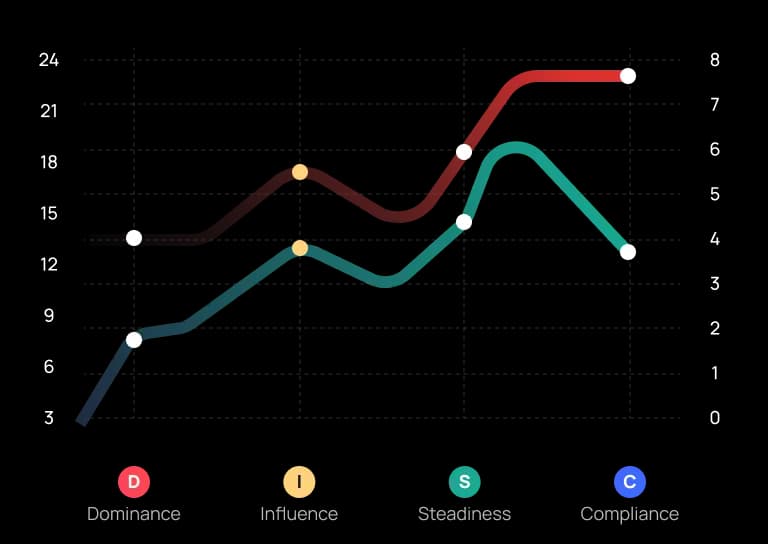
Represents your instinctive behaviors and desires.
Shows the behavioral tendencies you think you should exhibit in specific situations.
Related articles
You may also be interested in
 IQ, EQSep 25, 2026
Why Emotional Intelligence in the Workplace Matters for Leaders
Emotional intelligence in the workplace helps leaders handle difficult conversations, organizational change, employee concerns, collaboration, and conflict.
 IQ, EQSep 22, 2026
Emotional Intelligence and Conflict Resolution: A Practical Guide
Learn how emotional intelligence supports conflict resolution through self-regulation, active listening, empathy, and clear communication.
 IQ, EQSep 22, 2026
What Is a Low IQ Score? Meaning, Ranges, and What It Indicates
Learn what a low IQ score means, where different IQ ranges fall, and why IQ alone cannot determine intelligence, ability, or everyday functioning.
