


Table of content
What Happens When an IQ Is Too High?
Can an IQ be too high? See how a very high IQ links to overthinking, perfectionism, anxiety, relationships and neurodivergence, plus coping tips.
An IQ too high is not a disorder, but research shows that very high intelligence can come with its own risks: more overthinking, perfectionism and, in some groups, higher rates of anxiety and mood disorders. The evidence is mixed, though. Gifted adolescents in one study reported lower depression scores, while gifted adults in another showed higher rates of mood disorders.
This guide separates cognitive style from mental-health needs, explains the possible effects on relationships and neurodivergence, and covers coping strategies that work, so you can see what an IQ score can and cannot tell you about your situation.
Cognitive Challenges Linked to an IQ Too High
A very high IQ does not protect against poor judgment, overthinking or perfectionism, and in some people it can make these patterns stronger.
Dysrationalia
Dysrationalia is the gap between intelligence and rational judgment: being smart does not guarantee that you evaluate your own assumptions and biases well.
Psychologist Keith Stanovich of the University of Toronto has spent years developing ways to test rationality. His work suggests that intelligence does not make people more willing to let go of old assumptions or biases; smart people can cling to both. Stanovich uses the term dysrationalia for people who act irrationally despite having more than enough intelligence.
Analysis Paralysis
A high IQ can stretch out decisions because you see more options and more possible downsides.
- Excessive analysis: You may spend longer weighing every option while trying to find the optimal answer to the problem in front of you.
- Chasing the perfect choice: Real-life choices usually come with drawbacks. When overthinking meets anxiety, you may get stuck and not decide at all.
Maladaptive Perfectionism
Maladaptive perfectionism is the fear of falling short turning into avoidance, and it shows up in some gifted people.
- Fear of looking stupid: Worry about looking stupid may stop you from asking questions or trying something new.
- Crippling perfectionism: That fear can lead to missed deadlines because the work never feels good enough, or to avoiding a task because you fear doing poorly.
How perfectionism shows up among gifted children depends on who they are compared with. Guignard and colleagues studied anxiety and perfectionism in gifted 6th graders using the R-CMAS anxiety scale and the Children and Adolescent Perfectionism Scale (CAPS). Their anxiety scores matched those of non-gifted classmates. Compared with younger peers of the same age, gifted children scored higher on worry and oversensitivity but showed the same level of perfectionism. Compared with children in their own grade, they had higher total perfectionism scores and higher self-oriented perfectionism.
High IQ and Mental Health
The link between high IQ and mental health is inconsistent. A review of 19 studies on intellectual giftedness and socio-emotional or behavioral disorders (17 with children or adolescents, 12 with non-gifted control groups) found problems in 3 of 8 studies on socio-emotional issues such as withdrawal, 5 of 9 on internalizing disorders such as anxiety, and 3 of 5 on externalizing disorders such as hyperactivity. ADHD was the most studied co-occurring condition.
Mood Disorders
Results on mood disorders depend heavily on which group is studied.
- Mensa members: In a survey of Mensa members by Karpinski and colleagues (2018), about 20% reported an anxiety disorder diagnosis and nearly 27% a mood disorder diagnosis, such as major depression or bipolar disorder.
- Gifted adults: These rates were higher than the national averages, and the study also looked at generalized anxiety disorder and obsessive-compulsive disorder.
- Gifted adolescents: In contrast, gifted teenagers in another study reported lower depression and lower feelings of inadequacy than average-ability peers.
Anxiety Disorders
Some studies find more anxiety among people with very high IQs, but the pattern depends on the type of ability measured.
- Compared with the general population: About 10% of the general population has a mood disorder and about 10% an anxiety disorder, with some overlap. Both figures were much higher among the Mensa members surveyed.
- Verbal comprehension: Kermarrec and colleagues found more anxiety disorders among children with an IQ of 130 or above, mainly generalized, phobic and separation anxiety. Children with verbal comprehension (VCI) scores of 130 or above also scored higher on total anxiety, physical anxiety and worry.
- Perceptual reasoning: Children with perceptual reasoning (PRI) scores of 130 or above described themselves as less anxious.
Psychological Overexcitability
Psychological overexcitability means stronger, longer reactions to thoughts and stimuli, including rumination and worry, which are common features of mood and anxiety disorders. A very intelligent person may replay a boss's critical comment for days, trying to predict every consequence.
People with high IQs often show heightened sensitivity to sensory input, one of the subtle signs of high intelligence. Criticism can feel sharper and last longer, and when self-worth rests on intellectual ability, rejection of an idea may feel like rejection of the person.
Is a High IQ a Bad Thing?
No. A high IQ is not a bad thing in itself; some studies link giftedness with emotional and behavioral difficulties, while others suggest high ability protects against them. People who seek clinical support or join high-IQ societies are also easier to study than gifted people without distress, which can skew the picture.

Some studies connect giftedness with internalizing problems, such as over-controlling emotions, anxiety, social withdrawal, low self-esteem and excessive perfectionism. Others find externalizing behaviors, such as emotional dysregulation, hyperactivity, irritability and aggression. High intellectual ability has also been found to protect children and adolescents from both kinds of difficulty.
Peyre and colleagues studied gifted and non-gifted children aged 5 to 6 in a general-population cohort, using a parent-rated questionnaire (SDQ). The groups did not differ in peer relationships, prosocial behavior, or internalizing and externalizing problems.
Interpersonal Problems of Having a Very High IQ
A very high IQ can make friendships and dating harder, mostly because gifted people may think differently and struggle to find like-minded peers. Many feel out of step with others from childhood and keep looking for intellectual equals into adulthood.
Social Alienation
Social alienation in gifted people often comes from two habits: correcting others and withdrawing when conversations feel shallow.
- The urge to correct others: Psychologist Leon Seltzer has observed that brilliant people can find it hard to leave mistakes uncorrected. Constant correction can strain relationships and push people away.
- Preferring solitude: Some highly intelligent people avoid social contact because they fear rejection or grow impatient with others, even though they want companionship. When deep conversation and emotional closeness are missing, they may choose solitude over another disappointing interaction.
In one study, gifted adolescents aged 12 to 16 reported fewer friends, both in person and online, than non-gifted peers. Most described themselves as shy and unsure of themselves, and said social situations frightened them. Their family cohesion scores, however, were higher.
Communication Gaps
Communication gaps happen when people solve problems and take in information in very different ways, which makes ideas harder to share.

- People with high IQs may approach problems from unusual angles and follow long chains of reasoning that are hard for others to follow or accept.
- Many find it difficult to simplify their reasoning or to keep listeners engaged.
- Explaining fast thought processes to someone who needs more time with new concepts can lead to impatience on both sides.
- Learning how people differ, for example through a DISC personality test, plus patience and respect for other approaches, can build empathy and improve communication.
Sensitivity to Feedback
People with high IQs can be more sensitive to feedback, especially when they feel misunderstood.
- Some feel misunderstood when they believe others do not notice what they notice.
- That feeling can make them reluctant to accept criticism from people they see as less capable in the subject.
- It resembles an experienced artist hearing critiques from someone who has never studied art: the artist may hesitate to value that feedback.
When Giftedness and Neurodivergence Overlap
When giftedness occurs alongside a neurodevelopmental condition, it is called twice-exceptionality. The most common pairings are with attention-deficit/hyperactivity disorder (ADHD), autism spectrum disorder (ASD) and learning disabilities.
Telling the two apart can be hard because high intelligence can bring traits that also appear in ADHD, such as high activity, impulsiveness, frustration, boredom and a short attention span in unchallenging settings.
Autism Spectrum Disorder
Giftedness can look similar to high-functioning autism: both may involve social difficulties, trouble adapting, retreat into ideas, intense focus on narrow interests and hypersensitivity. Gifted people who cannot find intellectual peers may also become isolated.
The key difference is social awareness. Highly able children are usually aware of how their behavior affects others, quickly learn what is appropriate, and may take on leadership roles. Children with Asperger's profiles, in contrast, find it hard to see other people's perspectives and may not pick up social conventions intuitively.
How Giftedness Can Mask Neurodivergence
High intelligence can hide real executive or sensory struggles, and visible neurodivergent behaviors can hide high ability.

In gifted children, ADHD symptoms may be masked by a high IQ and good grades, because strong reasoning helps them compensate. Gifted children who mostly interact with adults rather than peers may also not be seen as having social difficulties; their behavior is often read as maturity instead.
Adaptive Coping Strategies
The most useful coping strategies for a very high IQ build self-awareness, emotional skills and realistic expectations. Support from parents, educators and psychologists can help gifted people understand their inner lives and find balance.

In relationships, this means knowing and accepting yourself, balancing your needs with accepting others as they are, and treating yourself with kindness. Those habits help a fast, intense mind build close and satisfying connections.
Handling Corrections in Conversation
Holding back an instinctive correction often keeps a conversation warm. If you hold back all the time and have nowhere else to go deep, though, you may feel drained, so make room for spaces where detailed debate is welcome.
Emotional Intelligence Cultivation
Building emotional intelligence strengthens relationships because it helps you notice emotions and respond to them well.
During difficult conversations, pause to read nonverbal cues, ask how the other person feels, and state your own needs clearly. The IQ vs EQ distinction is a useful reminder that intellectual and emotional skills are different.
Finding a Partner Who Enjoys Deep Conversations
A good match for a high-IQ person is someone who values and stretches your thinking without asking you to tone it down.
- Look for an intellectual match: Seek someone who enjoys deep conversations, complex ideas and ongoing learning, and stay true to your values instead of following fast-paced dating culture.
Setting Realistic Relationship Expectations
Realistic expectations matter because no relationship offers perfect alignment on every level.
- Accept partial fit: A partner may connect with you emotionally but not intellectually, or the other way round. Look for common ground and room to grow together.
- Question relationship stereotypes: Talk openly about traditional expectations and shape the relationship around both partners' strengths, not social pressure.
What Is Considered Too High IQ?
There is no official IQ that counts as too high. Scores of 130 or above, two standard deviations above the mean, usually mark exceptional ability, and some researchers use 120 as the cut-off for giftedness.
- Standardized measures: IQ is usually estimated with standardized tests such as the Wechsler scales (WPPSI, WISC and WAIS). You can take a free IQ test to check your baseline score.
- Two standard deviations: On the Wechsler scales, a score two or more standard deviations above average generally signals exceptional ability, a common benchmark for what counts as a high IQ.
- Population mean: The average IQ is 100 with a standard deviation of 15. An IQ score chart shows how these deviations map onto scores. A score of 140 sits about 2.7 standard deviations above the mean, a level reached by roughly 0.4% of people.

A very high IQ score is not a diagnosis or a destiny. It is a useful starting point for understanding cognitive ability, but support should respond to real distress or needs, not to the number alone.


DISC Team is a content writing team for tracnghiemtinhcach.vn, focusing on the DISC model, communication styles, and teamwork. The team aims to explain concepts in accessible language, helping readers connect them with situations in their work and everyday lives.
View author profile

Don't Let Your Potential Stay Hidden!
Take the DISC test today and discover your unique 'YOU', with deep insights into your true personality and potential.
 Understand yourself
 Choose the right career
 Suggest effective communication
 Reduce negative emotions
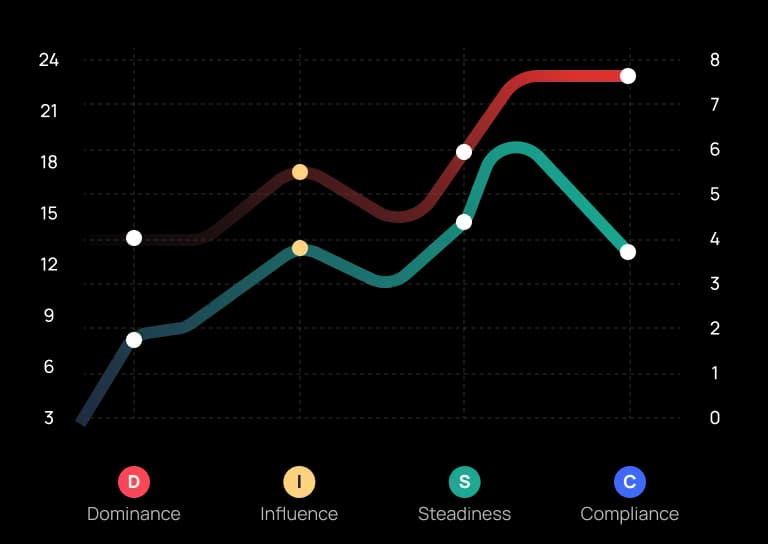
Represents your instinctive behaviors and desires.
Shows the behavioral tendencies you think you should exhibit in specific situations.
Related articles
You may also be interested in
 IQ, EQNov 03, 2026
25 Best Books for Emotional Intelligence
Looking for the best books for emotional intelligence? See 25 top EQ books for work, leadership, relationships and self-awareness, grouped by goal.
 IQ, EQNov 03, 2026
WAIS IQ Test: What It Measures and How It Works
What is the WAIS IQ test? Learn its subtests and index scores, how it is given and scored, how it differs from online IQ tests, and its limits.
 IQ, EQNov 02, 2026
What Is Genius IQ? Score Ranges, Rarity and Meaning
What IQ is considered genius? Learn the 140 benchmark, bell curve odds, and why IQ alone doesn’t make a genius. Take the IQ test.
