


Table of content
The 9 Types of Intelligence & How to Use Yours
IQ measures one channel. Explore all 9 types of intelligence, find your dominant strengths, and use them to learn faster and work smarter.
Table of content
Standardized test scores can't map the real boundaries of what your mind can do across different types of intelligence.
Traditional classrooms spent generations treating an IQ score as the only real yardstick of human capability. Natural strengths don't run along one track. Some people think best through spoken words, while others process the world through spatial layouts, physical motion, or social bonds. Figure out your own cognitive setup to spot those built-in advantages, then use that baseline to build practical habits for your work and personal growth.
What Are the Different Types of Intelligence?
There are nine recognized types of intelligence: linguistic, logical-mathematical, spatial, musical, bodily-kinaesthetic, interpersonal, intrapersonal, naturalistic, and existential. Each one is a distinct way your mind processes information and solves problems.
Psychologist Howard Gardner introduced this framework in his 1983 book Frames of Mind, arguing that human intellect depends on distinct, coordinated capabilities rather than a single general engine.
Think of your brain as a soundboard running separate audio sliders across different frequencies. When you step back and look at that console, what IQ actually measures is just one channel among a dozen independent tracks.
He defined each trait as a "biopsychological potential to process information that can be activated in a cultural setting to solve problems or create products that are of value in a culture." Your genetics and daily environment constantly trade signals to decide which capabilities you sharpen over time.
Gardner started with seven types in 1983, then added naturalistic intelligence as the eighth and existential intelligence as the ninth. He designed the model as a practical tool to map human strengths, not as a physical blueprint of the brain.
Two other frameworks are worth knowing. Charles Spearman introduced the general intelligence factor (the g factor) in 1904, and modern standardized scoring still leans on it because test results across academic subjects correlate closely. Robert Sternberg pushed back in 1985 with his triarchic theory, breaking thinking into analytical intelligence for academic work, creative intelligence for novel problems, and practical intelligence (everyday street smarts) for executing decisions under pressure.
Linguistic Intelligence
Linguistic intelligence is an instinctive feel for spoken syntax, prose rhythm, and word choice. Strong communicators tap into this baseline when they unpack conversational nuances, pick up foreign languages quickly, weigh subtle phrasing differences, and write crisp drafts that hit their targets. They read verbal and non-verbal signals with rock-solid precision, catching tone shifts and building clean arguments during difficult negotiations.
Core strengths and academic research
Writers see measurable jumps in productivity when they lean into their natural verbal talents during heavy writing projects. A 2023 study confirmed that these professionals stay more engaged, hold their focus longer, and drop into flow states with much less friction, where concentration and enjoyment increase noticeably.
Career pathways and exemplars
This foundation supports work as an author, editor, journalist, lawyer, speechwriter, teacher, podcaster, or public speaker, just as Maya Angelou used her voice to command moral authority.

A writer focused on their work, typing on a laptop inside a quiet library.
Logical-Mathematical Intelligence
Logical-mathematical intelligence is breaking down mechanical problems with pure logic, calculating numbers, and testing scientific theories. People with this setup track raw data, test sequential arguments, and run step-by-step proofs to isolate whatever variables are driving a problem.
Reasoning patterns and profiles
People leaning on this framework use symbolic logic, deduction, and step-by-step reasoning to tackle technical problems across pure math, physics, and software design. You see this exact wiring in left-brained thinkers. You can build up these analytical muscles by running controlled experiments, working through formal equations, testing rival theories, and drilling multi-stage quantitative puzzles on a regular schedule.
Career pathways and exemplars
You see this setup in roles like scientist, engineer, economist, data analyst, coder, game designer, strategist, and tech founder, exemplified by Stephen Hawking mapping theoretical cosmology.
Visual-Spatial Intelligence
Visual-spatial intelligence lets you hold, rotate, and manipulate complex physical shapes inside your mind. Deep-sea navigators and commercial airline pilots use this skill to read physical terrain. In smaller spaces, that same spatial engine helps surgeons, sculptors, chess players, and architects construct detailed plans in their head before touching a tool.
Mental modeling and design
Makers with this ability rotate parts, angles, and full assemblies in their head before building anything. You can widen that bandwidth by spending regular time with topological maps, physical scale mockups, architectural schematics, and 3D modeling tools. Dedicated self-assessments can help you spot your own spatial tendencies and hemispheric strengths.

An architect analyzing a detailed blueprint next to a physical 3D building model
Career pathways and exemplars
This background fits careers like architect, artist, designer, pilot, photographer, filmmaker, animator, and stage director, represented by Louie Schwartzberg controlling time and visual space on film.
Bodily-Kinesthetic Intelligence
Bodily-kinesthetic intelligence is putting your entire body or specific muscle groups to work to shape raw materials and solve physical challenges. People with high kinesthetic ability lock their mental choices directly to voluntary movement, relying on fine motor reflexes to execute delicate maneuvers under pressure.
Physical execution and learning styles
Learners with this profile grasp tough material much faster when you swap dry presentations for immediate physical drills, movement, and hands-on trial runs. They pull ahead quickly during competitive sports, dance choreography, stage acting, shop experiments, and applied laboratory tests.
Career pathways and exemplars
That instinct feeds work as a dancer, athlete, physical therapist, surgeon, craftsperson, builder, actor, choreographer, or movement coach, matching how Bianca Andreescu captured the US Open at age 19.
Musical Intelligence
Musical intelligence lets someone break down, assemble, and interpret intricate acoustic structures across pitch changes, rhythm signatures, and subtle tonal textures. Thanks to that ear, these listeners hear an off-pitch note or a missed beat in a split second. Picking up new instruments, memorizing long chord progressions, and transcribing dense audio layers feels completely natural to them.
Acoustic processing and auditory patterns
Playing an instrument is common here, but the real engine is how your brain arranges sound patterns and connects audio cues directly to emotion. Teachers tap into this wiring by anchoring key ideas to steady rhythms, using mnemonic hooks, and assigning simple songwriting exercises.
Career pathways and exemplars
This foundation aligns with paths like musician, composer, singer, audio engineer, music therapist, DJ, producer, and sound designer, as seen when DJ Bliss shapes live audience energy into dynamic sets.
Interpersonal Intelligence
Interpersonal intelligence is reading a room, sensing what people actually want, and picking up on hidden emotional currents. You adjust how you talk by paying attention to micro-expressions, vocal inflections, and sudden mood shifts. Leaders with this gift spot hidden motives early, weigh competing priorities without getting defensive, and realign divided groups before minor team friction blows up into a crisis.
Social interaction and group dynamics
Navigating messy team friction calls for solid interpersonal skills so you can listen closely, run difficult negotiations, and settle disagreements without torching valuable relationships. Setting up peer coaching, mixed-team initiatives, and formal mediation drills gives everyone the practical reps they need to get better.

A collaborative team of coworkers discussing plans around a meeting table
Career pathways and exemplars
This capability shines in work as a therapist, coach, social worker, teacher, or team leader, alongside HR, community organizing, and diplomatic work. Monty Moran leaned on this exact skillset to scale Chipotle, proving that candid listening and personal trust create massive long-term advantage.
Intrapersonal Intelligence
Intrapersonal intelligence turns your analytical focus inward to take a brutally honest inventory of your own mind. People with this ability keep a close eye on their emotional reactions, personal expectations, and daily energy swings during long work sprints. By understanding their own attention spans, memory gaps, and blind spots, they make sharper calls and dodge repeat mistakes.
Self-awareness and academic impact
Real self-awareness produces tangible results: a 2021 study on academic performance found that students with strong intrapersonal awareness routinely posted higher marks. You can build this muscle by writing daily reflections, setting structured goals, and maintaining a regular mindfulness habit.
Career pathways and exemplars
You often find this strength in writers, philosophers, psychologists, coaches, strategists, solo founders, and spiritual guides. Vishen used this inward clarity to launch Mindvalley, converting personal reflection and self-study into a learning network that reaches millions of people.
Naturalistic Intelligence
Naturalistic intelligence is spotting plant varieties, reading wildlife habits, and mapping environmental patterns. People with this strength read living systems effortlessly. They rely on disciplined field observation to see how separate organisms, seasonal shifts, and physical terrain interact across a changing outdoor landscape.
Classroom application and systemic focus
Mentors sharpen these outdoor habits by scheduling field research, tending community gardens, tracking local biodiversity, and taking groups into natural environments to observe habitat shifts firsthand.
Career pathways and exemplars
This background fits biologists, conservationists, park rangers, herbalists, environmental educators, farmers, sustainability directors, animal behaviorists, and geologists, just as Jane Goodall transformed how humanity views wild ecosystems.

A researcher closely inspecting plant leaves in a sunlit greenhouse environment.
Existential Intelligence
Existential intelligence is the ability to place daily life against the vastness of the universe. Gardner defined it as "the ability to locate oneself with respect to the cosmos and the existential features of the human condition, such as the meaning of life and death, the final destination of the physical and psychological world in deep experiences like love for another person."
Philosophical inquiry and questioning
People with this outlook spend a lot of time wrestling with big questions around mortality, purpose, and foundational morality. They question inherited orthodoxies through steady observation and deep reflection, refusing to accept standard social rules just because earlier generations did. That mental independence leaves serious thinkers unimpressed by lazy brush-offs like "that is just how it is."
Career pathways and exemplars
You see this drive in philosophers, authors, theologians, coaches, futurists, ethicists, and policy researchers. Theoretical physicist Nassim Haramein reflects this mindset by developing unified field models that challenge traditional assumptions about how the broader universe connects together.
Beyond IQ: EQ, SQ, AQ and Other Applied Intelligences
Emotional Intelligence
Emotional intelligence sits right at the seam where personal discipline meets interpersonal friction, governing how directly you track and manage your own emotions alongside reactions from people across the table. Anchoring your daily habits in emotional intelligence connects internal psychological control directly to the messy reality of day-to-day team relationships.
Psychologists Peter Salovey and John Mayer broke down this framework across five core dimensions:
- Emotional self-awareness
- Emotional self-control
- Self-motivation
- Empathy
- Social skills
Leaders who master these five read their own reactions instantly while gauging the room around them. They stay grounded under heavy operational friction, so immediate workplace fire drills never hijack their reasoning.
Writing as an author and New York Times journalist, Daniel Goleman argued that as much as 80% of adult success comes from EQ rather than IQ or SQ. Evaluate your talent by stacking raw IQ against social and emotional capabilities, because people with strong EQ and SQ consistently outlast peers who rely purely on technical talent. School programs that target EQ and SQ drive major drops in student bullying, peer pressure, behavioral problems, physical violence, and substance abuse.
Social Intelligence
Social Quotient (SQ), often called social intelligence, measures your everyday ability to communicate across complex groups while handling interpersonal friction with balanced assertiveness and empathy. It serves as a clear benchmark for how someone builds enduring bonds and keeps personal relationships healthy across long horizons.
Building SQ requires active interpersonal engagement, not just shared room space. Sitting in a lecture hall alongside 35 peers accomplishes very little unless you jump into structured collaborative projects, small breakout working groups, and hands-on efforts across in-person or digital setups.
Adversity Intelligence
Adversity Quotient (AQ) dictates your operational resilience and capacity to persevere through sustained difficulty, measuring whether you withstand intense challenges without breaking your mental stability or quitting.
Take two project managers who suddenly face a budget cut. The first freezes up and complains about the unfair mandate, grinding execution to a halt because they can't adapt. The second brings high AQ, treats the constraint as a creative puzzle, and delivers results with fewer supplies.
Creative Intelligence
Creative intelligence blends raw intellect with disciplined imagination to generate original answers or concrete work. Fixing an issue doesn't automatically mean your solution is new. Original thinkers tackle friction from unfamiliar angles to unlock inventive outcomes, guided by open curiosity and flexible habits.
That divergent mindset reflects the most creative personality type, where open curiosity and flexible habits guide daily decisions.
Collaborative Intelligence
Collaborative intelligence reflects a group's true capacity to unite behind one shared mission. It depends on structured group dialogue rather than uncoordinated effort, allowing colleagues to pool fragmented information, make smarter joint decisions, and clear operational roadblocks. That collective alignment lets teams navigate unpredictable obstacles in fast-shifting environments.
Operating this way demands disciplined teamwork, open sharing of practical methods, and genuine alignment around unified action. People with high collaborative strength plug right into group structures, driving exceptional output whenever shared campaigns launch.
How to Assess Your Own Types of Intelligence
No credible single evaluation covers all nine profiles, so treat any pop quiz promising that as cheap entertainment. Use the three approaches below instead.
Cognitive Metric Examinations
Standardized batteries like CAT4 and GL Assessment establish a Standard Age Score, helping schools gauge actual student capability separate from raw exam grades:
- CAT4 and GL Assessment measure verbal, non-verbal, spatial, and quantitative reasoning.
- The Standard Age Score shows how a child is performing relative to their ability, not simply relative to the class.
- This identifies the child who is quietly coasting and the child who is working hard to keep up, since neither shows up in a raw exam mark.
Standard benchmarks for measuring how you tackle logic equations, retain raw facts, spot sequences, and retrieve past instructions usually boil down to traditional IQ testing. Set aside an afternoon to test your reasoning if you want a clean analytical baseline, relying on structured tools that track how you process numerical patterns, verbal prompts, and deductive problems under time limits. For generations, classic psychometrics treated those paper puzzles and working memory drills as the only metric that mattered.
Unprompted Free-Time Observation
Watch what people gravitate toward during unstructured hours, because unprompted curiosity reveals real competence.
Pay close attention to your kids during self-directed play. A student who tunes out during worksheet arithmetic but spends three unbroken hours building intricate physical models is showing deep concentration, just like a restless kid who directs intense focus through non-stop movement. Standard school schedules overlook these physical and spatial strengths entirely.
For yourself, log which daily tasks feel smooth, engaging, and genuinely energizing. Ask whether hours disappear while you write, draft diagrams, untangle logical puzzles, or work with your hands outdoors, because those absorption patterns reveal your dominant intelligence right now. Compare notes with three or four colleagues you trust to pinpoint the capabilities that leave you energized rather than wiped out.
Self-Reflection Inventories
Viewing the nine categories as practical behavioral patterns lets you understand how your mind solves problems without trapping yourself inside rigid boxes.
Start with three diagnostic questions:
- What kind of tasks light you up?
- When do you lose track of time in the best way?
- What kind of "smart" have people always told you you are?
These inventories reflect how you currently perceive yourself rather than measuring objective cognitive capacity, so treat them as prompts for self-discovery rather than permanent diagnoses.

A person listing down questions and answers to self-reflect in a notebook.
A high score in logical-mathematical reasoning doesn't lock you into a narrow technical lane, since your day-to-day work draws on multiple cognitive channels. Treat this assessment alongside free personality tests as an accessible self-reflection lens, giving you practical perspective to steer your ongoing development and daily focus.
How to Develop and Strengthen Your Intelligences
You build cognitive horsepower through regular practice, not by waiting for a fixed trait to set in. When kids and teenagers get methodical training, they wire specific mental competencies that turn into durable habits long before any workplace starts tracking their deliverables.
Identifying where your aptitudes sit gives you leverage across every project. Knowing your primary strengths shows you which assignments move without friction and where the bottlenecks are, so you can tweak your daily calendar and compound real improvements over several quarters. Treat any test result as a loose baseline, using it to test your weekly routine against concrete output on actual projects.
Professional Alignment
The right professional track fits your daily core duties into the mental channels your brain uses without friction.
Vocational strength matching
Put someone with strong naturalistic strengths into roles overseeing open-air sites and living environments. Steer people with sharp logical-mathematical strengths toward quantitative modeling or analytics.
Workplace operational strategies
Pick communication channels that lean into your natural wiring. An operator with strong visual-spatial abilities can map complicated trade-offs using clean diagrams, while someone with strong linguistic-verbal skills builds alignment faster by writing clear memos and talking directly to the room.
Executive leadership dynamics
Relying on raw academic credentials won't buy you much managerial leverage if you lack the interpersonal fluency needed to rally a group around a single goal. Strong emotional intelligence anchors genuine organizational leadership, helping you establish trust, fix hidden team friction, and navigate tough personnel issues under real pressure. Digging into IQ or EQ, which matters more makes it clear that while technical IQ gets you through the door, moving up into executive roles depends on emotional resilience.
Targeted Skill Acquisition
Running new material through your dominant intellectual channel cuts your learning curve significantly, because it anchors hard concepts to the mental pathways where your brain runs fastest.
Strengths-based instructional adaptation
A kinesthetic learner absorbs mechanical principles faster by building a physical prototype. Musical thinkers lock in intricate sequences by translating technical steps into distinct cadences or rhythms.
Two learners might tackle the core mechanics of trading stocks differently:
- A logical-mathematical learner creates spreadsheets to track daily stock performance, reads analytical reports, and builds predictive models.
- An interpersonal learner joins an investment club, interviews experienced traders, and learns by discussing strategies and market trends with others.
Cognitive load optimization
Tune the difficulty of the material so learners master hard ideas without stalling. Make a lesson too basic and students tune out; make it impossible and they freeze up. Getting the balance right is the main lever for growing mental bandwidth, because tight pacing keeps people at the edge of their skill without derailing execution.
Practical habit formation
Reach for your strongest strengths as an entry point when building new routines. High naturalistic strengths and want more stamina? Take your training outside onto open trails. Strong interpersonal abilities and want to pick up a foreign language? Join a discussion group and practice with live partners. Logical-mathematical tendencies and want to fix your finances? Build a clean spreadsheet tracking monthly cash numbers, then run that tracker every week.
Metacognitive Mastery
Operators who score high on intrapersonal awareness track their internal operating state, watching how pressure impacts their working memory, attention, and decision making. They back that self-discipline with structured goal setting, detailed personal notebooks, consistent review routines, and quiet mindfulness sessions.
The human brain has its own pace and operating rhythm. Paying attention to how your head sorts through information keeps you from grinding through counterproductive routines. Protect your mental clarity with simple guardrails: set a reliable morning sequence to get your head straight, and use concrete memory cues to hold onto names and key details. Own your calendar end to end, hitting deadlines and untangling hard problems without needing someone looking over your shoulder.
How to Apply Multiple Intelligences at School and Home
Adjust teaching tactics to the nine categories so every primary school student gets an honest shot at growing across all of them, instead of getting stuck with damaging labels before adults give them a fair hearing.
Most classrooms use Gardner's nine categories to evaluate ordinary schoolwork today. If a school treats diagnostic notes as permanent intellectual fences, that student ends up boxed beneath an artificial ceiling for years. True cognitive diversity starts when you isolate the exact strengths each kid brings through the door, creating a setup where everyone has room to produce.
Good instructors do far more than distribute raw facts. They build genuine independence, teach kids how their own minds run, and show them how to treat others with respect.
You get better outcomes from parent-teacher conferences by running a collaborative agenda, framing it like this:
"I have been studying different intelligence profiles recently. My child really comes alive when [building things / moving around / working with others], and I want to connect that strength to challenging subjects like [subject]. Let us brainstorm practical classroom adjustments together, and I will reinforce whatever specific learning routines you establish across our daily home schedule."
A narrow syllabus only discovers narrow abilities, which is why schools need a wider operating surface. Stage productions and physical performances give kids who struggle with written exams an avenue to show what they can do. Team research initiatives and live debates pull verbal agility and negotiation instincts to the front. Run schoolwide contests across athletics, writing, and music so different personalities take charge during the term. Moving science projects outside a standard laboratory rewards close, patient observation instead of memorization.
Curricular Differentiation
Design class assignments around actual cognitive variety, since no two kids process problems the same way. Build varied coursework that exercises distinct mental strengths across the room rather than slotting students into fixed tracks. A classroom needs dependable daily formats that reward divergent ways of solving problems and building artifacts.
Here is how these eight types of intelligence surface in everyday student behavior, along with the classroom adjustments teachers use:
Type of Intelligence | How It Is Manifested | Adaptation in the Classroom |
| Logical-mathematical | Logical reasoning, problem analysis | Experiments, logic games, research |
| Linguistic | Reading, writing, storytelling | Debates, essays, dramatisations |
| Spatial | 3D thinking, visualisation | Maps, diagrams, digital design, art |
| Musical | Rhythms, melodies, instruments | Songs, composition |
| Kinaesthetic | Body language, coordination | Sports, theatre, hands-on learning |
| Intrapersonal | Self-awareness, reflection | Journaling, mindfulness, goal setting |
| Interpersonal | Empathy, teamwork | Group projects, collaborative dynamics |
| Naturalistic | Interest in nature and living things | Gardens, excursions, environmental projects |
These tweaks ensure pupils tackle challenging coursework through methods that align with their sharpest natural capabilities.
Social-Emotional Learning Integration
Support a student's emotional health as seriously as standard classroom targets. Most conventional institutions pour their energy into driving IQ through rote memorization, standardized exams, and rigid benchmarks, while modern frameworks evaluating IQ, EQ, SQ and AQ get left to chance. As Daniel Goleman's research demonstrates, the young people who flourish as adults deliberately developed all four quotients.
Emotional Quotient development: EQ grows out of active daily practice, not passive lectures about abstract morals. Kids build emotional intelligence when they name their feelings, resolve interpersonal friction, and watch adults manage stress with steady composure. Structured social-emotional learning (SEL) gives young learners the vocabulary and mental models to process their internal states.
Social-emotional behavioral outcomes: Baking emotional coaching into the weekly timetable pays clear dividends. Goleman notes that rooms giving serious focus to EQ and SQ see far fewer disruptions, less peer pressure, less bullying, and lower rates of violence and substance abuse. These social gains feed into higher grades and sharper classroom conduct.
Core competencies for young learners: Targeted coursework helps kids between ages 6 and 12 identify emotions, de-escalate fights, and build empathy through team exercises and interactive software. Track how students develop self-awareness, healthier outlooks, stronger friendships, solid boundaries against peer pressure, and better grades. Through these programs, students learn how to:
- Recognise and practice character strengths, like curiosity, persistence, and collaboration.
- Understand and manage their emotions, like fear and anger.
- Work in a team; listen to and appreciate each other.
- Understand the consequences of their actions to others.
Common Questions About the 9 Types of Intelligence
How many types of intelligence are there, and what are they?
There are nine, from Howard Gardner's Theory of Multiple Intelligences: linguistic, logical-mathematical, spatial, musical, bodily-kinaesthetic, interpersonal, intrapersonal, naturalistic, and existential. Standard school exams test only a tiny strip of mental ability, while Gardner maps a far wider slice. Most educators today use the nine categories as an illuminating lens rather than a rigid label.
Can your intelligence change over the course of your life?
Yes. Fresh experiences and deliberate practice sharpen abilities that previously went unnoticed. Your long-term growth stems from a mix of everyday life and inherited genetic traits, which means you can build intelligence as an active muscle you steadily strengthen instead of treating it like a fixed shoe size.
Can you have more than one type of intelligence?
Yes. Real-world cognitive function behaves like an ensemble performance, with multiple channels collaborating at once. Each child holds baseline competence everywhere while usually showing greater strength in two or three intelligences. Standing out in one dimension leaves the others intact. Someone can have strong interpersonal intelligence that eases social connection while also drawing on musical intelligence to pick up instruments quickly. A student who struggles to finish written maths assignments may easily dismantle a broken machine and put it back together.
Which type of intelligence is the rarest?
Nobody universally agrees on the rarest, though naturalistic intelligence shows up less often in research studies simply because typical classrooms and offices rarely highlight it. Each intelligence still brings distinct angles and advantages that other profiles routinely miss.
Is one type of intelligence better than the others?
No. Some intelligences carry wider public recognition and more social prestige, but no single category holds greater inherent weight. The model puts every talent on equal footing. There is no top tier or superior intelligence, only the specific configuration that belongs to you.
Conclusion
Standard school exams measure real skills, but test scores never tell the whole story. Mapping your natural strengths gives you the clarity to set realistic goals and steer your daily execution through the intelligence profiles that suit you best.
Once you step past a single fixed score, you can structure your daily routines around how your brain actually processes information. Track where your strengths cluster across different types of intelligence, lean on complementary abilities during difficult projects, and advance your personal goals deliberately. What remains is a practical operating model built around your real strengths.


DISC Team is a content writing team for tracnghiemtinhcach.vn, focusing on the DISC model, communication styles, and teamwork. The team aims to explain concepts in accessible language, helping readers connect them with situations in their work and everyday lives.
View author profile

Don't Let Your Potential Stay Hidden!
Take the DISC test today and discover your unique 'YOU', with deep insights into your true personality and potential.
 Understand yourself
 Choose the right career
 Suggest effective communication
 Reduce negative emotions
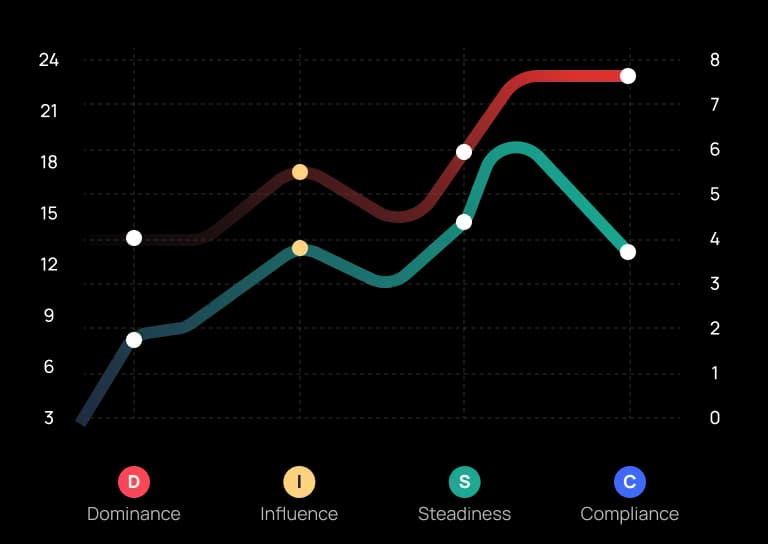
Represents your instinctive behaviors and desires.
Shows the behavioral tendencies you think you should exhibit in specific situations.
Related articles
You may also be interested in
 IQ, EQSep 25, 2026
Why Emotional Intelligence in the Workplace Matters for Leaders
Emotional intelligence in the workplace helps leaders handle difficult conversations, organizational change, employee concerns, collaboration, and conflict.
 IQ, EQSep 22, 2026
Emotional Intelligence and Conflict Resolution: A Practical Guide
Learn how emotional intelligence supports conflict resolution through self-regulation, active listening, empathy, and clear communication.
 IQ, EQSep 22, 2026
What Is a Low IQ Score? Meaning, Ranges, and What It Indicates
Learn what a low IQ score means, where different IQ ranges fall, and why IQ alone cannot determine intelligence, ability, or everyday functioning.
