


Table of content
Introvert vs Extrovert: Which One Are You?
Are you an introvert, extrovert, or ambivert? See how energy, behavior, and environment shape your personality style, with traits and subtypes.

Table of content
The true boundary between introvert and extrovert comes down to how you restore your personal energy, and how you interpret the world around you. Locating yourself along this spectrum explains a lot about your communication habits, your relationships, and the environments where you actually thrive.
Rather than splitting people into two neat boxes, introversion and extraversion sit at two ends of a continuous scale, with most people landing somewhere in the middle.

The Difference Between Introvert and Extrovert Lifestyles
The clearest way to see the introvert vs extrovert difference is to watch how each style plays out in real settings: work, school, friendships, and daily routines. The traits themselves matter less than the context they operate in.
Workplace and leadership. Leadership effectiveness rests on context, not personality type alone. Extraversion correlates with leadership emergence, but it does not guarantee good management. Team dynamics change everything: high extraversion helps when employees stay passive, while quieter leaders bring out better performance from proactive teams. Being outgoing does not make someone a better leader, and being soft-spoken does not automatically make someone a better listener. Read more on how this plays out in workplace personality.

Classrooms. Outgoing students are often expected to pull ahead, but the link between extraversion and academic success sits near zero across large samples. Adult achievement links far more reliably to conscientiousness and openness than to extraversion.
Friendships and emotions. These split along similar lines and directly shape personality type compatibility. Extraversion tends to build large groups of like-minded contacts, while introversion leans toward smaller networks with deeper ties. Extraverts seek company or outward stimulation when stress hits; introverts turn inward and use quiet time to work through feelings.
Daily work habits. Introverts prefer steady routines, deliberate pacing, and firm borders between work and personal downtime. Extraverts gain energy from variety and collaboration, weaving social interaction directly into how they get things done.
Life Area | Introvert Lifestyle | Extrovert Lifestyle |
| Leadership fit | Draws out proactive teams | Energizes passive teams |
| Social network | Small, deep, loyal ties | Large, like-minded groups |
| Stress response | Turns inward, recharges alone | Seeks company and stimulation |
| Work rhythm | Steady routines, clear boundaries | Variety, collaboration, spontaneity |
| Academic edge | Near-zero link either way | Near-zero link either way |
Treating introversion and extraversion as a flexible continuum lets you organize work, rest, and relationships around your actual energy needs. Block out uninterrupted time when you need focus, walk into a busy room when you want momentum, and tell coworkers plainly how you operate.
Determining Your Introvert vs Extrovert Personality Style
Personality never splits into neat little boxes. Introverts and extroverts belong to a single mixed type, with introversion and extraversion acting as two distant poles rather than separate groups of people. Most of us land somewhere in the middle.
People also show plenty of variation across their lifespan, so this is a good place to ask can people change their personality through daily habits over time. Someone might lean hard toward one end, while others settle right in the center, where the ambivert represents a balanced middle point.
If you are asking whether you are an introvert or an extrovert, a quick test helps you find your behavioral style. Keep in mind that acting shy or putting on an outgoing front reflects learned habits, not a fixed personality. Low scorers can still speak up when the room requires it, and high scorers can sit back quietly in the right setting.
Energy Restoration Patterns
The core of being an introvert or extrovert is how you get your energy. As Dr. Tworek puts it, "It's a matter of what stimulates you and what drains you."

A woman quietly reading a book in a peaceful room filled with natural light
Introverts draw energy from inside and recharge with quiet time. Extroverts draw power from active conversation and being around other people. The old battery metaphor is a handy shortcut, but it does not describe real biology. Modern tests track how you think, feel, and behave across different situations instead.
Social Battery Duration
- Introverts: A shorter social fuse in big crowds. Running out of steam quickly during events you actually enjoy points to an introverted baseline.
- Extroverts: A longer-lasting battery that climbs through active engagement. Leaving a busy gathering feeling wide awake usually signals an extroverted orientation.
- Ambiverts: Social stamina depends entirely on the setting, shifting between craving company and needing silence.
Cognitive and Emotional Processing Style
Mental habits reveal clear contrasts in how people communicate and how information is taken in:
Personality Style | Primary Processing Mode | Communication Tendency |
| Introvert | Internal processors | Think through ideas before sharing, considering every angle before speaking |
| Extrovert | External processors | Figure things out by talking, brainstorming, and bouncing ideas around |
| Ambivert | Mixed processors | Talk it out or mull it over privately depending on complexity |
Introverts often pause to sort out feelings alone before speaking, while extroverts usually respond on the spot during emotional moments.
Scientific Measurement Through the Big Five Inventory
Modern psychometrics maps personality along continuous scales rather than strict boxes. Standard tests built on the Big Five personality model measure five broad traits: openness, conscientiousness, extraversion, agreeableness, and neuroticism.
A typical quiz uses 50 statements scored on a five-point scale from agree to disagree, offering a useful tool for understanding the personality factors driving behavior. The BFI-2 goes further by splitting extraversion into sociability, assertiveness, and energy level, which matters because one overall score can hide a mixed profile.
Understanding Introversion
Introversion is an inward pull of personal energy toward internal thoughts, first described by Carl Jung. Introverts take in stimulation in small, manageable doses and prefer to explore fewer subjects in real depth.
On the physiological side, introverts carry higher resting levels of cortical arousal, which makes them more sensitive to outside stimuli. When stimulation hits, they show greater brain activity than extroverts, so they rely on lower doses of external input to keep arousal at a comfortable level.
Common Introvert Traits and Daily Habits
Key signs of an introvert closely match the steady, reserved habits of the S personality style. Because overstimulation happens quickly, introverts need lower doses of environmental input:
- You enjoy spending time alone or in small groups of people you know well
- You are a thoughtful listener
- You prefer deep, one-on-one conversations over large group dynamics
- You think before speaking, and sometimes keep it to yourself
- Solitude does not feel lonely
- You would rather text than call
- You need greater separation between work and home to manage stress
Subtypes of Introverted Processing
These analytical habits align closely with the C personality style:
Subtype | Core Processing Pattern | Typical Social Behavior |
| Social introverts | Energy depletes quickly in large crowds | Prefer small, intimate gatherings |
| Thinking introverts | Content to spend much time deep in thought | Enjoy introspection, big ideas, and creative projects |
| Anxious introverts | Feel nervous or self-conscious socially | Replay every word after an interaction |
| Restrained introverts | Think and process before acting | Take their time meeting people and adjusting to new settings |
Understanding Extraversion
Extraversion pulls attention outward toward the external world. As Jung framed it, extroverts send their personal energy straight out into their social surroundings, tracking the whole room instead of their private thoughts.
On the neurobiological side, extrovert brains have more dopamine receptors but lower baseline dopamine sensitivity, so they need higher levels of stimulation to feel genuinely happy. Dopamine responses climb quickly as extroverts stay active and chase stimulation, and physical movement and novelty add to that effect. Extroverts also jump eagerly at reward cues while staying mostly unbothered by punishment cues, with research linking higher testosterone to social dominance in both men and women.
Common Extrovert Traits and Daily Habits
Extroverts generally share the lively, warm communication tied to the I personality style:
- You feel energized by social interaction and thrive in collaborative projects
- You process thoughts by talking them out and brainstorming
- You feel off after too much time alone and find silence uncomfortable
- You make decisions quickly and prefer action to contemplation
- You usually plan or initiate social events and enjoy parties
- You actively seek new experiences and embrace spontaneity
- You prefer large, socially similar networks

An energetic creative team discussing ideas around a whiteboard in a modern office
Subtypes of Extraverted Processing
Subtype | Core Behavioral Pattern | Primary Focus |
| Affiliative extroverts | Knows everyone, values loyal relationships | Organizing group dinners and checking in |
| Agentic extroverts | Natural leaders and action-takers | Setting goals, rallying teams, pitching ideas |
| Expressive extroverts | Open, enthusiastic, emotionally connected | Cheering others on and offering comfort |
| Energetic extroverts | Thrill-seekers chasing adventures | Booking spontaneous trips, midnight karaoke |
| Extroverted thinkers | Goal-oriented, high achievers | Objective data and logical analysis |
| Extroverted feelers | Focused on interpersonal harmony | Fostering connection and group alignment |
| Extroverted sensors | Driven by immediate stimulation | Direct sensory experiences |
| Extroverted intuitives | Future-focused abstract thinkers | Future possibilities and potential |
Can You Be Both Introvert and Extrovert?
Yes. This works more like a dimmer dial than an on-off switch. Your tolerance for noise and people shifts constantly depending on where you are, how safe you feel, and who is in the room. Your foundational baseline stays fairly steady over the years, but you can still pick up new habits anywhere along that line.
The middle of the scale is often praised as the "ambivert advantage," but that idea comes from one study on call center sales revenue, not general office life or academic success. Landing in the middle does not help you in every setting.
Behavior also shifts with age, especially when a job pushes you to practice outgoing habits. Growing older tends to quietly mute extraversion, gradually pulling your baseline toward more solitude. Trendy labels like omniversion and otroversion try to describe wild swings or personal-terms socializing, but neither has scientific standing.
If you want to see how these leanings map onto broader frameworks, comparing DISC vs MBTI is a useful next step.
Frequently Asked Questions
Is introvert or extrovert better?
Neither. Each style thrives in different contexts. Introverts do well in focused, independent work, while extroverts excel in collaborative, high-interaction settings.
Can you change from introvert to extrovert?
Your baseline stays fairly stable, but habits and behavior can shift with age, environment, and job demands. You can build outgoing skills without changing your core wiring.
What is an ambivert?
An ambivert sits in the middle of the spectrum, shifting between craving company and needing solitude depending on the situation.
How do I know if I am an introvert or extrovert?
Notice how you recharge. If quiet time restores you, you lean introverted. If social interaction energizes you, you lean extroverted. A quick behavioral test can confirm where you fall.


Don't Let Your Potential Stay Hidden!
Take the DISC test today and discover your unique 'YOU', with deep insights into your true personality and potential.
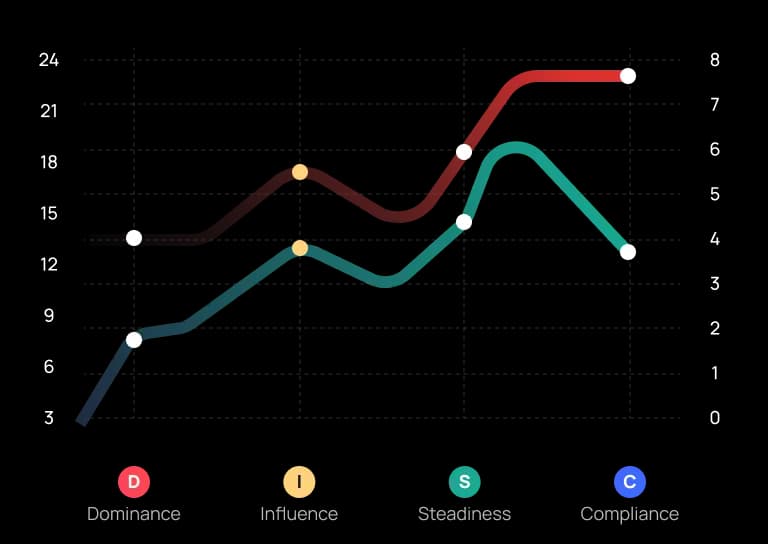
 Understand yourself
 Choose the right career
 Suggest effective communication
 Reduce negative emotions
Represents your instinctive behaviors and desires.
Shows the behavioral tendencies you think you should exhibit in specific situations.
Related articles
You may also be interested in
 Self ExplorationDec 17, 2025
What Are the Dynamics of a Team? Understanding How Teams Really Work
Discover what are the dynamics of a team and how they impact team performance. Learn how communication, roles & personality differences boost collaboration.
 Self ExplorationDec 16, 2025
100+ Team Building Questions to Build Trust & Collaboration at Work
Explore effective team building questions to boost connection, trust, and collaboration in your team. Engage everyone and strengthen your team's dynamics today!
 Self ExplorationDec 10, 2025
How to Profile a Person: A Clear Step-by-Step Guide to Reading People
Learn how to profile a person step-by-step. Master practical techniques to read behavior, understand motives, and identify personality patterns accurately.
