


Table of content
Compatibility of Personality Types: How Different People Connect & Work
Discover the Compatibility of Personality Types and how different traits connect. Learn how strengths and differences shape deeper, more lasting bonds.
Table of content
Exploring the compatibility of personality types gives you a clearer view of why certain relationships flow easily while others require more patience. Rather than judging people by labels, it highlights how communication, energy levels, and decision styles shape everyday dynamics. In this guide, you'll discover what truly drives compatibility, how different traits balance or challenge each other, and how DISC insights make these patterns easier to understand. With the right awareness, any relationship can grow stronger and more connected.
What Does “Compatibility Of Personality Types” Mean?
The compatibility of personality types refers to how well two people’s natural traits and behaviors function together in everyday situations. Instead of relying solely on labels, it focuses on how compatible different personality types are based on their communication styles, emotional responses, and decision-making processes.
When discussing personality type compatibility, the goal is to understand which personality traits complement each other and where differences may necessitate adjustments. This helps explain why some pairs feel like compatible personalities while others need more effort to stay aligned. Models like DISC simply provide language to describe these patterns - such as whether someone is more flexible or structured - but they do not define the outcome of a relationship.
Overall, compatibility of personality types highlights how two people balance each other, whether their strengths complement one another, and how compatible their everyday behaviors feel in a shared relationship or partnership.

Why Do Different Personalities Interact Differently?
People interact differently because each person brings their own way of thinking, feeling, and responding to daily situations. These differences shape the compatibility of personality types, even when two people seem like compatible personalities at first.
A few traits have the strongest impact on how we relate to each other:
- energy style (introverted vs. extroverted)
- emotional focus (thinking vs. feeling)
- planning habits (judging vs. perceiving)
For example, a creative personality type may enjoy flexible plans, while a structured partner prefers clear decisions. These contrasts influence how compatible different personality types are because each person sees the same moment through a different internal state.
Even when traits align, both people may share blind spots. When they differ, tension can arise, but these differences can also create a balanced personality type match. Your natural conflict resolution style also plays a role in how well you handle challenges together.
Instead of focusing only on what personality types match best, it is more helpful to understand how traits complement each other. This perspective makes the compatibility of personality types easier to navigate and helps relationships grow stronger over time.
Why Personality Type Compatibility Matters
Understanding the compatibility of personality types helps us interact with others with less stress and more clarity. When we know why people think or behave in certain ways, it becomes easier to communicate, solve problems, and build steady relationships.
In relationships
In romantic relationships, the compatibility personality types influences how partners handle emotions, make decisions and respond under stress. Two people may enjoy the same hobbies, but if their communication styles clash, small issues can quickly feel huge.
When couples understand their personality type matching, they are more likely to see differences as complementary strengths, rather than as signs that they “don’t fit.” This awareness supports healthier relationship compatibility and more resilient long-term bonds.
In friendships
Friendships also benefit from knowing the compatibility of personality types. Some friends prefer deep one-to-one talks; others feel energised in busy social settings.
When you recognise these differences, you stop taking them personally and start planning time together that works for both sides. This makes it easier to maintain supportive, low-drama connections, even when friends have very different social needs or ways of expressing care.
In the workplace
The compatibility affects teamwork every day. People may share the same goal but work in very different ways. Some move fast. Others plan slowly. Used well, these differences help a team balance speed and accuracy.
- Assign tasks that match each person’s strengths
- Reduce conflict through clearer communication
- Build a team culture where differences are useful
In personal development
Exploring the compatibility of personality types supports growth. It helps you see patterns in your behaviour and understand why certain interactions feel smooth while others feel draining. This awareness encourages better habits, stronger boundaries and more meaningful connections.
- Notice your blind spots and stress triggers
- Practice adapting to different styles
- Build healthier, more balanced relationships
Core Factors That Influence Compatibility Between Personality Types
When exploring compatibility, it helps to understand the core areas where people naturally differ. These factors shape how two individuals connect, respond, and support each other in daily life.
Communication style
How we express thoughts and emotions strongly shapes the compatibility of personality types. Some people are direct and brief, others prefer gentle, emotional, or detailed conversation. When two styles are too far apart, messages get lost, and both sides may feel unheard.
Understanding whether your partner needs clarity, reassurance, space, or depth in dialogue makes personality type compatibility more stable and predictable.
Decision-making style
Another key factor in the personality types is the way people make choices. Logical decision-makers rely on facts, pros and cons, and long-term impact. Others decide based on feelings, values, and how outcomes affect people.
Neither style is “better,” but clashes appear when one person sees the other as cold or, on the flip side, too emotional. Couples who learn to combine both logic and empathy usually build stronger personality type compatibility over time.
Energy orientation
Energy levels affect how two people spend time together and what makes them feel recharged. Introverted partners recharge in quiet spaces, while extroverted partners gain energy from activity and social time.
If this gap is ignored, one person may feel drained, and the other feels restricted. Healthy personality type compatibility happens when both can negotiate balance: time together, time with others, and time alone, instead of pushing only one preferred rhythm.
Conflict-handling patterns
How each person responds to tension is central to the compatibility of personality types. Some confront issues quickly, others withdraw, and some need time to process before speaking.
When one pushes for immediate answers while the other shuts down, arguments escalate. More compatible personality types learn each other’s conflict style and agree on simple rules: when to pause, when to talk, and how to return to the problem without blame.
Values, priorities & lifestyle alignment
Shared values form the base of long-term harmony. Shared views on family, money, work, free time, and personal growth help two people move in the same direction. Personality type compatibility is not only about traits or labels, but about whether both partners can align their choices, routines, and long-term goals in a way that still feels authentic for each individual.

Compatibility Trends In Popular Personality Frameworks
People searching for compatibility of personality types often want clear examples of how different traits interact. The patterns below show how certain pairs balance or challenge each other in daily life.
Introverted vs Extroverted Compatibility
Introverts recharge in quiet spaces. Extroverts gain energy from people and activity. Because of this, they often approach daily life very differently.
- Strengths
- They balance each other’s social needs.
- Extroverts encourage introverts to explore more.
- Introverts help extroverts slow down and enjoy calm moments.
- Challenges
- Introverts may feel tired by constant social plans.
- Extroverts may feel bored or disconnected with too much quiet time.
When both communicate clearly, this form of compatibility of personality types becomes very supportive.
Thinker vs Feeler compatibility
Thinkers focus on facts, logic, and objective decisions. Feelers care about emotions, values, and how choices affect people.
- Strengths
- Thinkers bring clarity and structure to decisions.
- Feelers add empathy and emotional understanding.
- Together, they often reach balanced and thoughtful solutions.
- Challenges
- Thinkers may seem too direct or unemotional.
- Feelers may feel overlooked or misunderstood.
This pairing works well when both try to understand how the other processes feelings and information.
Planner vs Improviser compatibility
Planners love schedules and predictability. Improvisers prefer flexibility and spontaneous choices.
- Strengths
- Planners keep things organized and reduce chaos.
- Improvisers add fun, creativity, and new ideas.
- They can create a routine that is steady but still exciting.
- Challenges
- Planners may get stressed when plans change suddenly.
- Improvisers may feel limited by strict timelines.
This type of compatibility of personality types improves when both agree on how much structure is needed.
Structured vs Flexible compatibility
Structured types like order and clear rules. Flexible types adjust easily and enjoy going with the flow.
- Strengths
- Structured partners bring stability and direction.
- Flexible partners keep the relationship adaptable and calm during surprises.
- Challenges
- Structured individuals may get anxious when things don’t go as planned.
- Flexible individuals may feel controlled or restricted by routines.
When each person respects what the other needs, they can create a life that feels steady but not overwhelming.

How To Improve Compatibility Between Different Personality Types
Improving the compatibility of personality types starts with simple habits. When two people understand each other’s style, it becomes easier to stay calm, talk clearly and work as a team.
Practicing adaptive communication
People communicate in different ways. Some respond fast, while others need a moment to think. Adjusting how you speak helps both of you feel understood. Use clear words, listen with care, and check in to make sure you share the same meaning.
Setting shared expectations early
Many misunderstandings start when partners guess instead of asking. Clear expectations make daily life smoother.
- Agree on how to divide tasks
- Talk about money habits or planning styles
- Share how much social time or quiet time you prefer
These talks help you see what personality traits go well together in daily routines.
Learning each other's stress triggers
Each person reacts differently to pressure. Sudden changes, noise, or strong emotions can affect people in unique ways. When you know what stresses your partner, you can choose better timing and respond more gently. This keeps the relationship steady.
Developing conflict-resolution strategies
Arguments are normal. The important part is how you solve them.
- Stay respectful and avoid blaming
- Take short breaks when tension rises
- Return to the issue once both feel calm
- Focus on solutions instead of winning
Good habits like these help you move through conflict without harming the connection.
Building mutual respect for differences
A healthy bond does not require being the same. Each person has strengths. One may be organized, the other more flexible. When you respect these differences, you create balance and help each other grow. This is the foundation of strong relationships between personality types.
How DISC Personality Types Affect Compatibility
Understanding the compatibility of personality types becomes much easier when viewed through the DISC model. DISC shows how people behave, respond to tension, and communicate. This approach also connects well with what are the 5 levels of compatibility, because it highlights the patterns that help or challenge a partnership.
Strengths & stress behaviours of each style
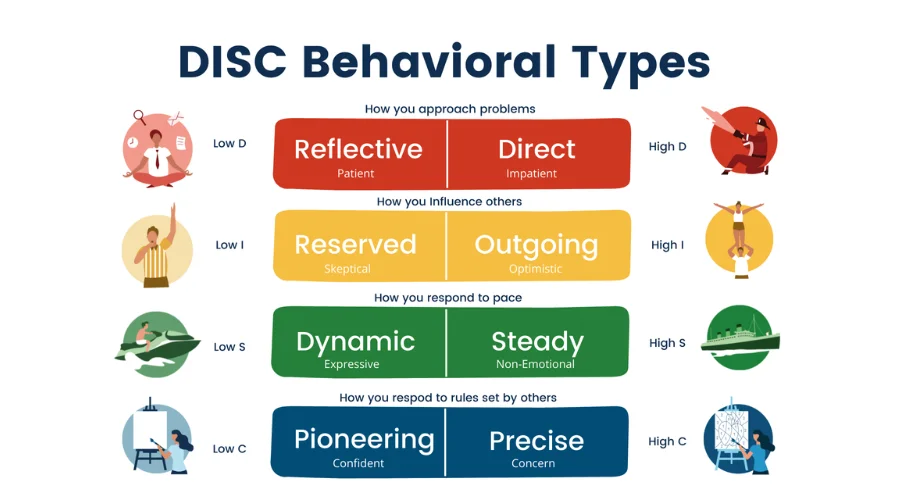
Each DISC style has its own strengths and stress reactions that shape the compatibility of personality types. These patterns influence teamwork, relationships, and daily communication in clear and predictable ways:
- D (Dominance): confident, fast-moving, direct. Under stress, a D style may become impatient or push too hard.
- I (Influence): friendly, expressive, energetic. When pressure rises, an I style can lose focus or avoid difficult topics.
- S (Steadiness): calm, patient, supportive. During conflict, an S style might withdraw or resist change.
- C (Compliance): careful, structured, analytical. Under strain, a C style may become overly critical or slow to decide.
These reactions are also helpful when working with the rarest DISC personality type, because understanding their stress patterns supports smoother interactions.
Compatible DISC pairings
Some DISC pairings feel more natural, and these patterns show how DISC personalities work best together. These combinations help explain how compatible are different personality types in real-life situations:
- D style pairs well with C style or S style, which offer structure or steadiness.
- I style often blends easily with S style, creating a balanced social dynamic.
- C style and S style usually connect through shared focus on consistency and care.
These pairings also reflect what are the 5 levels of compatibility, where balance, pace, and communication shape how well two people work together.
How DISC compatibility applies in teams & relationships
DISC makes the compatibility of personality types practical and easy to use. Teams can adjust their roles and communication to suit each style. Couples and families can understand why someone prefers structure, while another prefers flexibility. Knowing whether someone is a D style, I style, S style, or C style helps reduce tension and build trust.
When differences are understood - not resisted - they become strengths. This is where DISC shows its real value: helping people appreciate each other’s approach and building relationships that feel steady, balanced, and genuinely supportive.
Limitations Of Using Personality Types To Predict Compatibility
Personality models can be helpful, but they are not perfect tools for understanding relationships. Before relying too much on compatibility of personality types, keep these limits in mind:
- Types only show preferences, not the whole person: A personality type cannot reflect values, maturity, life history, or emotional skills.
- Tests are not always accurate: Results may shift based on mood, honesty, or life changes, which affect how we view compatibility of personality types.
- Similar or opposite types are not guaranteed matches: Two similar types can still clash, while very different people can form strong bonds with good communication.
- Labels can create stereotypes: Relying too much on type charts may limit growth or lead people to excuse unhelpful behavior.
- Real compatibility comes from actions: Respect, effort, and communication shape relationships far more than a simple personality category.
Conclusion
When you understand the compatibility of personality types, relationships stop feeling like a guessing game. You begin to see how differences can create balance rather than conflict, and how each person brings something valuable to the connection. With clearer communication and genuine curiosity for each other’s strengths, even challenging dynamics can turn into opportunities for growth. In the end, compatibility isn’t something you find - it’s something you build together.
FAQs
Are opposite personality types attracted to each other?
Yes, opposite personality types can be drawn to each other because their differences feel exciting and complementary. However, long-term success depends on communication and mutual respect rather than contrast alone. Opposites work well when they balance each other’s strengths and manage differences with patience, understanding, and healthy boundaries.
Do similar personality types make better couples or teammates?
Similar personality types often get along more easily because they share habits, communication styles, and comfort zones. This can reduce conflict in daily life. However, too much similarity can lead to blind spots or a lack of balance. Strong relationships and teams come from shared values, good communication, and complementary skills, not sameness alone.
Which model is best for checking compatibility?
There is no single “best” model for measuring the compatibility of personality types. MBTI, Big Five, and DISC all offer useful insights, but none can predict relationship success on their own. The most effective approach is using these tools as guidance while observing real behaviors, communication patterns, and values in the actual relationship or team setting.
Can compatibility improve over time?
Yes, compatibility can grow as two people learn how to communicate, solve problems, and understand each other’s needs. Relationships often strengthen when partners adapt, share responsibilities, and respect differences. Even pairs with low initial compatibility of personality types can build a strong connection through effort, empathy, and shared experiences over time.


Don't Let Your Potential Stay Hidden!
Take the DISC test today and discover your unique 'YOU', with deep insights into your true personality and potential.
 Understand yourself
 Choose the right career
 Suggest effective communication
 Reduce negative emotions
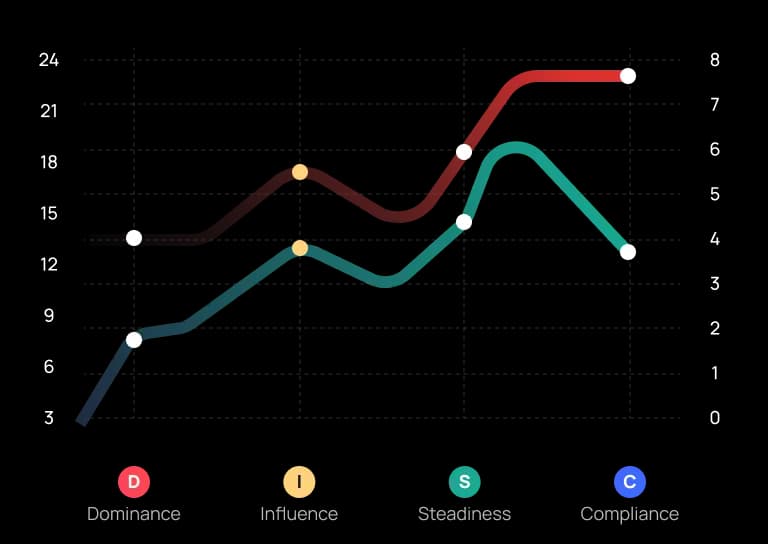
Represents your instinctive behaviors and desires.
Shows the behavioral tendencies you think you should exhibit in specific situations.
Related articles
You may also be interested in
 DISCMay 29, 2026
DISC Profile Activities for Team Building, Communication, & Workplace
Discover how DISC profile activities enhance team collaboration and communication. Apply practical exercises to build self-awareness and apply at work.
 DISCMay 29, 2026
DISC Assessment for Hiring: How to Use DISC to Hire Better Candidates
Learn how to use DISC assessment for hiring responsibly. Discover how DISC helps evaluate work style, team fit, communication, onboarding, and hiring decisions.
 DISCMay 21, 2026
What Does the DISC Assessment Measure? Key Behavioral Styles Explained
Discover what does the DISC assessment measure and understand your behavior & communication style. Learn how insights can improve teamwork and personal growth.
