


Table of content
EQ Examples at Work and in Real Life, With Phrases
See 10 EQ examples with realistic scenarios and sample phrases for work, family, and friendships, then take a free EQ test to find your starting point.
Table of content
What does emotional intelligence look like when a meeting turns tense, a friend vents for ten minutes, or a critical email lands in your inbox? Real EQ examples are small, repeatable behaviors, such as pausing before you react, listening to understand, and naming a feeling before it takes over your reply. Each example in this guide comes with a short and realistic scenario and a sample phrase, so you can borrow the language and try it in your own conversations at work, at home, and with friends. You will also see how examples of high emotional intelligence differ from low EQ habits, how they show up at work and in close relationships, and which daily practices make them easier to repeat.
What Is Emotional Intelligence and Why Do EQ Examples Help?
Emotional intelligence, often shortened to EQ, is the ability to notice, understand, manage, and respond to emotions in yourself and in other people. EQ examples help because the idea stays abstract until you see it inside a real behavior, such as pausing before an angry reply or asking a teammate how they are actually coping.
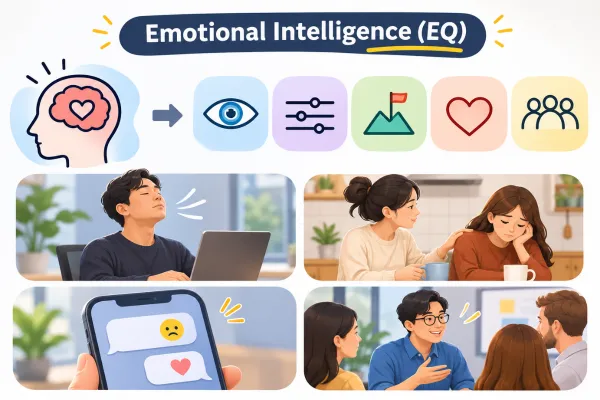
Researchers define emotional intelligence through several models, and the one most people know comes from Daniel Goleman, whose 1995 book Emotional Intelligence brought the term to a wide audience. Peter Salovey and John Mayer had already proposed an ability model in 1990, so the idea has a longer research history than the popular books suggest. Goleman describes five components, which are self awareness, self regulation, motivation, empathy, and social skills.
Psychologists still debate how fixed EQ is, and while some studies connect higher scores with stronger workplace performance, a clear cause has not been shown. Even so, most practical models treat these skills as trainable habits. Concrete examples are useful for that reason, because they turn a vague trait into behavior you can notice, copy, and rehearse in your own day.
Each example in the sections below maps back to at least one of the five components, so you can see which skill is doing the work. The scenarios cover desks, kitchens, group chats, and team meetings, since emotional intelligence shows up wherever people interact. Sample phrases appear in italics so you can adapt the language to your own voice.
What Are 10 Emotional Intelligence Examples You Can See in Everyday Life?
Ten widely recognized emotional intelligence examples are pausing before reacting, listening to understand, owning a mistake, taking feedback calmly, setting a boundary, naming a feeling precisely, reading the room, validating before fixing, staying curious in a disagreement, and repairing trust after conflict. Each one pairs awareness of an emotion with a deliberate and respectful action.
The examples follow a simple pattern, with a short scenario, the skill it reveals, and a sample phrase you can adapt. They run from an internal habit, which is managing your own reaction, to a relational habit, which is repairing a connection after harm.
1. Pausing Before You React
A manager receives a blunt email late in the afternoon and feels the urge to fire back immediately. Instead, the manager closes the draft, takes a slow breath, and replies the next morning with a calm question about the missing details. The pause does not erase the frustration, because it simply gives the first surge of emotion time to settle so the response reflects judgment rather than impulse. A sample line is: I need a few minutes to think about this, so can we revisit it after lunch?
2. Listening to Understand
During a team check in, a colleague explains why a deadline slipped. A person with high EQ puts the phone face down, keeps eye contact, and summarizes what they heard before offering any opinion. Because the speaker feels understood, the conversation moves toward solutions faster, and this habit is the practical side of active listening. A sample line is: So the delay came from the vendor, and you were unsure when to tell us. Is that right?
3. Owning a Mistake Without Excuses
After sending a report with the wrong figures, an analyst tells the team right away, explains the impact, and shares a corrected version. There is no blame and no defensive story, which builds trust because colleagues see that errors can be discussed safely. The analyst also describes how the check will change next time, so the apology leads to action. A sample line is: I made an error in the second table, here is the fix, and here is how I will verify it in the future.
4. Taking Feedback Without Defending
When a supervisor points out three weaknesses in a presentation, a person with high EQ lets the supervisor finish, asks one clarifying question, and says thank you. The person separates personal identity from the work being criticized, so the feedback becomes information rather than an attack. The separation also keeps the relationship intact, which makes the next round of feedback easier to give. A sample line is: Which part of the opening felt unclear to you?
5. Setting a Boundary Calmly
A teammate who is asked to cover another weekend shift declines politely and offers a different kind of help. The refusal comes from self respect rather than guilt or anger, and it protects the relationship from resentment later. Calm boundaries work because they describe a limit without accusing the other person of anything. A sample line is: I cannot take Saturday, though I can prepare the schedule on Friday afternoon.
6. Naming a Feeling Precisely
Instead of saying that everything is stressful, a person with strong emotional awareness says they feel overlooked, anxious about a deadline, or disappointed after a canceled plan. A precise label turns a vague and overwhelming state into something that can be observed and addressed. Many people find that the intensity drops once the feeling has a name, which leaves more room for a thoughtful response. A sample line is: I think what I am feeling is disappointment, not anger.
7. Reading the Room
Walking into a meeting where the mood is tense, a person with strong social awareness notices crossed arms, short answers, and long silences. They respond by slowing the pace, asking a gentle opening question, and saving a joke for later. Nonverbal cues often carry feelings that people do not say aloud, so noticing them gives you information before a small tension grows into a conflict.
8. Validating Before Fixing
A friend vents about a rough week at work. Rather than jumping straight to advice, a person with high EQ first reflects the feeling and then asks whether the friend wants ideas or simply wants to be heard. The response shows empathy in action, because it treats the emotion as real before trying to solve the problem. A sample line is: That sounds exhausting. Do you want suggestions, or would it help to talk it through?
9. Staying Curious in a Disagreement
A product designer and an engineer disagree about whether a feature can ship before the holiday. Rather than defending positions, both describe the concern behind their position, which is quality for one and timing for the other. Curiosity keeps the focus on the problem instead of the person, and it often reveals a middle option that neither had considered. A sample line is: Help me understand what worries you about the date, and I will explain what worries me.
10. Repairing Trust After Conflict
After a heated argument, a partner waits until both people are calm, returns to the topic, acknowledges their own part, and asks what would help. Repair of this kind is not forgetting the issue, since it means releasing resentment while keeping expectations clear. The same pattern works with friends and coworkers, because most relationships survive conflict when someone is willing to reopen the conversation kindly. A sample line is: I raised my voice earlier, and I am sorry. Can we talk about what you needed from me?
What Are Examples of High Emotional Intelligence Versus Low EQ?
Examples of high emotional intelligence include noticing a trigger before reacting, listening without interrupting, owning mistakes, and responding to other people with empathy. Low EQ shows up as sudden outbursts, blame, dismissed feelings, and avoided conversations. The gap rarely reflects intelligence or kindness, and it usually comes from how quickly a person notices an emotion and manages the response.
Seeing both sides together makes the difference easier to recognize, because the same situation can unfold in two very different ways. The table below compares six common moments and shows how each one looks when EQ is low and when it is high.
| Situation | Low EQ response | High EQ response |
|---|---|---|
| Receiving critical feedback | Gets defensive, makes excuses, or goes silent | Listens fully, asks a clarifying question, and says thank you |
| A project fails | Searches for someone to blame and hides a personal mistake | Owns a personal share, stays calm, and focuses on lessons |
| A teammate seems stressed | Ignores the signs or tells them to relax | Checks in privately, listens, and offers practical help |
| A disagreement in a meeting | Interrupts, raises their voice, or makes it personal | Waits their turn, states a concern, and looks for shared ground |
| A friend shares bad news | Changes the subject or rushes to fix it | Reflects the feeling first and asks what kind of support helps |
| A rude message arrives | Replies immediately in anger | Waits, drafts a calmer reply, and sends it after the first surge fades |
None of the low EQ responses make someone a bad person, since most people slip into them under stress. The more useful question is how quickly you notice the slip and how willingly you repair it, because recovery speed is a more honest signal than a single difficult moment.
What Are Emotional Intelligence Examples in the Workplace?
Emotional intelligence examples in the workplace include accepting feedback without defending, asking questions before assuming intent, helping an overloaded teammate, and staying steady when a deadline slips. Leaders add to this by acknowledging pressure, giving specific feedback in private, and adjusting plans when workloads are unrealistic. Each behavior builds trust, which supports cooperation and faster problem solving.
Emotional Intelligence Examples for Employees and Teams
On a team, EQ often appears in small choices during ordinary meetings. A developer who disagrees with a plan states the concern in terms of the project goal rather than the colleague's competence, and a coordinator who notices a quiet teammate follows up privately after the call. Others ask what a vague request really means instead of assuming the worst, or take a short break after a tense exchange so the next conversation starts from a calmer baseline.
Peer support is another clear example. When a colleague faces a major deadline, a teammate with strong social awareness offers to proofread the final draft so the colleague can focus on the analysis, and does so without waiting to be asked. A gesture like that costs little, yet it signals that effort is noticed and that the team can rely on one another.
Emotional Intelligence Examples for Leaders
Leaders carry extra weight because their mood spreads through a team quickly. An emotionally intelligent manager who sees a project slipping acknowledges the strain openly, reviews what can realistically move, and avoids passing frustration downward. Feedback receives the same care, with specific observations delivered in private and followed by a question about what support would help.
A leader does not need to avoid pressure to show emotional intelligence, because the skill lies in noticing pressure early and responding without passing it down. Teams remember how a leader behaves when things become difficult.
Humility belongs on this list as well. A leader who admits they do not know the answer and asks the person with more expertise to take the lead models the openness that makes teams safe for honest discussion. Openness of this kind tends to surface problems earlier, which saves time and protects morale when projects become difficult.
What Are Emotional Intelligence Examples in Real Life Relationships?
Emotional intelligence examples in real life relationships include listening before responding, apologizing specifically, naming needs without blame, and respecting limits. They appear when a partner explains what hurt without attacking, when a parent stays calm during a tantrum, and when a friend offers support instead of advice. Moments like these make closeness safer and conflict shorter.
Partners and Romantic Relationships
In a romantic relationship, a person with high EQ notices rising tension and asks for a break instead of saying something cutting. The pair returns to the topic when both are calmer, and each person describes what they felt rather than what the other did wrong. Small compromises, such as alternating how a weekend is spent, also count, since they show that both people's wishes matter.
Family and Parenting
Families are where old emotional patterns often surface, so awareness matters here. An adult who notices a familiar argument with a parent starting again can lower their voice, state a boundary, or step away rather than reacting on autopilot. Parents show EQ when they name a child's feeling and stay calm beside it, which teaches the child that big emotions can be handled safely.
Friendships
Friendship tests EQ through everyday moments such as an unanswered message or a canceled plan. A friend with strong social awareness checks in about the silence rather than assuming rejection, and celebrates good news without steering the conversation back to themselves. When someone is venting, that friend reflects the feeling before offering any suggestion.
Close relationships rarely fail because of one hard conversation, and they weaken when hard conversations are avoided for months. Naming a difficulty early keeps small tensions from becoming lasting distance.
How Are Emotions, EQ, and IQ Different?
Emotions are the feelings people experience, such as joy, fear, or anger, while EQ is the skill of recognizing and managing those feelings, and IQ is a measure of reasoning ability. A person can feel strong emotions without much EQ, and a person can score high on IQ yet struggle to handle conflict calmly.
Many searches for examples of emotions are really asking where emotional intelligence starts, so a quick list helps. Common emotions include happiness, sadness, anger, fear, surprise, disgust, love, joy, anxiety, excitement, contentment, guilt, shame, envy, jealousy, pride, embarrassment, loneliness, gratitude, and confusion. Naming these precisely is the first practical step of EQ, because a specific label makes a feeling easier to understand and discuss.
| Concept | What it describes | Everyday example |
|---|---|---|
| Emotion | A feeling that arises in response to an event | Feeling anxious before a presentation |
| EQ | The skill of noticing, understanding, and managing feelings | Taking a breath, naming the anxiety, and preparing calmly |
| IQ | A measure of reasoning and problem solving ability | Solving a logic puzzle or analyzing a dataset |
Seen this way, the three ideas work together rather than compete. IQ helps you analyze a problem, emotions tell you what matters to you, and EQ helps you act on both without damaging the people around you.
How Can You Practice EQ Examples Every Day?
You can practice EQ examples every day by choosing one small behavior, using it in a real conversation, and reviewing the result at night. Good starting habits include pausing before replying, naming your feeling, summarizing what you heard, and asking one trusted person for honest feedback. Progress comes from repetition, not from a single big insight.
- Pause for about six seconds when a trigger hits. A common rule of thumb suggests breathing and counting to six, which gives the first surge of emotion time to pass, although the exact number is a guideline rather than a scientific threshold.
- Name the emotion in one word. Frustration, disappointment, anticipation, and relief are more useful labels than stressed, because specific words turn an overwhelming state into something you can observe.
- Summarize before you respond. Repeating the other person's point in your own words confirms understanding and signals respect, which lowers defensiveness on both sides.
- Ask for honest feedback. A trusted colleague, friend, or manager can describe how you come across, and a question such as Do you feel heard when we disagree? opens the conversation.
- Review the day in writing. Three short lines about what you felt most strongly, how you reacted, and what you would change turn experience into learning.
Mindfulness supports all five habits, since paying attention to the present moment helps you catch an emotion while it is still small. Suppressing a feeling is a common mistake because it tends to resurface later in less controlled ways, whereas noticing it without judgment lets you acknowledge anger and still choose a measured reply.
How Can You Measure Your Own EQ?
You can measure EQ with a structured test that follows one of three approaches, which are ability tests that score how well you handle emotional information, self report questionnaires about typical behavior, and mixed models that combine emotional and social skills. Every format has limits, so results serve better as a starting point for reflection than as a final verdict.
Self report tools depend on honest self assessment, and people often overestimate skills such as listening, so pairing a test with feedback from others gives a fuller picture. A free option is the EQ test on DISC Personalities, which you can complete online and use to choose one or two habits from this guide to practice first.
Retaking a test after a few months of practice, while comparing the result with real feedback from colleagues and friends, shows whether your daily habits are actually changing. Small gains in one area, such as listening, are worth noticing even when the overall score moves slowly.
Frequently Asked Questions About EQ Examples
Can you give me 10 examples of emotional intelligence?
Yes. Ten examples are pausing before reacting, listening to understand, owning mistakes, taking feedback calmly, setting boundaries, naming feelings precisely, reading the room, validating before fixing, staying curious in disagreements, and repairing trust after conflict. Each one pairs awareness of an emotion with a respectful action, which is what separates EQ from simply feeling strongly.
What are 20 examples of emotions?
Common emotions include happiness, sadness, anger, fear, surprise, disgust, love, joy, anxiety, excitement, contentment, guilt, shame, envy, jealousy, pride, embarrassment, loneliness, gratitude, and confusion. Naming them is the first step of emotional intelligence, because a precise label makes a feeling easier to understand, discuss, and manage without being overwhelmed.
What is emotional intelligence in simple words?
Emotional intelligence is the skill of understanding your own feelings and the feelings of others, then using that understanding to choose a helpful response. It combines self awareness, self control, empathy, and social skills, and it appears in everyday moments such as handling criticism, resolving conflict, or comforting a friend who had a hard day.
What are examples of high emotional intelligence in relationships?
In relationships, high EQ looks like speaking up when something bothers you, listening without interrupting, apologizing specifically, and respecting a partner's limits. A person might say they felt hurt by a comment instead of going silent for days. Behaviors like these keep small tensions from growing and make closeness feel safer for both people.
What are examples of emotional intelligence in the workplace?
Workplace examples include accepting feedback without defending, asking clarifying questions before assuming intent, offering help to an overloaded teammate, and staying calm when a deadline slips. Leaders show it by acknowledging pressure, giving specific feedback in private, and adjusting unrealistic plans. Behaviors like these build trust, which supports teamwork and faster problem solving across a department.
How can I improve my emotional intelligence?
Start with one habit at a time. Pause before reacting, name the emotion you feel, and summarize what others say before replying. Then ask trusted colleagues or friends for honest feedback and review your day with a short journal. Repeating these small actions turns awareness into a reliable response pattern over weeks and months.
What are signs of low emotional intelligence?
Common signs include frequent outbursts that are out of proportion to the situation, blaming others, interrupting, dismissing other people's feelings, and avoiding difficult conversations. People with low EQ often struggle to keep relationships steady because they miss emotional cues. The pattern can change, since these are behaviors rather than fixed labels, and awareness is the first step.
Can emotional intelligence be learned?
Largely yes, although researchers still debate how much is innate. Most practical models treat skills such as self regulation, empathy, and communication as trainable through feedback, mindfulness, and repeated practice. Progress tends to be gradual, so choose one behavior, use it in real situations, and review what happened afterward to see what to adjust.
Final Thoughts on EQ Examples
Strong EQ examples share one quality, which is a short gap between feeling and acting. Inside that gap you can name the emotion, consider the other person, and choose a response you will still respect tomorrow. Start with one example from this guide, such as pausing before a reply or summarizing what you heard, and practice it in your next real conversation this week. If you want a clearer picture of your own strengths and blind spots, you can take the free EQ test on DISC Personalities and use the result to decide which habit to practice first. For questions about the tests or the business suite, reach out to the DISC Personalities team directly using the contact details listed below.
- Website: DISC Personalities
- Phone: Call (+84) 286 270 5825


DISC Team is a content writing team for tracnghiemtinhcach.vn, focusing on the DISC model, communication styles, and teamwork. The team aims to explain concepts in accessible language, helping readers connect them with situations in their work and everyday lives.
View author profile

Don't Let Your Potential Stay Hidden!
Take the DISC test today and discover your unique 'YOU', with deep insights into your true personality and potential.
 Understand yourself
 Choose the right career
 Suggest effective communication
 Reduce negative emotions
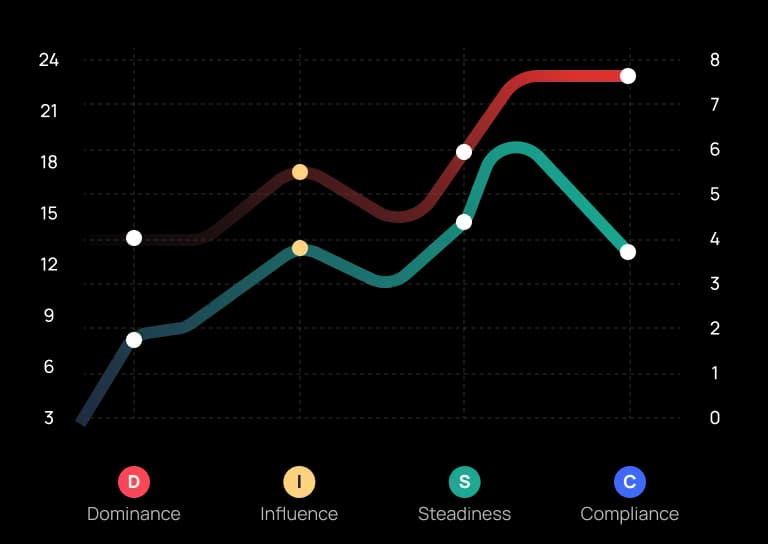
Represents your instinctive behaviors and desires.
Shows the behavioral tendencies you think you should exhibit in specific situations.
Related articles
You may also be interested in
 IQ, EQNov 08, 2026
Mensa IQ Test: Qualifying Score, Cost, and How It Works
How high is the Mensa IQ test cutoff? See scores by test scale, US costs, and age rules, then take our IQ practice test to check your pace.
 IQ, EQNov 08, 2026
IQ Test for Kids: How to Choose the Right One by Age
Learn which IQ test for kids fits ages 2 to 16, how scores work and when testing helps. Take the IQ test on discpersonalities.com as a parent.
 IQ, EQNov 08, 2026
Famous People IQ Scores: Which Are Documented?
See which famous people IQ scores come from real tests, which are estimates, and how to check any claim. Take the IQ test to see your own.
