


Table of content
DISC Personality Test for Sales: Unlock Your Team’s Full Potential
DISC Personality Test for Sales helps sales teams improve role fit and performance. Learn how DISC boosts hiring, coaching, and customer alignment.

Table of content
The DISC Personality Test for Sales is a powerful tool that helps sales leaders understand their team’s behavior, communication styles, and decision-making processes. By tailoring sales strategies to each individual's strengths, the DISC test boosts team performance, reduces conflict, and enhances customer interactions. In this article, we explore how DISC assessments can align your team with the right sales roles, improve communication, and ultimately drive better sales results.
What is the DISC Personality Test for Sales?
A DISC personality test for sales is a behavioural assessment that explains how someone prefers to communicate, decide, and respond under pressure - factors that directly shape selling performance.
Instead of labeling one “perfect salesperson,” the DISC personality test for sales maps tendencies across four styles: Dominance (D), Influence (I), Steadiness (S), and Compliance (C).
How it works in practice:
- The DISC personality for sales asks people to choose statements that best describe their behaviour. Their answers generate a profile showing their natural sales communication style.
- The results highlight strengths, likely pressure points, and the situations where a rep may need to adjust their approach - especially when dealing with different buyer styles.
In short, the DISC for sales helps sales leaders and reps build stronger self-awareness, tailor conversations, and match selling approaches to role needs - whether the role leans more toward technical sales, relationship selling, or fast-paced outreach.

Understanding the 4 DISC Behavioral Types for Sales
A DISC test for sales helps explain how salespeople communicate, make decisions, and react under pressure. Many teams ask which personality test is best for sales, but DISC stands out because it clearly shows what are the 4 personality types in sales and how each type performs in different selling situations. This understanding supports better hiring, coaching, and disc sales training aligned with real sales roles.
Below is a clear breakdown of each DISC style and how it typically shows up in sales work.
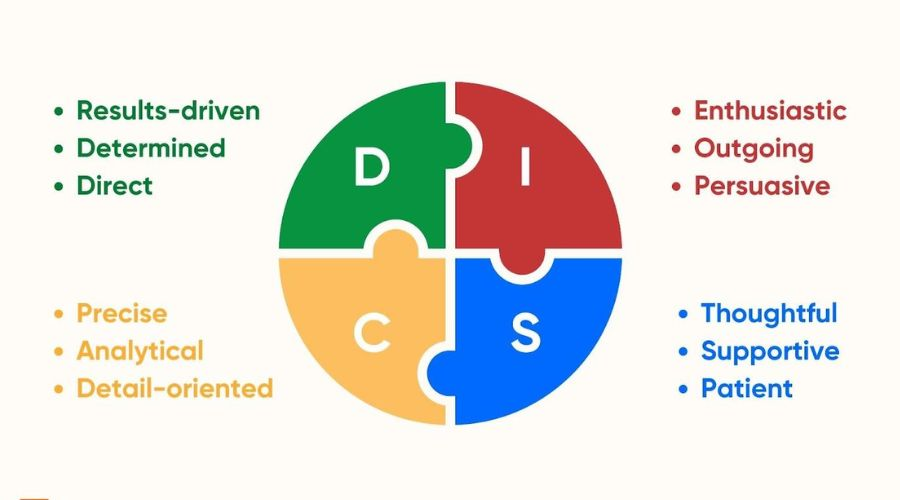
Dominance (D)
Dominance profiles are driven by results and action. They prefer fast decisions and direct conversations. In sales, they often succeed in competitive and target-driven roles.
Key characteristics in sales include:
- Comfortable leading conversations and pushing deals forward
- Strong focus on goals, outcomes, and performance metrics
- High energy in new business development and closing roles
D-types often display strong traits of a sales manager, such as decisiveness and authority. However, a DISC personality test for sales helps them recognise when to slow down and adapt to different buyer styles.
Influence (I)
Influence profiles are expressive, optimistic, and people-focused. They enjoy interaction and are skilled at building emotional connections with prospects.
In sales environments, they typically excel at:
- Relationship selling and early-stage prospect engagement
- Presentations, networking, and account expansion
- Creating enthusiasm around products or services
With the right structure, I-types maintain momentum without losing focus. This balance is why DISC is often mentioned when teams ask what personality type is best for sales in relationship-driven markets.
Steadiness (S)
Steadiness profiles value trust, stability, and cooperation. They are patient listeners and focus on long-term relationships rather than quick wins.
Their strengths in sales often include:
- Account management and customer retention
- Repeat sales and after-sales support
- Building loyalty through reliable communication
A DISC personality test for sales helps place S-types in roles where consistency matters. These profiles are often overlooked when teams focus only on aggressive selling styles.
Compliance (C)
Compliance profiles are analytical, precise, and detail-oriented. They prefer logic, facts, and clear processes in sales conversations.
They are especially effective in:
- Technical and consultative sales roles
- Complex products with long decision cycles
- Industries that require accuracy and deep product knowledge
Instead of asking what DISC assessment is best for sales, organisations benefit more by matching C-types to roles where expertise builds trust. A DISC personality test makes this alignment clearer and more reliable.
Why DISC Profiles Matter in Sales Environments
Understanding behaviour is critical in sales, where communication, pressure, and relationship-building directly affect results. The DISC personality test for sales provides clear insight into how people work, interact, and perform, helping teams operate with greater alignment and consistency.
The impact of DISC on team dynamics and sales performance
Sales teams are often made up of individuals with very different working styles. DISC profiles explain these differences and show how each style contributes to overall performance. When roles align with behavioural strengths, teams become more effective and balanced.
Key impacts include:
- Better role fit across prospecting, closing, and account management
- Reduced conflict caused by mismatched working styles
- More predictable and sustainable sales performance
By using the DISC test for sales, leaders can build teams that complement each other rather than compete internally.
Enhancing communication and collaboration using DISC insights
Sales success depends heavily on how well people communicate with both teammates and customers. DISC insights help sales professionals recognise different communication preferences and adapt their approach accordingly. This improves clarity, trust, and cooperation across the team.
For example, DISC supports:
- Clearer conversations between fast-paced and detail-focused sellers
- Stronger collaboration between sales, account management, and leadership
- More effective customer interactions by adjusting tone and messaging
Applying the DISC personality test helps teams communicate with intention, not assumption.
Why DISC is essential for identifying high performers and improving team alignment
Top sales performance looks different depending on the role, product, and sales cycle. DISC helps leaders understand why certain individuals perform well in specific situations and where others may struggle. This insight allows for smarter coaching and better long-term alignment.
DISC supports sales leaders by:
- Identifying behavioural strengths linked to consistent performance
- Improving coaching by focusing on style-based development needs
- Aligning individual behaviour with team and business objectives
When used correctly, the DISC personality test for sales becomes a practical tool for building stronger teams, developing talent, and driving measurable sales results.
Which DISC Profiles Thrive in Sales and Why?
In sales, success depends on how well a person’s natural behaviour fits the selling role. The DISC personality test for sales helps identify which profiles perform best in specific sales functions, rather than promoting a one-size-fits-all approach.

D-types (Hunters)
D-types are driven by results and action. They prefer fast decisions and clear outcomes, which makes them effective in high-pressure sales environments.
They often thrive in roles such as:
- Outbound sales and cold calling
- New business development
- Target-driven or commission-based sales
According to the DISC personality test, D-types perform best when they can move quickly, take control of conversations, and focus on closing deals.
I-types (Networkers)
I-types succeed through communication and influence. They are energetic, persuasive, and enjoy interacting with people, which supports relationship-focused selling.
Rather than pushing for quick closes, I-types excel at:
- Building rapport with prospects
- Opening new accounts
- Pitching ideas and presenting solutions
The DISC test for sales shows that I-types are especially effective in roles where trust, enthusiasm, and strong first impressions matter.
S-types (Account Managers)
S-types bring stability and reliability to sales teams. They are patient listeners who value long-term relationships over short-term wins.
Their strengths are often seen in:
- Account management and renewals
- Customer success and after-sales support
- Upselling to existing clients
Based on insights from the DISC personality test for sales, S-types thrive where consistency, trust, and ongoing client care are essential.
C-types (Consultants)
C-types are detail-oriented and analytical. They prefer structure, facts, and clear processes, which support complex or technical sales roles.
They perform well when:
- Products require an in-depth explanation
- Buyers need accuracy and evidence
- Decisions involve risk or compliance
The DISC personality highlights C-types as strong performers in consultative and technical sales, where expertise builds buyer confidence.
How to Use DISC for Hiring and Onboarding Salespeople
Using DISC in hiring and onboarding helps sales leaders reduce guesswork and make better people decisions. A DISC personality test for sales provides behavioural insight that supports smarter recruitment choices and faster, more effective onboarding.
Spotting natural fits during recruitment
Hiring for sales is high-stakes, and interviews can be misleading. A DISC personality test helps you look past confidence and see how a candidate is likely to sell, communicate, and handle pressure in real situations. The goal is alignment, not a “perfect” profile.
Use a DISC test for sales to match behavioural tendencies to the role’s demands:
- Outbound / fast closing roles: often suit people who act quickly and push for outcomes.
- Relationship-based selling: fits candidates who build rapport and maintain long-term client trust.
- Technical or consultative sales: benefits from candidates who are detail-focused and confident in product knowledge.
With a DISC personality, you can reduce guesswork, avoid style mismatches, and hire for long-term fit instead of first impressions.
Explore: List of personality interview questions
Speeding up onboarding with DISC insights
Once hired, a DISC personality test for sales can shorten ramp time by tailoring onboarding to how the new rep learns and works. Instead of a one-size plan, you use behavioural insight to guide training, coaching, and early goals.
Practical onboarding adjustments based on a DISC personality test include:
- Give quick ownership and clear targets to reps who thrive on speed and autonomy.
- Provide shadowing, talk tracks, and relationship practice for reps who learn through interaction.
- Offer steady support, predictable check-ins, and confidence-building steps for reps who prefer stability.
- Share structured playbooks, product documentation, and data-driven feedback for reps who want clarity and accuracy.
Coaching and Managing Sales Teams with DISC
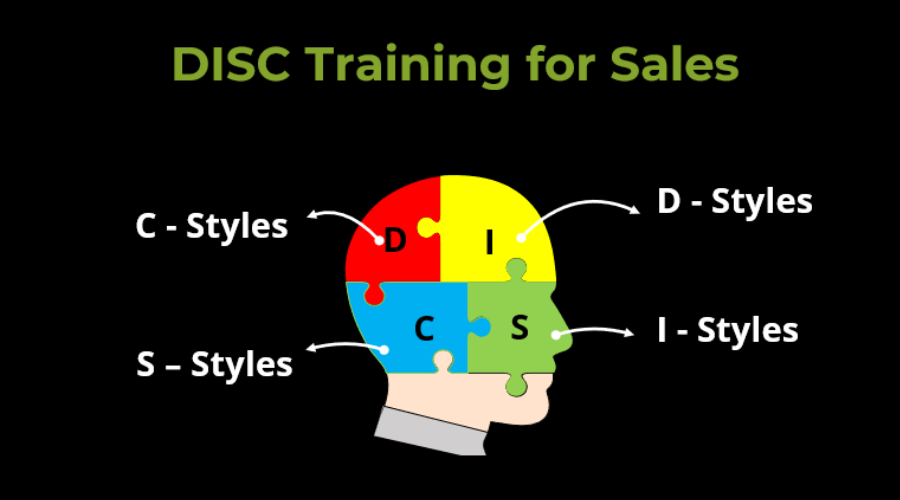
Using a DISC personality test for sales helps managers coach reps based on how they communicate, decide, and respond under pressure. Rather than using one approach for everyone, feedback and support can be tailored to different behavioral and communication styles. Applied consistently, DISC reduces friction, improves daily execution, and strengthens overall team performance.
Tailoring your management style to individual DISC profiles
A DISC personality test makes coaching clearer because it shows what each rep responds to best.
- D (Dominance): Keep feedback direct and outcome-focused. Set clear targets and timelines.
- I (Influence): Recognize wins and keep energy high. Use encouraging language and fast check-ins.
- S (Steadiness): Offer steady support and reassurance. Give time to process change and build confidence.
- C (Compliance): Bring structure and detail. Use data, clear steps, and strong product knowledge.
With a DISC personality test for sales, your coaching becomes easier to land. Reps hear the message in a way that fits their natural style.
Building balanced sales teams – Leveraging complementary strengths
There is no single “perfect” sales profile. A DISC personality test helps you build a team that covers different parts of the sales cycle by combining strengths.
- D-types often thrive in target-driven roles and fast decisions.
- I-types support relationship building, networking, and early momentum.
- S-types strengthen long-term accounts through consistency and trust.
- C-types perform well in technical or detail-heavy sales conversations.
Many teams over-index on bold, outgoing styles. A DISC personality for sales helps avoid that bias. It supports smarter role fit and stronger team coverage.
Navigating conflict and communication gaps between different DISC types
Sales pressure can create misunderstandings. A DISC personality test for sales helps you spot where clashes may happen and how to prevent them.
- If D feels slowed down, shorten updates and focus on results.
- If C feels rushed, add facts, proof, and clear logic.
- If S feels pushed, slow the pace and confirm stability.
- If I loses focus, reinforce follow-through and next steps.
Small adjustments matter. When managers use a DISC personality to guide conversations, teams resolve tension faster and communicate with less friction.
Using DISC to Improve Sales Conversations and Customer Alignment
Applying a DISC personality test for sales allows sales teams to communicate with customers in a way that feels natural, relevant, and aligned with individual decision-making styles. Instead of relying on a fixed script, salespeople learn to adapt their approach based on behavioral cues shown during conversations.
Key ways a DISC personality test improves sales conversations include:
- Identifying buyer communication styles: Sales reps can quickly sense whether a customer prefers direct answers, relationship-driven dialogue, steady reassurance, or detailed explanations.
- Adapting message delivery: Some buyers value speed and outcomes, while others focus on trust, consistency, or technical accuracy. DISC helps tailor how benefits and solutions are presented.
- Improving pacing and tone: Adjusting conversation speed, structure, and depth reduces friction and keeps buyers engaged.
- Reducing misunderstandings: Behavioral awareness prevents mismatched expectations that often delay decisions.
Customer alignment also becomes stronger because reps stop using one approach for every prospect. With insights from a DISC personality for sales, teams can:
- Frame value based on what matters most to each buyer
- Build trust faster through relevant communication
- Create smoother sales interactions from first contact to close
Over time, using a DISC personality test for sales leads to more effective conversations, higher engagement, and better long-term customer relationships.
Conclusion
In conclusion, the DISC Personality Test for Sales offers invaluable insights that can transform your sales team's performance. By understanding each individual's strengths and communication style, you can tailor strategies that boost productivity, foster collaboration, and improve customer relationships. Start implementing DISC today and watch your team unlock its full potential, driving better results and long-term success in sales.
FAQs
Can DISC assessments really improve team performance?
Yes. DISC assessments enhance team performance by enabling managers to understand individual behavioral styles, communication preferences, and motivators. This insight allows better role alignment, clearer coaching, and reduced conflict. When salespeople work in roles that match their strengths, productivity, engagement, and collaboration increase naturally.
How often should I reassess my sales team using DISC?
DISC assessments should be revisited every 12–24 months or when roles, responsibilities, or team structures change. Reassessment is also useful after promotions, major performance shifts, or organizational changes, ensuring coaching and expectations remain aligned with each salesperson’s current behavior and work context.
Are DISC profiles helpful for customer-facing roles?
Absolutely. DISC profiles are especially valuable for customer-facing roles because they help salespeople adapt communication styles to different buyers. By recognizing behavioral cues, reps can tailor conversations, build trust faster, reduce friction, and improve close rates across diverse customer personalities.


DISC Team is a content writing team for tracnghiemtinhcach.vn, focusing on the DISC model, communication styles, and teamwork. The team aims to explain concepts in accessible language, helping readers connect them with situations in their work and everyday lives.
View author profile

Don't Let Your Potential Stay Hidden!
Take the DISC test today and discover your unique 'YOU', with deep insights into your true personality and potential.
 Understand yourself
 Choose the right career
 Suggest effective communication
 Reduce negative emotions
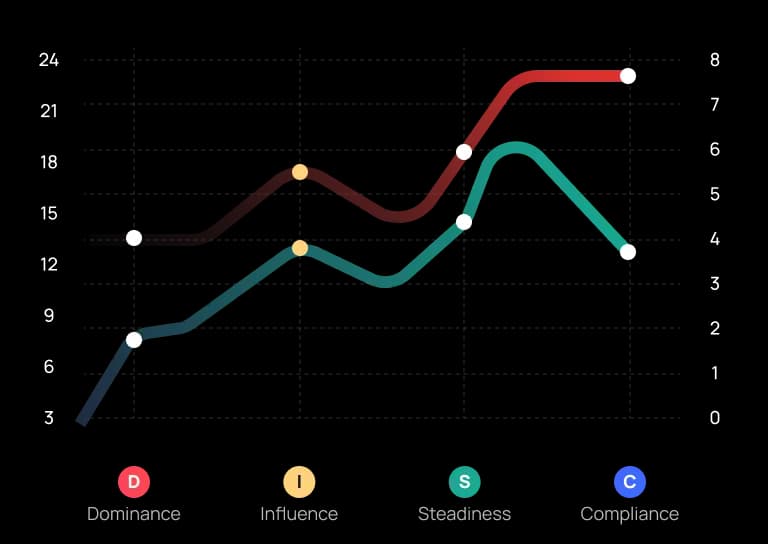
Represents your instinctive behaviors and desires.
Shows the behavioral tendencies you think you should exhibit in specific situations.
Related articles
You may also be interested in
 DISCSep 28, 2026
How to Identify Your Strengths and Weaknesses at Work
Understand your strengths and weaknesses at work by reviewing your skills, past achievements, etc. Improve and align your strengths with career goals.
 DISCMay 29, 2026
DISC Profile Activities for Team Building, Communication, & Workplace
Discover how DISC profile activities enhance team collaboration and communication. Apply practical exercises to build self-awareness and apply at work.
 DISCMay 29, 2026
DISC Assessment for Hiring: How to Use DISC to Hire Better Candidates
Learn how to use DISC assessment for hiring responsibly. Discover how DISC helps evaluate work style, team fit, communication, onboarding, and hiring decisions.
