


Table of content
Understanding the DC Personality Type: Traits, Strengths, and Challenges
Discover the DC personality type in the DISC model, its traits, strengths, challenges, and how DC types behave in the workplace and leadership roles.
Table of content
The DC personality type in DISC is a combination of Dominance (D) and Conscientiousness (C). People with a DC profile are driven, analytical, results-focused, and highly disciplined.
Unlike pure D types who act quickly, DC personalities tend to slow down to analyze risks and details before executing. This balance makes them strong leaders, strategists, and problem-solvers—especially in high-stakes or complex environments.

What Is the DC Personality Type?
According to DISC personality theories, the DC personality type in the DISC assessment represents individuals with high Dominance (D) and high Conscientiousness (C). This profile blends a strong drive for results with a deep need for accuracy, logic, and structure.
People with a DC DISC profile are decisive yet cautious. They want to win—but only if the strategy makes sense. Unlike pure D types who act fast and instinctively, DC personalities prefer to evaluate data, assess risks, and plan carefully before taking action.
This combination makes DC individuals highly effective in environments that demand leadership, precision, and accountability. They often take charge of complex problems, set high standards for themselves and others, and expect performance to be measurable and objective.
In short, the DC personality type is known for being driven, analytical, disciplined, and results-oriented, especially in roles that require both authority and technical expertise.
DC is one of the blended profiles within the DISC system. To understand how it compares to other profiles, you can explore the full overview of the 16 DISC personality types.
Key Traits of the DC Personality Type
DC DISC Profile – Key Characteristics
Here is the DC Characteristic Profile at a glance:
- High standards and strong self-discipline
- Goal-oriented with a focus on accuracy and quality
- Logical, analytical, and data-driven decision-making
- Direct communication style, prefers facts over emotions
- Strong sense of responsibility and control
- Thrives in structured, high-performance environments
People with a DC personality type display a unique blend of Dominance (D) and Conscientiousness (C). This combination shapes how they think, decide, and interact with others. Below are the most defining DC personality traits:

- Results-driven and analytical: DC individuals aim for high performance while relying heavily on logic, data, and evidence.
- High standards and precision: They value accuracy, quality, and well-defined processes. Mistakes are not taken lightly.
- Decisive but cautious: Unlike pure D types, DC personalities prefer to analyze risks before taking action.
- Independent and self-disciplined: They trust their own judgment and work best with clear authority and autonomy.
- Direct and objective communication: DC types focus on facts rather than emotions when expressing ideas.
- Strong sense of control and responsibility: They feel accountable for outcomes and expect others to meet the same standards.
To see how DC traits compare with other DISC combinations, you can explore the differences across the most common DISC personality types.
DC Personality Type: Strengths and Weaknesses
The DC DISC personality type is known for combining strong leadership drive with analytical precision. Below is a clear comparison of the key strengths and weaknesses associated with the DC profile.
Strengths | Weaknesses |
| Highly analytical and logical decision-makers | Can overanalyze and delay decisions |
| Strong sense of control and accountability | May struggle with delegating tasks |
| High standards ensure quality outcomes | Perfectionism can cause stress or rigidity |
| Direct, clear, and objective communicators | May appear overly critical or emotionally distant |
| Excellent at managing complex projects | Can become controlling or micromanaging |
Personality traits can evolve depending on the environment and experience. Learn more about this in our blog, answering whether people can change their personality.

DC Personality Type in Leadership and Work Style
Individuals with a DC DISC personality type often demonstrate a leadership and work style shaped by both decisiveness (D) and analytical precision (C). This combination allows them to perform exceptionally well in structured, results-driven environments.
In leadership roles, DC personalities tend to:
- Set clear goals and high performance standards
- Make decisions based on logic, data, and careful evaluation
- Take control in complex or high-pressure situations
- Emphasize efficiency, accountability, and measurable outcomes
At work, DC individuals prefer roles with defined responsibilities, authority, and structure. They thrive when expectations are clear, and performance is assessed objectively. However, balancing task focus with emotional awareness is often key to maintaining strong team dynamics.

DC Communication Style in the Workplace
The DC personality type communicates with clarity, logic, and purpose. Their communication style is strongly influenced by their desire for efficiency and accuracy.
Key characteristics of DC communication include:
- Direct and concise: They avoid unnecessary wording and focus on the core message.
- Fact-based and logical: Opinions and decisions are supported by data and evidence.
- Assertive and confident: DC individuals clearly express expectations and viewpoints.
- Results-oriented: Conversations often revolve around goals, deadlines, and outcomes.
- Formal and professional: Depending on their level of Conscientiousness, they may prefer a business-like tone.
DC personalities value structured discussions and clear intentions. Ambiguity, excessive small talk, or emotionally driven conversations without a clear purpose may frustrate them.
Best Careers for the DC DISC Personality Type
Thanks to their strengths in analysis, leadership, and execution, individuals with a DC DISC personality type tend to excel in careers that demand precision, responsibility, and strategic thinking.
Some of the best-suited career paths for DC personalities include:
- Strategic planning and business leadership: Roles such as business development director, strategy manager, or operations leader benefit from their long-term thinking and control-oriented mindset.
- Project and operations management: DC types perform well as project managers or operations managers, ensuring projects meet deadlines, standards, and performance targets.
- Analytical and technical roles: Careers in engineering, data analysis, research and development, or quality assurance align well with their logical and detail-focused nature.
- Consulting and advisory roles: Their ability to evaluate complex situations and propose structured solutions makes them effective consultants.
- Compliance, legal, and risk management: Positions such as compliance officer or legal consultant suit their need for accuracy, rules, and accountability.
- Entrepreneurship: With strong independence, discipline, and strategic thinking, many DC personalities succeed in building and managing their own businesses.
If you're also considering D-type paths, check out our curated list of the best DISC D personality type careers.
How DC Personality Type Differ From Other “D” Types
While all “D” types in the DISC model share traits like assertiveness and a results-driven mindset, the DC personality type stands apart due to its structured, analytical approach. Let’s explore how the DC blend compares with other common “D” combinations.
DC Personality Type and Pure D
The DC personality type shares the Dominance trait with a pure D type, but adds a layer of caution, precision, and detail orientation.

- Pure D: Bold, fast-paced, and often impulsive in decision-making.
- DC: Just as decisive, but decisions are grounded in logic and risk assessment.
- Key Difference: Pure D types move quickly, while DC types move smartly and strategically.
| Aspect | DC Personality Type | Pure D Type |
| Focus | Results with a structured, analytical approach | Fast results without detailed planning |
| Communication Style | Direct but precise and often formal | Direct, forceful, and commanding |
| Relationship Orientation | Task-oriented, but values competence and respect | Task-oriented with less emphasis on relationship building |
| Approach to Risk | Calculated and data-informed | Bold and often impulsive |
DC Personality Type and DI
Compared to the more socially outgoing and persuasive DI personality, the DC personality type is more task-focused and reserved.

- DI: Energetic, people-oriented, and thrives on enthusiasm and influence.
- DC: Values structure over spontaneity and results over relationships.
- Key Difference: DI leads through inspiration; DC leads through execution and planning.
| Aspect | DC Personality Type | DI Personality Type |
| Focus | Results with a structured, analytical approach | Results with a focus on achieving goals through influencing |
| Communication Style | Direct but precise and often formal | Direct and persuasive, often enthusiastic and outgoing |
| Relationship Orientation | Task-oriented, but values competence and respect | People-oriented, focuses on building relationships and networking |
| Approach to Risk | Calculated and data-informed | Decisive and optimistic |
DC Personality Type and DS
While DS types are often known as peacemakers, the peacemaker DC personality type still seeks resolution, but with a stronger focus on structure and accountability.
- DS: Loyal, patient, and focused on harmony.
- DC: Objective, firm, and less concerned with emotional dynamics.
- Key Difference: DS prioritizes stability; DC prioritizes control and efficiency.
| Aspect | DC Personality Type | DS Personality Type |
| Focus | Results with a structured, analytical approach | Results and stability with a steady and dependable approach. |
| Communication Style | Direct but precise and often formal | Direct and supportive, more patient and accommodating |
| Relationship Orientation | Task-oriented, but values competence and respect | Both task-oriented and people-oriented, values loyalty and cooperatio |
| Approach to Risk | Calculated and data-informed | Moderate risk-taker, balances the need for results with a desire for stability |
Final Thoughts
The DC personality type is people who value results, rationality, and correctness. It combines decisiveness with organization. DC individuals bring a strong presence to strategy, leadership, and problem-solving, backed by high standards and critical thinking. While their directness and control-oriented temperament can often lead to interpersonal problems, DC types who are self-aware and adaptable can create strong, productive relationships and lead with excellence.
Take out the DISC assessment to explore more about yourself and find out suitable career path
FAQs
What does DC mean in DISC personality?
In the DISC personality model, "DC" represents a blend of two primary personality traits: Dominance (D) and Conscientiousness (C). Individuals with a DC personality type exhibit characteristics of both: a drive for results, assertiveness, and a desire to take charge (Dominance), combined with a focus on analysis, detail-orientation, and high standards (Conscientiousness).
Are DC personality types rare?
DC personality types are less common than single-trait DISC profiles. This is because the DC profile requires a balance between assertiveness (D) and caution (C), a combination that does not frequently occur in the general population.
The DC type is uncommon, but it is not the rarest personality type there is. Learn which is the rarest DISC personality type among the 16 DISC personalities.
What careers are best for DC types?
Careers requiring strategic thought, leadership, problem-solving, and an emphasis on efficiency and quality are frequently ideal for people with a DC personality type. The following are some ideal job paths:
- Management and Executive Roles
- Project Management
- Engineering and Technical Fields
- Research and Development
- Data Analysis and Science
- Consulting
- Entrepreneurship
They are ideal for positions where they can lead initiatives, carry out strategic plans, and guarantee high performance standards because of their motivation and analytical abilities.
Is DC a good leadership personality type?
Of course. Leaders of the DC personality type thrive in environments that require accountability, structure, and output. Their Conscientiousness ensures that their decisions are well-thought-out and focused on achieving exceptional results, while their Dominance provides them with the motivation and courage needed to take on leadership roles. They may, however, need to exercise caution in striking a balance between high expectations and empathy, as well as encouraging cooperative environments.
How can a DC personality improve relationships?
By emphasizing the development of specific interpersonal skills, people with a DC personality type can improve their relationships:
- Softening Directness: Being direct can be effective, but it can be avoided by being careful with tone and delivery to avoid coming across as harsh or judgmental.
- Respecting Collaboration: Understanding the advantages of other viewpoints and remaining receptive to the thoughts and methods of others.
- Delegating and Trusting: Stronger teams and relationships can be achieved by learning to assign duties and having faith in people to carry them out.
- Expressing Gratitude: Positive relationships can be cultivated by recognizing and appreciating the efforts and accomplishments of others.
What are the main traits of a DC personality type?
The main DC personality traits include analytical thinking, high standards, direct communication, independence, and a strong focus on control and results.
What is the difference between DC and D personality types?
While both are results-driven, DC personalities are more analytical and cautious. Pure D types act faster and rely more on instinct, whereas DC types prefer data, structure, and risk evaluation before taking action.
Can DC personality traits change over time?
Yes. While core DISC traits tend to remain stable, DC personalities can adapt their behavior based on experience, environment, and personal development—especially in communication and leadership style.


Don't Let Your Potential Stay Hidden!
Take the DISC test today and discover your unique 'YOU', with deep insights into your true personality and potential.
 Understand yourself
 Choose the right career
 Suggest effective communication
 Reduce negative emotions
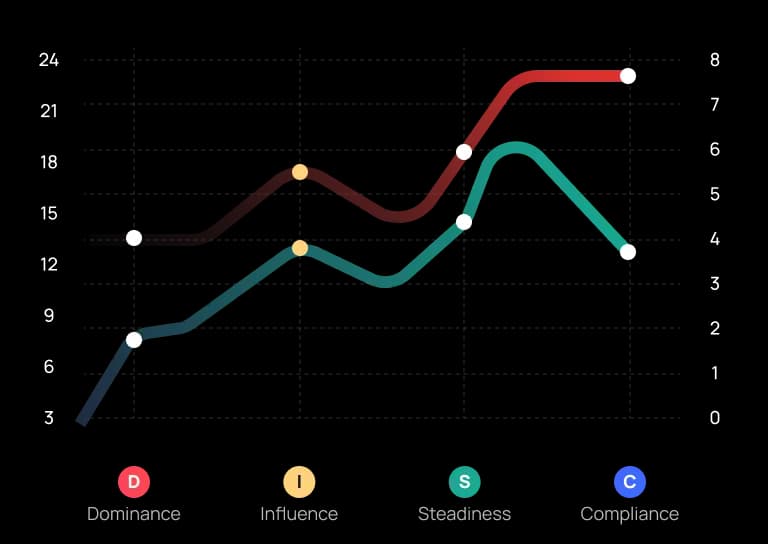
Represents your instinctive behaviors and desires.
Shows the behavioral tendencies you think you should exhibit in specific situations.
Related articles
You may also be interested in
 DISCSep 28, 2026
How to Identify Your Strengths and Weaknesses at Work
Understand your strengths and weaknesses at work by reviewing your skills, past achievements, etc. Improve and align your strengths with career goals.
 DISCMay 29, 2026
DISC Profile Activities for Team Building, Communication, & Workplace
Discover how DISC profile activities enhance team collaboration and communication. Apply practical exercises to build self-awareness and apply at work.
 DISCMay 29, 2026
DISC Assessment for Hiring: How to Use DISC to Hire Better Candidates
Learn how to use DISC assessment for hiring responsibly. Discover how DISC helps evaluate work style, team fit, communication, onboarding, and hiring decisions.
