


Table of content
Type A Personality: Traits, Health Risks, and Types B, C, D
Type A personality explained: core traits, health effects, who is happier, and how to manage urgency. Take the free DISC test to learn more.
Table of content
Type A personality describes a pattern of ambition, urgency, and competitiveness that shapes how a person works, waits, and responds to pressure. The pattern helps people deliver results, yet the same impatience can drain energy, strain relationships, and keep stress levels high when it never switches off. Psychologists no longer treat it as a fixed box, because research shows that these habits sit on a spectrum and shift with job, environment, and mindset. Knowing where useful drive ends and harmful irritability begins therefore matters more than collecting a label. The article separates what research supports from what popular quizzes exaggerate, so readers can judge their own style calmly and keep the strengths of a driven approach without paying for them in health or relationships.
What Is a Type A Personality?
A Type A personality is a behaviour pattern defined by competitiveness, time urgency, and, in some people, hostility. It describes how someone tends to act under pressure rather than a medical condition or a formal diagnosis. Cardiologists Meyer Friedman and Ray Rosenman first described the pattern in the 1950s while studying heart disease.
The concept became famous through a story from a cardiology waiting room. According to the often-told account, an upholsterer noticed that the chairs wore out only on the arms and the front edge of the seat, which suggested that patients perched forward and stood up again and again. Friedman and Rosenman described the underlying pattern as a constant struggle to achieve more in less time, and the phrase still captures the core of the idea.
Modern research treats Type A and Type B as the two ends of a continuum instead of two separate kinds of people. A 2019 analysis by Wilmot and colleagues in the Journal of Personality and Social Psychology concluded that Type A behavior is better described as a set of dimensions than as a distinct type. Because those dimensions do not always travel together, one person can be fiercely competitive without being impatient, while another can be impatient without any hostility at all. The Type A and Type B personality theory is therefore read today as a description of habits instead of a classification of people.
What Are the Main Type A Personality Traits?
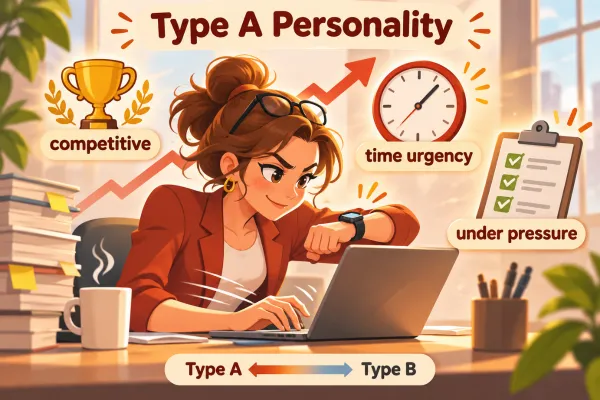
The main Type A personality traits are time urgency, competitive drive, and a tendency toward irritability or hostility, and each trait can appear at a low, moderate, or high level. Ambition, organisation, and independence often accompany these three. Nobody needs to show every trait for the label to be useful, and extreme levels are not required.
Time urgency
Time urgency is the sense that every minute is scarce and every delay is a personal obstacle. People with this trait often move, speak, and eat faster than those around them, cut into conversations, and bristle in queues or slow meetings. Roles where speed is rewarded make the habit look like a strength, although tasks that need reflection suffer when speed replaces careful thought. A useful test is whether the person can wait calmly when nothing can be done to hurry the outcome.
Competitive drive
Competitive drive pushes Type A individuals to measure progress against a target or another person, even in settings that were never meant to be contests. Studies have often linked that drive with higher productivity, and a 1984 study by Taylor, Locke, Lee, and Gist found Type A university faculty more productive than their Type B colleagues. Results still depend on the task, since intense urgency can backfire on complex decisions that reward patience.
Hostility and control
Hostility covers aggressive behaviour as well as attitudes such as cynicism and mistrust, and it is the trait most closely tied to health concerns. Teammates often experience a hostile Type A person as unwilling to adopt suggestions, which strains cooperation and weakens the social support that buffers stress. Control and independence belong in the same cluster, because wanting things done a certain way frequently ends with one person doing everything personally.
How Do Type A Traits Show Up at Work and at Home?
Type A traits show up wherever speed, performance, and responsibility are rewarded, and they tend to intensify under pressure. Researchers generally describe them as a mix of temperament and learned response, so a demanding job, a competitive culture, or a heavy workload can bring the behaviours out even in people who are naturally relaxed.
At work, the pattern often looks like volunteering for difficult projects, checking progress constantly, and taking over tasks when the pace slips. Managers value the output, although teams may feel worn down when deadlines are treated as emergencies by default. People who feel they must stay productive every hour may also report more worry and lower satisfaction during periods of overload.
At home, the same urgency can appear as impatience with traffic, children, or shared decisions, and rest may feel like wasted time. Partners and friends frequently notice the pattern before the person does, so honest feedback from them works as a practical early warning.
Drive becomes a problem when speed stops being a choice and turns into a reflex.
What Is the Difference Between Type A and Type B Personality?
Type A and Type B personality differ mainly in how strongly urgency and competition shape daily behaviour. Type A people move fast, react sharply to delays, and treat results as a measure of worth, while Type B people work at a steadier pace, stay calmer under pressure, and enjoy an activity even when they do not win.
| Feature | Type A | Type B |
|---|---|---|
| Pace | Fast, urgent, rarely idle | Steady and unhurried |
| Response to delays | Frustration or irritation | Patience and flexibility |
| Competition | Winning feels essential | The activity itself feels rewarding |
| Stress response | Quicker to react with anger or tension | Quicker to settle and stay calm |
| Work style | Driven, controlling, independent | Collaborative, adaptable, reflective |
| Common risk | Burnout and strained relationships | Procrastination and drifting goals |
Type B does not mean unambitious, since many Type B people work hard and take pride in results without attaching their self-worth to every outcome. Their usual weakness runs the other way, because low urgency can delay decisions and slow progress on goals that matter to them. Plenty of people sit between the two poles, and some sources label a balanced mix of both styles Type AB.
What Are Type C and Type D Personalities?
Type C and Type D are later labels added to the Type A and Type B framework. Type C describes a calm, cooperative person who suppresses emotion, while Type D, the distressed type, combines frequent negative emotions with social inhibition. Type D has stronger research support, whereas the proposed link between Type C and cancer has not held up.
| Type | Core pattern | Under stress | Research status |
|---|---|---|---|
| Type A | Driven, urgent, competitive | Irritable, rushed, or hostile | Weaker heart link than first believed |
| Type B | Relaxed, patient, flexible | Calm, sometimes avoids pressure | Described mostly as the contrast to Type A |
| Type C | Detail-oriented, reserved, restrained | Withholds feelings and overthinks | Cancer link not supported |
| Type D | Worried, gloomy, socially inhibited | Hides distress and withdraws | Studied in heart patients |
Type C personality
Psychologist Lydia Temoshok and colleagues proposed in the 1980s that people who suppress anger and put other people first might face a higher cancer risk. Later research has largely set the idea aside, and a 2010 study of about 60,000 people in Sweden and Finland found no link between personality and overall cancer risk or cancer survival, according to the Dana-Farber Cancer Institute. Traits associated with Type C still matter for coping, so reserved people benefit from healthy ways to express frustration instead of storing it.
Type D personality
Belgian psychologist Johan Denollet defined the Type D personality in the 1990s while studying heart patients. Researchers classify a person as Type D when scores reach 10 or higher on both subscales of the 14 item DS14 questionnaire. One subscale measures negative affectivity, and the other measures social inhibition. A 2011 review by Denollet and Viviane Conraads in the Cleveland Clinic Journal of Medicine reported that Type D is associated with roughly a threefold increase in adverse cardiovascular outcomes, even after adjusting for depression.
The DS14 is a research and screening tool rather than a diagnosis, so anyone worried about persistent distress should speak with a licensed clinician. Type D also differs from depression, because many patients in the research met one condition without the other.
Who Is Happier, a Type A or a Type B Personality?
Type B people are often described as happier because lower urgency leaves more room for rest and relationships, yet the evidence does not support a blanket winner. Happiness depends less on the letter and more on whether a person's drive comes with satisfaction or with constant irritation.
Researchers who split Type A behaviour into achievement striving and impatience or irritability report different outcomes for each part. Employees high in achievement striving tend to describe more control over their work and higher job satisfaction, whereas employees high in impatience and irritability describe heavier stress, more burnout, and strained working relationships. Type B people avoid many of those stress costs, although procrastination can hold back goals they care about.
A Type A person who enjoys the pursuit and recovers well can therefore feel as content as anyone, and a relaxed person who feels stuck may not. Wellbeing follows the balance between ambition and recovery far more closely than it follows a letter.
Is a Type A Personality Bad for Your Health?
A Type A personality is not automatically bad for health, because current research points to hostility and chronic irritability as the parts most likely to cause harm. Early studies suggested a much higher risk of heart disease, but later studies found weaker and less consistent links than first believed.
Friedman and Rosenman reported that men with Type A behaviour faced roughly double the risk of coronary heart disease. Follow-up studies produced mixed results, and researchers gradually shifted attention from the whole pattern to hostility and anger as the more likely culprits.
Recovery matters as well. People with Type A habits often struggle to switch off mentally after work, and research on recovery by Geurts and Sonnentag suggests that insufficient rest between work periods predicts strain beyond the number of hours worked. Health sources also discuss higher blood pressure under stress, work-related burnout, and social isolation when work crowds out relationships.
A healthy version of Type A keeps the ambition and releases the hostility.
Hard work and ambition do not damage the body on their own. Irritability that keeps the stress response active day after day is what builds up costs over time.
How Can You Tell If You Have a Type A Personality?
No single test can officially label someone as Type A, although researchers have used two structured tools. The Structured Interview scores speech, reactions, and body language during a deliberately frustrating conversation, and the Jenkins Activity Survey is a questionnaire covering speed and impatience, job involvement, and hard-driving competitiveness.
A quick self-check starts with everyday behaviour. Do routine delays make you sharply frustrated, do you feel guilty when you rest, and do you hurry people whose conversations move slowly? Frequent yes answers point toward Type A habits, although a short quiz cannot confirm them.
Feedback from a trusted colleague adds a second view, and a broader behavioural style assessment such as the free DISC personality test can show how you handle pace, pressure, and people. The direct, results-focused D style in DISC resembles the driven side of Type A, although DISC describes behavioural preference and says nothing about health risk.
How Can You Manage Type A Tendencies?
Managing Type A tendencies means keeping the drive while reducing the irritability that keeps stress switched on. Practical changes include scheduling recovery time, delaying reactions, asking for feedback, and redefining what counts as winning. Each habit lowers the stress response without requiring a person to become less ambitious.
- Schedule recovery as seriously as work. Short breaks and a clear end to the workday protect health over time more reliably than extra hours do.
- Delay your reaction by ten seconds when something irritates you. The pause gives judgment time to catch up with emotion, and the habit becomes automatic with repetition.
- Ask two trusted people which situations make you seem tense. Outside observations reveal patterns that self-assessment tends to miss.
- Measure progress against your own earlier results instead of against everyone in the room. Personal benchmarks keep motivation high without turning every interaction into a contest.
- Let others finish their point before you respond. Listening first improves decisions and softens the control habit that colleagues notice most.
Change usually arrives gradually, so small repeated adjustments work better than an attempt to rebuild personality overnight. A licensed professional can help when irritability, worry, or low mood persists.
Why Do Psychologists Say the Type A, B, C, and D Labels Are Too Simple?
Psychologists say the Type A, B, C, and D labels are too simple because personality varies across several continuous traits instead of fitting four boxes. The Big Five personality traits model measures conscientiousness, neuroticism, agreeableness, extraversion, and openness, and Type A behaviour looks like a profile across several of them rather than a separate category.
A 1997 study found that Type A behaviour correlated with higher neuroticism and extraversion scores in the Five Factor Model, and achievement striving is often compared with conscientiousness. The competitive and mistrustful side resembles low agreeableness, while anxiety and stress reactivity resemble neuroticism, which explains why the same person can look very different across situations.
The practical lesson is to read each letter as a snapshot of habits instead of a prediction about a life. People gain more from asking which traits help them and which ones cost them than from asking which type they are.
Frequently Asked Questions About Type A Personality
What are Type A, B, C, and D personalities?
Type A, B, C, and D personalities are four informal behaviour patterns. Type A is driven and urgent, Type B is relaxed and patient, Type C is reserved and emotionally restrained, and Type D is distressed and socially inhibited. They are broad descriptions rather than medical diagnoses, and most people show a mix of several patterns.
What do Type A, B, C, and D mean?
The letters label how people tend to handle stress, time, competition, and emotion. Types A and B came from 1950s heart research; Type C came from 1980s cancer research that later lost support, and Type D came from 1990s cardiac research by Johan Denollet. Each letter simplifies a spectrum of traits.
What is a Type A vs B personality?
Type A is fast, competitive, and quick to feel frustrated, while Type B is steady, flexible, and patient. Both can achieve a great deal. The difference lies in how urgency and winning shape daily mood, since Type A people react more strongly to delay and Type B people recover from setbacks with less tension.
Who is happier, Type A or Type B?
Type B people are often reported as happier because they carry less urgency and stress, but research does not crown a winner. Type A people who enjoy the pursuit and recover well report satisfaction, while those dominated by impatience and irritability report more burnout and lower job satisfaction.
Is a Type A personality a medical condition?
A Type A personality is not a medical condition and does not appear as a diagnosis in medical records. It is a descriptive label for habits such as urgency and competitiveness. A clinician can assess stress, anxiety, or heart health directly, which matters more than the label itself.
Can a Type A person become more relaxed?
Yes, because Type A behaviour reflects habits and reactions that respond to practice and environment. Scheduling recovery, delaying reactions, and asking for feedback can reduce irritability without lowering ambition. Change usually comes gradually, so tracking small improvements works better than trying to switch personality overnight.
Keep the Drive and Release the Tension
A Type A personality works well when ambition is paired with deliberate rest, because the habits that deliver results are the same ones that wear people down when they never pause. Evidence now points to hostility and chronic irritability, rather than the drive itself, as the part worth changing, and that distinction gives readers a realistic target for improvement. Knowing your broader behavioural style adds useful context, since the same urgency can look very different depending on how you handle people, pace, and pressure. The free DISC personality test on discpersonalities.com shows where your natural style sits and how it may come across to colleagues, family, and clients. Visit the website to take the test, or contact the team through the site for guidance on reading your results and applying them at work.
- Website: DISC Personalities
- Phone: Call (+84) 286 270 5825


DISC Team is a content writing team for tracnghiemtinhcach.vn, focusing on the DISC model, communication styles, and teamwork. The team aims to explain concepts in accessible language, helping readers connect them with situations in their work and everyday lives.
View author profile

Don't Let Your Potential Stay Hidden!
Take the DISC test today and discover your unique 'YOU', with deep insights into your true personality and potential.
 Understand yourself
 Choose the right career
 Suggest effective communication
 Reduce negative emotions
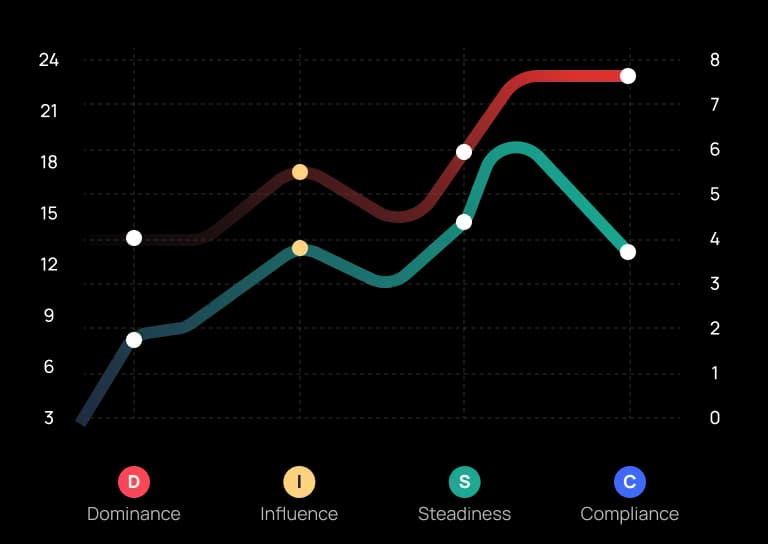
Represents your instinctive behaviors and desires.
Shows the behavioral tendencies you think you should exhibit in specific situations.
Related articles
You may also be interested in
 Self ExplorationNov 14, 2026
Conscientiousness: Meaning, Facets, and Test Guide
Conscientiousness explained: what the personality trait means, how high and low scorers differ, and ways to improve it. Start with the free test.
 Self ExplorationNov 14, 2026
Ambivert vs Omnivert: Meaning, Differences, Examples
Ambivert vs omnivert explained: meaning, key differences, real examples, and how to tell which social style fits you. Try the free DISC test.
 Self ExplorationNov 14, 2026
What Is an Extrovert? Meaning, Traits, and Types
Understand what an extroverted person is like, how extroverts and introverts differ, and what an extroverted introvert means. Try the free DISC test.
