


Table of content
Conscientiousness: Meaning, Facets, and Test Guide
Conscientiousness explained: what the personality trait means, how high and low scorers differ, and ways to improve it. Start with the free test.
Table of content
Conscientiousness is the Big Five personality trait that describes how organised, disciplined, and dependable a person is, and it explains why two people with identical goals often follow through at very different rates. The trait works like a project manager inside the mind, because it does not create ambition but decides which ambitions get scheduled, protected from distraction, and carried across the finish line. Researchers connect it with job performance, academic results, health habits, and relationship stability, although very high levels can also bring perfectionism and burnout. Knowing where you stand on the trait, and which of its six facets raise or lower your score, gives you a practical way to change routines instead of waiting for willpower to appear. Such knowledge serves students, employees, managers, and anyone building better habits.
What Is the Conscientiousness Personality Trait?
Conscientiousness is the personality trait that reflects how organised, responsible, disciplined, and goal-directed a person tends to be. It forms one of the five dimensions of the Big Five model, alongside openness, extraversion, agreeableness, and neuroticism. Twin research suggests that roughly 40 to 50 per cent of the differences between people trace back to genetics.
Environment, habits, and deliberate effort account for the rest of the differences, which is why the trait responds to routines and surroundings more than to pep talks. Twin studies such as the 1996 work by Jang and colleagues placed heritability close to that range, so genes set a starting point without fixing the outcome.
Roberts and Mroczek reported in 2008 that average conscientiousness rises through the twenties and thirties and keeps climbing into middle age. Rank order stays fairly stable at the same time, so many people become somewhat more conscientious with age without changing places relative to their peers.
Personality rank stays steady across decades, yet habits and surroundings remain open to deliberate change. Lasting progress therefore comes from adjusting routines more than from waiting for new impulses.

What Does Conscientiousness Mean?
Conscientiousness means acting with care, effort, and a firm sense of duty toward work and obligations. The word grows out of conscience, the inner sense of what is right and fair, which is why a conscientious person double-checks reports, keeps promises, and treats others honestly.
The adjective conscientious describes the person, the adverb conscientiously describes how an action is carried out, and the noun conscientiousness names the quality itself. Close synonyms include diligent, thorough, careful, painstaking, and dutiful, although each carries a slightly different shade of meaning.
In everyday speech, a conscientious student turns in assignments on time and studies with care, while a conscientious employee verifies reports and arrives prepared. Understanding the conscientiousness meaning in both senses helps, because psychologists use the same word more precisely, as a measurable trait that varies from low to high across the population, so a score describes tendencies rather than moral worth.
Where Does Conscientiousness Fit in the Big 5 Model?
Conscientiousness is one of the five broad dimensions in the Big Five personality traits model, often remembered by the acronym OCEAN for openness, conscientiousness, extraversion, agreeableness, and neuroticism. Researchers use the framework widely because it measures each trait on a continuous scale rather than sorting people into fixed types.
The conscientiousness personality trait rarely acts alone, because the five dimensions interact. High conscientiousness combined with high neuroticism can produce anxious perfectionism, whereas high conscientiousness paired with high openness often channels structure toward creative projects. Low conscientiousness combined with high extraversion can look like charming spontaneity that struggles with deadlines.
Some readers compare the trait with DISC styles, since the C style also values structure and the S style values steadiness. DISC and the Big Five come from different models, so the match is loose, and neither instrument replaces the other.
What Are the Facets of Conscientiousness?
Conscientiousness has six facets in the Revised NEO Personality Inventory, namely order, achievement striving, self-discipline, competence, dutifulness, and deliberation. Each facet captures a narrower habit, which explains why a person can keep a spotless desk yet procrastinate, or work extremely hard inside a cluttered room.
| Facet | What it describes | High score tends to | Low score tends to |
|---|---|---|---|
| Order | Preference for a neat, structured environment | Label files, keep routines, and feel unsettled by clutter | Work comfortably in loose structure and improvise |
| Achievement striving | Pull toward ambitious goals | Pursue excellence, recognition, and promotion | Feel content with a good enough result and value inner rewards |
| Self-discipline | Ability to keep going when work turns boring or hard | Push through tedious tasks and delay gratification | Find tasks that fail to hold attention hard to finish |
| Competence | Belief that you can handle what comes your way | Approach challenges with confidence | Doubt their own skills in unfamiliar situations |
| Dutifulness | Commitment to rules and obligations | Keep promises even when it is inconvenient | Bend rules that seem unfair |
| Deliberation | Habit of thinking before acting | Weigh options and consequences first | Act quickly and adapt along the way |
DeYoung and colleagues proposed in 2007 that the trait also splits into two broader aspects, orderliness and industriousness. Orderliness covers structure and planning, while industriousness covers hard work and persistence, and the two can move in different directions.
A low score on a facet does not signal weakness in every case. Competence, for example, reflects confidence more than ability, so a highly skilled person can still score low when facing unfamiliar situations.
How Do High and Low Conscientiousness Differ?
High scorers plan, arrive on time, and follow through on commitments, while low scorers stay flexible and respond to whatever is in front of them. Neither pattern is automatically better, because each fits different settings, and a low score does not mean laziness or irresponsibility.
| Area | High conscientiousness | Low conscientiousness |
|---|---|---|
| Planning | Plans ahead and uses calendars and lists | Prefers to decide in the moment |
| Deadlines | Finishes early or on time | Often performs well under last-minute pressure |
| Rules | Follows procedures closely | Bends rules that seem pointless |
| Change | Can struggle when plans fall apart | Adapts quickly to surprises |
| Loose ends | Feels uneasy about a missed obligation | Feels relaxed about unfinished items |
Lower conscientiousness can be an advantage in improvisational work, in fast-changing roles such as emergency response, and in settings where schedules stay flexible. Highly conscientious people may struggle in those settings when goals remain vague, or plans keep collapsing.
A highly conscientious project manager and a less conscientious creative strategist can each add real value in the right role. Fit between the trait and the task matters more than the score itself.
What Is Conscientiousness in the Workplace?
Conscientiousness in the workplace is the habit of planning work, keeping commitments, and finishing tasks with care. It appears as meeting deadlines, checking details, and problems raised early. A 1991 research review by Barrick and Mount found the trait related to job performance across every occupational group they studied.
What does high conscientiousness look like at work?
High conscientiousness shows up in observable work habits that managers can recognise quickly. Typical behaviours include the following.
- Employees deliver projects on time or early without constant supervision.
- They keep promises, take ownership of tasks, and honour commitments to colleagues.
- They hold high standards and double-check details before work leaves their desk.
- They notice issues early and tell the team before small problems become crises.
- They keep workspaces, schedules, and project trackers organised.
How does conscientiousness benefit teams and organisations?
Managers can count on conscientious employees to finish work to a consistent standard, even in remote or hybrid settings where direct oversight is limited. Such employees also tend to cooperate with colleagues, act with integrity, and avoid counterproductive behavior such as unjustified absences, which lowers risk for the organisation.
What are the downsides of conscientiousness at work?
Perfectionism can lead conscientious workers to spend too much time on minor details and to resist changes in plan. Burnout risk also rises because they rarely complain, so workload can quietly expand until rest begins to feel like guilt.
Managers can reduce these risks by setting clear definitions of finished work, scheduling recovery time, and rewarding adaptation as well as accuracy. Employees with lower scores usually benefit from visible deadlines, written priorities, and accountability partners.
Why Does Conscientiousness Predict Success, Health, and Relationships?
Conscientiousness predicts outcomes in school, work, health, and relationships because it drives consistent planning, effort, and self-control over many years. Small habits such as showing up prepared, taking medication as prescribed, and keeping promises compound over time, turning a modest personality difference into a measurable gap in results.
How does conscientiousness affect academic success?
A 2009 research review by Poropat found that conscientiousness relates to academic performance independently of intelligence, which means effort and organisation add something that ability alone does not. Intelligence opens doors, while conscientiousness helps students walk through them.
How does conscientiousness affect health and longevity?
The Terman Life Cycle Study began in 1921 and followed participants for decades, and Friedman and colleagues found that children rated as more conscientious tended to live longer. A 2008 review by Kern and Friedman confirmed a small but reliable link between the trait and longevity, and conscientious adults tend to smoke less, drive more carefully, and use preventive care.
How does conscientiousness affect relationships?
Partners value reliability, and Roberts and colleagues reported in 2007 that higher conscientiousness was associated with a lower risk of divorce. Following through on small commitments builds trust over time, which supports relationship satisfaction.
What Are the Downsides of High Conscientiousness?
High conscientiousness is a strength that carries four costs when it runs unchecked, namely perfectionism, burnout, rigidity, and harsh judgment of others. Each cost grows when rest, flexibility, and boundaries are missing, so awareness of the pattern matters as much as the score itself.
- Anxious perfectionism appears when high conscientiousness combines with high neuroticism, which fuels rumination and harsh self-criticism.
- Burnout develops when drive outruns rest, so work expands to fill every hour.
- Rigidity slows adaptation when a strong habit of following rules meets a fast-changing situation.
- Harsh judgment of others occurs when high scorers underestimate how hard self-control feels to other people and label them lazy.
Such patterns describe tendencies rather than diagnoses, and persistent distress deserves attention from a licensed professional. Educational content about personality traits cannot replace clinical care.
What Does a Conscientiousness Test Measure?
A conscientiousness test is a questionnaire that asks you to rate statements about planning, organisation, persistence, and follow-through, then converts your answers into a score. Established Big 5 instruments produce a domain score for conscientiousness, and fuller versions such as the NEO-PI-R also report scores for each facet.
What are typical conscientiousness test questions?
Typical items ask how well a statement describes you on a scale from strongly disagree to strongly agree. Examples include the following statements.
- I put my files and tools in the same place every time.
- I finish tasks even when they become boring.
- I think through consequences before I act.
- I meet deadlines without needing reminders.
- I set goals and track my progress toward them.
How do you read your conscientiousness score?
| Score range | What it often looks like | Useful next step |
|---|---|---|
| Lower third | Flexible and spontaneous, with more trouble finishing long or boring tasks | Add structure through reminders, deadlines, and if-then plans while keeping the flexibility that suits creative work |
| Middle range | Balanced planning and adaptability, with strengths that vary by situation | Check individual facet scores to find where discipline slips or rigidity creeps in |
| Upper third | Organized, dependable, and driven, with a higher chance of perfectionism and overwork | Define when work is finished, schedule recovery time, and practice tolerating small errors |
Test results reflect how you see your own behaviour, so they serve as a starting point rather than an objective measurement. Retaking a test after several months and comparing it with feedback from a colleague or partner gives a fuller picture.
How Can You Improve Conscientiousness?
You can improve conscientiousness by changing routines and surroundings rather than waiting for impulses to change, because personality shifts slowly while habits respond to structure. Five methods work well together, namely picking one facet, using if-then plans, shaping your environment, adding accountability, and building simple weekly rituals.
- Pick one facet. Start with a facet where your score runs low, such as order or self-discipline, instead of trying to raise the whole trait at once.
- Use if-then plans. Gollwitzer introduced implementation intentions in 1999, and specific plans such as drafting the report right after lunch improve follow-through while reducing reliance on willpower.
- Shape your environment. Laying out gym clothes the night before, setting phone reminders for recurring tasks, and automating bill payments let structure do part of the work.
- Add accountability. Deadlines, accountability partners, and public commitments are widely used tools, not signs of weakness.
- Build simple rituals. Planning the week on Sunday, finishing one task before starting another, and reviewing open tasks at the end of each workday create a steady rhythm.
Change is realistic but gradual. Hudson and Fraley reported in 2015 that people who worked deliberately on a trait described measurable change after several weeks, although the evidence rests on self-reports and the effects are modest.
Habit research points the same way. Lally and colleagues found in 2010 that a new habit took 66 days on average to become automatic, with individual cases ranging from about 18 to 254 days, so patience matters more than intensity.
Frequently Asked Questions About Conscientiousness
What is conscientiousness personality?
Conscientiousness is one of the Big Five personality traits, and it reflects a tendency to be organised, responsible, hard-working, and disciplined in pursuit of goals. People high in the trait plan ahead, keep promises, and resist short-term temptations, while people low in it prefer flexibility and decide in the moment.
What does conscientious mean?
Conscientious is an adjective for a person who puts care, effort, and thought into work and responsibilities, guided by a sense of what is right and fair. A conscientious worker double-checks reports and arrives on time, and a conscientious student studies carefully and submits assignments when due.
What is conscientiousness in the workplace?
Conscientiousness in the workplace is the habit of planning work, keeping commitments, and finishing tasks with care. It appears as meeting deadlines, high standards, and early warnings about problems, and it lowers risk for teams, although too much of it can bring perfectionism and burnout.
What Should You Do With Your Conscientiousness Score?
Conscientiousness serves a person well when it is treated as a set of habits you can adjust rather than a label you must accept. A reasonable next step is to identify the facet that limits your follow-through, apply one if-then plan to it this week, and review the result after a month. Because Big Five scores describe tendencies, they become more useful when paired with a clear picture of how you behave day to day, including your pace, your work style, and your approach to rules. The free DISC personality test on DISC Personalities offers that behavioural view, and it complements what a Big Five questionnaire shows about planning and persistence. Take the test, compare both pictures, and use the gap between them to choose where to build structure next.
- Website: DISC Personalities
- Phone: Call (+84) 286 270 5825


DISC Team is a content writing team for tracnghiemtinhcach.vn, focusing on the DISC model, communication styles, and teamwork. The team aims to explain concepts in accessible language, helping readers connect them with situations in their work and everyday lives.
View author profile

Don't Let Your Potential Stay Hidden!
Take the DISC test today and discover your unique 'YOU', with deep insights into your true personality and potential.
 Understand yourself
 Choose the right career
 Suggest effective communication
 Reduce negative emotions
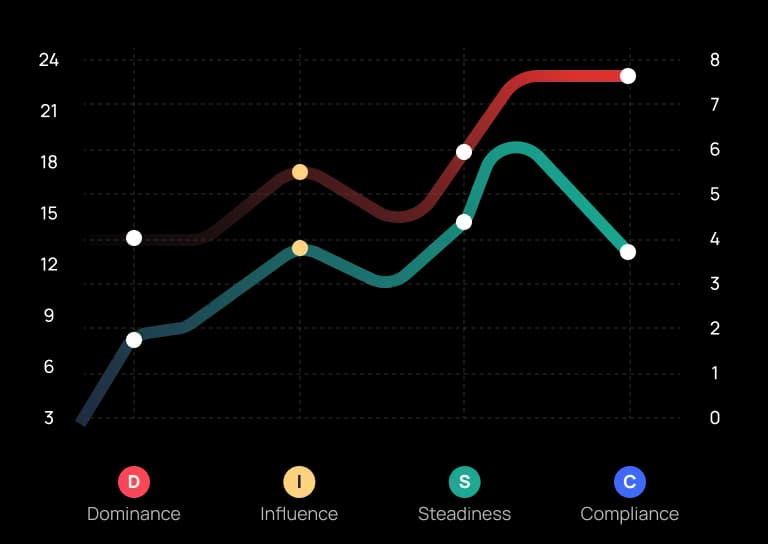
Represents your instinctive behaviors and desires.
Shows the behavioral tendencies you think you should exhibit in specific situations.
Related articles
You may also be interested in
 Self ExplorationNov 14, 2026
Type A Personality: Traits, Health Risks, and Types B, C, D
Type A personality explained: core traits, health effects, who is happier, and how to manage urgency. Take the free DISC test to learn more.
 Self ExplorationNov 14, 2026
Ambivert vs Omnivert: Meaning, Differences, Examples
Ambivert vs omnivert explained: meaning, key differences, real examples, and how to tell which social style fits you. Try the free DISC test.
 Self ExplorationNov 14, 2026
What Is an Extrovert? Meaning, Traits, and Types
Understand what an extroverted person is like, how extroverts and introverts differ, and what an extroverted introvert means. Try the free DISC test.
