


Table of content
Ambivert vs Omnivert: Meaning, Differences, Examples
Ambivert vs omnivert explained: meaning, key differences, real examples, and how to tell which social style fits you. Try the free DISC test.
Table of content
Ambivert vs omnivert is a comparison between two social styles that both sit between introversion and extroversion, yet behave very differently over time. An ambivert holds a steady middle position and adjusts gently to each situation, while an omnivert swings between strongly introverted and strongly extroverted days depending on mood, energy, and company. Many people confuse the two because each can look outgoing at a party and withdrawn the next morning, so the labels often get mixed up in conversation and online quizzes. Below you will find the ambivert vs omnivert meaning, the difference between omnivert and ambivert in daily life, real examples, the research behind each label, and a practical way to check your own pattern with a free DISC personality test.
What Is the Ambivert vs Omnivert Meaning?
The ambivert vs omnivert meaning comes down to stability. An ambivert stays near the middle of the introversion and extroversion scale and shifts a little between settings. An omnivert moves between the two far ends, acting strongly extroverted at one time and strongly introverted at another, often within the same week.
Both words describe people who are not clearly introverts or extroverts. The first is an established idea in personality research, whereas the second is an informal label that became popular online. Because of that gap, it helps to treat ambiversion as a trait position and omniversion as a description of habits.
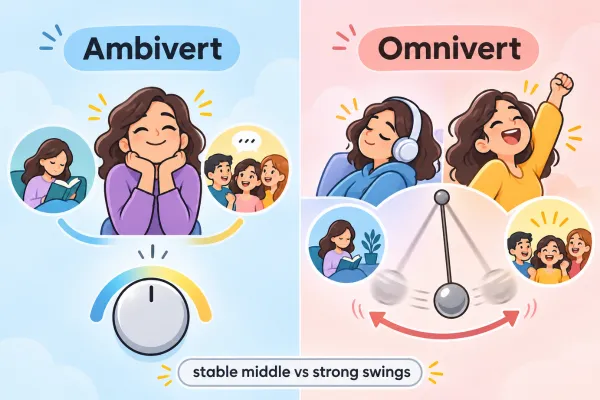
A simple way to picture the contrast is a volume knob and a pendulum. The ambivert is a knob resting near the middle that turns slightly up or down for the room. The omnivert is a pendulum that swings far to one side and then far to the other, and the swing often feels natural to the person even when others find it surprising.
What Is an Ambivert?
An ambivert is a person who shows a balanced mix of introverted and extroverted traits and sits near the centre of the spectrum. Ambiverts enjoy company and solitude in similar amounts, adapt to the setting, and keep a fairly steady mood. Their social energy rises and falls gently, without sharp reversals.
Psychologists describe ambiversion as falling more or less in the middle of a continuous scale. Most modern trait theories measure extraversion as one dimension, so many people land near the centre and not at either end. Ambiverts are therefore common, which also explains why the label feels familiar to so many readers.
Signs of an Ambivert
An ambivert often enjoys a lively dinner and a quiet evening about equally, and rarely feels strong dread or strong excitement about invitations. Friends describe them as easy to be around because they can talk or listen as the moment requires. After a busy week, they want some rest, but the need is mild and predictable.
Ambiverts also tend to read the mood of a group and match it. In a loud gathering, they join in, and in a calm one they lower their own volume. Their energy after social time stays fairly even, so they seldom cancel plans they looked forward to.
What Is an Omnivert?
An omnivert is a person who alternates between strongly introverted and strongly extroverted modes instead of staying near the middle. One day they want to talk with everyone, and another day they want almost no contact. The term is informal and is not a recognised category in personality psychology.
Omniverts usually say the swings feel like a response to their inner needs and not a conscious choice. The pattern can depend on mood, stress, sleep, the people present, or how familiar a place feels. Because the label is not formally measured, the safest way to use it is as a way to describe your own habits.
Signs of an Omnivert
An omnivert may feel like the most outgoing person in a room on Friday and want a silent weekend on Saturday. They often surprise themselves by cancelling plans they were excited about a few days earlier. Friends who meet them in different phases may describe them in opposite ways.
Omniverts also tend to behave differently with different groups. They may speak freely with close friends, then go quiet around strangers, and later become the centre of attention at a work event. Understanding these patterns helps them plan their calendar around energy instead of guilt.
What Is the Difference Between Omnivert and Ambivert?
The difference between omnivert and ambivert lies in range and predictability. Ambiverts move within a narrow band around the middle and behave consistently, while omniverts travel across the whole scale and can look quite different from one day to the next. Both mix introverted and extroverted traits, but they do it in different rhythms.
| Area | Ambivert | Omnivert |
|---|---|---|
| Position on the scale | Near the middle | Moves between both ends |
| Energy pattern | Steady, with small shifts | Uneven, with large swings |
| Predictability | Others can usually guess their mood | Others often find the changes surprising |
| Social planning | Rarely cancels plans | May feel strong urges to withdraw or join in |
| Public speaking | Consistent, often balanced | Varies with the day |
| Personality test results | Scores near the middle | Scores change between attempts |
| Scientific status | Recognized trait position | Informal popular label |
Another way to see the difference is through effort. An ambivert usually keeps a stable baseline and adapts with little cost, whereas an omnivert may spend extra energy managing the gap between a high-energy day and a low-energy day. Neither pattern is a problem, and both can be handled with good planning.
Are Omnivert and Ambivert the Same?
No, omnivert and ambivert are not the same, although they overlap. Both describe people with a mix of introverted and extroverted traits. The first stays steady near the centre, while the second swings between extremes. Researchers recognise ambiversion, whereas omnivert is an informal term without its own measurement scale.
People often wonder whether they can be both. A fair answer is that the labels describe different patterns, so one person usually fits one better than the other. Even so, behaviour changes with age, stress, and life stage, so someone may feel closer to an ambivert in a calm year and closer to an omnivert during a demanding one.
Are omnivert and ambivert the same in everyday speech? Many people use the words interchangeably, which is why the confusion is so common. Choosing the label that matches your day-to-day rhythm is more useful than arguing over definitions, because the goal is understanding your own energy.
What Are Ambivert vs Omnivert Examples in Real Life?
Ambivert vs omnivert examples show up at work, with friends, at events, and online. In each setting, the ambivert behaves with a steady, flexible style, while the omnivert shows a sharper contrast between high-energy and low-energy days. The scenarios below use ordinary situations so you can compare them with your own habits.
At Work
An ambivert on a project team contributes in meetings, then sits down for focused solo work without much adjustment. Their level of participation stays consistent from week to week. An omnivert may lead the discussion on Tuesday, then barely speak on Thursday and prefer to answer by message.
With Friends and Family
An ambivert enjoys a family dinner and is equally happy to leave after a couple of hours. An omnivert may stay late and tell stories at one gathering, then decline the next invitation because they feel emotionally full. Relatives who see just one side may describe the same person in very different ways.
At Events and Networking
At a conference, an ambivert meets a few new people, attends a talk, and returns to the hotel feeling comfortably tired. An omnivert might work the room for hours on the first evening, then skip the second day social events and rest alone. Both are normal, and both can plan around their natural pattern.
An ambivert adjusts the volume for the room, while an omnivert changes the whole station depending on the day. Neither approach is a flaw, and each works better when you know what to expect from yourself.
In Messages and Online Spaces
An ambivert answers messages at a steady pace and joins group chats at a similar rate. An omnivert may reply with long, energetic messages for a few days, then go quiet for several. Friends who understand the pattern learn to treat silence as rest and not as a sign of distance.
What Does Science Say About Ambiverts and Omniverts?
Research supports ambiversion as a position on a continuous extraversion scale, whereas omniversion has no formal research base. Current personality science treats extraversion as a trait measured in degrees, so most people fall in the middle. The omnivert label remains a popular way to describe large swings in social energy.
The Big Five model measures extraversion on a continuous scale, which means scores fall along a spectrum and not into two boxes. The Big Five personality traits describe extraversion through qualities such as gregariousness, assertiveness, excitement seeking, warmth, activity, and positive emotions. A person with moderate scores across these qualities fits the ambivert description.
Historical sources trace the idea in two steps. According to reference summaries of extraversion and introversion, the concept of ambiversion was proposed by Edmund Smith Conklin in 1923 and became popular after Adam Grant published research on it in 2013. The word ambivert itself is credited to Kimball Young, who used it in a 1927 source book.
Grant's 2013 study of call centre staff suggested that people with mid-range extraversion sold more than strong introverts and strong extroverts, although later large-sample research suggests the effect is narrower than first reported. Another study found that students who scored as ambiverts did better academically than introverts or extroverts. Findings like these are interesting, but they do not prove that ambiverts are better at everything.
Research on everyday behaviour also helps explain the omnivert experience. A well-known study by Fleeson and Gallagher in 2009 found that people vary a lot in how extroverted they act from moment to moment, and that extroverts and introverts differ by a small margin in how often they act extroverted. In other words, behaviour changes with context for nearly everyone, and the swings extroverts describe are an exaggerated version of a common human pattern.
Labels are useful when they help you understand your habits and unhelpful when they become a verdict. Treat ambivert and omnivert as starting points for reflection and keep watching how you actually behave.
The popular Myers-Briggs system adds another wrinkle. The Myers-Briggs Type Indicator assigns a single letter for introversion or extraversion, so people near the middle or with swings often feel that no option fits. Scores near the middle can flip between attempts, which is one reason ambiverts and omniverts both report inconsistent results.
How Do You Know If You Are an Ambivert or an Omnivert?
You can tell whether you are an ambivert or an omnivert by tracking how stable your social energy is across weeks, not days. A steady middle pattern points to ambiversion, while strong swings between craving company and needing solitude point to the omnivert pattern. No single quiz settles the question, so combine several observations.
- Track your energy for two to four weeks. Note each day whether you wanted company or quiet, and look for a pattern of small changes or large reversals.
- Compare similar situations. Ask whether you react the same way to the same kind of event on different days, since an omnivert often reacts very differently.
- Notice how you feel about plans. If you often feel excited and then want to cancel, or the reverse, that points toward bigger swings.
- Ask people who know you. Friends from different parts of your life may describe you as outgoing or reserved, which can reveal how much your style shifts.
- Take a structured assessment such as the free DISC test on DISC Personalities, and compare the result with your journal before concluding.
Remember that mood, stress, and sleep all affect how social you feel. A rough month can make anyone look like an omnivert, so give the pattern time before settling on a label. If your swings feel distressing or interfere with daily life, speaking with a licensed professional is a sensible next step.
What Are the Benefits and Challenges of Each Type?
Ambiverts benefit from flexibility and steadiness, while omniverts benefit from depth in both modes. Each type also faces a challenge, since ambiverts may feel pressure to keep everyone comfortable and omniverts may struggle to explain their changes to others. Knowing both sides helps you use your style well.
Benefits of Being an Ambivert
Ambiverts adapt easily to teams, clients, and family settings. They can listen and speak in balanced amounts, which helps them bridge introverted and extroverted colleagues. Their steady mood also makes them dependable in group situations.
Challenges of Being an Ambivert
Because ambiverts can fit in almost anywhere, other people may expect them to act as the peacemaker or the connector all the time. They can also struggle to find a clear label for themselves, since they do not feel strongly like either end. Setting clear boundaries keeps the role manageable.
Benefits of Being an Omnivert
Omniverts can fully enjoy both modes. On high-energy days, they bring enthusiasm and presence, and on low-energy days they bring focus and reflection. Many find that this range makes them good at both collaborative and independent work when they plan around it.
Challenges of Being an Omnivert
Omniverts can feel guilty about cancelling plans or confuse others with sudden changes. Their results on personality tests may vary, which can feel frustrating. Sharing a simple explanation with friends and colleagues, such as saying you need a quiet day to recharge, reduces misunderstandings.
How Can You Work and Live Well as an Ambivert or an Omnivert?
Living well with either style means planning around energy and communicating your needs. Ambiverts benefit from mixing social and quiet time on purpose, and omniverts benefit from keeping flexible schedules and honest conversations. The habits below are simple and can be adjusted to your own routine.
Plan Around Your Energy
Schedule demanding social events when your energy is naturally high, and keep recovery time open afterwards. Omniverts can leave one or two flexible slots each week so they do not feel trapped by plans. Ambiverts can use a regular rhythm, such as a social evening followed by a quiet one.
Communicate Your Pattern
A short and kind explanation saves a lot of confusion. You might tell a friend that you sometimes feel talkative and sometimes need space, and that neither mood is about them. People usually respond well when they understand what to expect.
Use Tools for Self-Awareness
A behaviour assessment can help you notice what drives your choices at work and in relationships. The free DISC test on DISC Personalities describes your style across four behaviour patterns, which makes it easier to talk about how you communicate and decide. Use the result as a conversation starter and not as a fixed label.
Frequently Asked Questions About Ambiverts and Omniverts
Are omnivert and ambivert the same?
No, they are not the same, although both describe people who mix introverted and extroverted traits. An ambivert stays steady near the middle of the scale, while an omnivert swings between strongly introverted and strongly extroverted modes. Ambiversion is recognised in research, whereas omnivert is an informal label used in everyday conversation.
Am I an ambivert or an omnivert?
You are probably an ambivert if your social energy stays fairly steady and adapts gently to each situation. You may be an omnivert if you swing between wanting lots of company and needing time alone. Track your energy for a few weeks and compare it with a structured test before choosing.
Can I be ambivert and omnivert?
Formally, the two labels describe different patterns, so most people fit one better than the other. Even so, many people feel they relate to both depending on the season, stress level, or life stage. Treat the labels as flexible descriptions of habits and notice which one explains your behaviour most often.
What is the difference between an ambivert and an omnivert?
The difference is range and predictability. Ambiverts stay close to the centre and behave consistently, while omniverts travel between the two far ends and can look very different from one day to the next. Both mix introverted and extroverted traits, but they do so with different rhythms and levels of intensity.
Is omnivert a real psychological term?
Omnivert is not a formally recognised category in personality psychology. It is an informal label popular online, while ambiversion is accepted as a position on the extraversion scale. The word can still help with self-reflection, as long as you treat it as a description of habits and not as a diagnosis.
Are most people ambiverts?
Many people sit near the middle of the extraversion scale, which is why ambiversion is common. Trait models treat extraversion as a continuous dimension, so scores cluster toward the centre and thin out at the extremes. Exact percentages vary by study and measure, so avoid relying on a single figure.
Can an omnivert become an ambivert?
Personality is fairly stable, but behaviour can change with practice and circumstances. An omnivert may learn to soften the swings through routines, rest, and planning, and may feel more steady over time. Whether that counts as becoming an ambivert depends on how you define the labels.
Is an ambivert the same as an extroverted introvert?
They are closely related, because both describe people who act outgoing but need quiet to recover. An extroverted introvert leans introverted at its core, while an ambivert sits near the centre. Many people use the terms loosely, so the exact label matters less than the pattern you notice.
Final Thoughts on Ambivert vs Omnivert
The ambivert vs omnivert question is really a question about rhythm. Ambiverts keep a steady middle position, omniverts move between strong highs and lows, and both are normal ways to mix introverted and extroverted traits. The more useful step is to watch your own energy over several weeks, notice what drains and restores you, and plan your days with that pattern in mind, since self-awareness makes every social choice easier and kinder to yourself. If you want a clearer picture of how you communicate and make decisions, you can take the free DISC test on DISC Personalities and use the result to start a conversation with friends or colleagues. For questions about the tests or the business suite, contact the DISC Personalities team through the details below.
- Website: DISC Personalities
- DISC Test: Take the free DISC test
- Email: Write to admin@discpersonalities.com
- Phone: Call (+84) 286 270 5825



DISC Team is a content writing team for tracnghiemtinhcach.vn, focusing on the DISC model, communication styles, and teamwork. The team aims to explain concepts in accessible language, helping readers connect them with situations in their work and everyday lives.
View author profile

Don't Let Your Potential Stay Hidden!
Take the DISC test today and discover your unique 'YOU', with deep insights into your true personality and potential.
 Understand yourself
 Choose the right career
 Suggest effective communication
 Reduce negative emotions
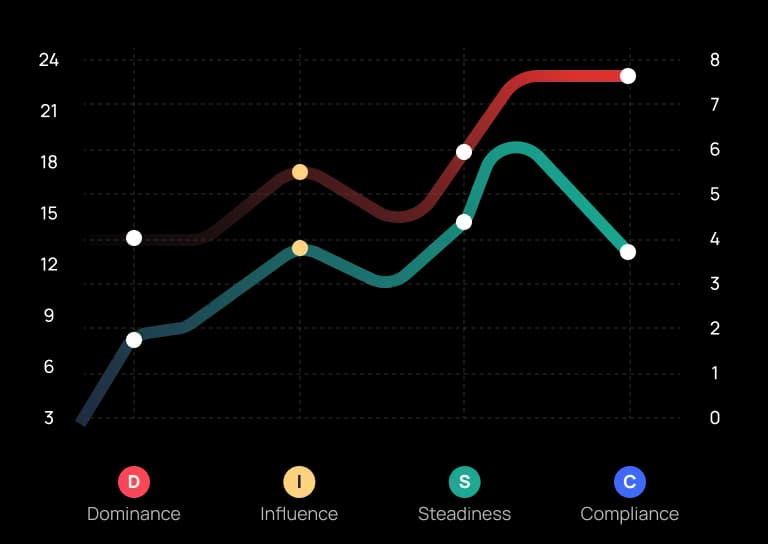
Represents your instinctive behaviors and desires.
Shows the behavioral tendencies you think you should exhibit in specific situations.
Related articles
You may also be interested in
 Self ExplorationNov 14, 2026
What Is an Extrovert? Meaning, Traits, and Types
Understand what an extroverted person is like, how extroverts and introverts differ, and what an extroverted introvert means. Try the free DISC test.
 Self ExplorationSep 28, 2026
What Is Self-Awareness and How Can You Develop It?
Discover what self-awareness means, how it shapes your thoughts and behavior, and practical ways to make better decisions and more.
 Self ExplorationSep 16, 2026
Introvert vs Extrovert: Which One Are You?
Are you an introvert, extrovert, or ambivert? See how energy, behavior, and environment shape your personality style, with traits and subtypes.
