


Table of content
SD Personality Type: Traits, Strengths and Careers
Learn what the SD personality type means in DISC: Core traits, strengths, blind spots and careers. Take the free DISC test to find your blend.

Table of content
The SD personality type is a DISC blend in which Steadiness (S) is your strongest style and Dominance (D) is your second. It describes someone who looks calm, patient and loyal on the surface but carries a quiet drive to finish what they start. SDs keep teams steady when plans shift, and they move work forward without making noise about it. This guide explains the core traits, strengths, blind spots and careers that fit the SD blend. It also shows how SD differs from DS and SC, where the DISC model comes from, and what a DISC result can and cannot tell you.
What Is the SD Personality Type?
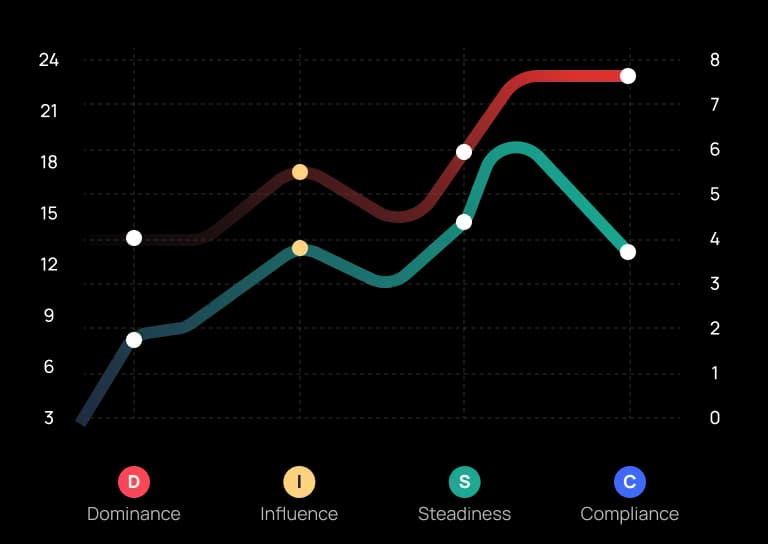
The SD personality type is a DISC profile where Steadiness scores highest and Dominance scores second. It combines the patience, consistency and loyalty of the S style with the decisiveness and results focus of the D style. On a DISC graph, it shows up as a high S point with a strong D point close behind it.
The order of the letters matters. Your first letter is your primary style, the one you fall back on without thinking. Your second letter is your secondary style, which shapes how the primary style shows up. In an SD, Steadiness sets the tone and Dominance gives it direction. Influence (I) and Compliance (C) usually sit lower. A lower score is not a weakness. It simply shows where you spend less energy.
| DISC style | Core focus | Role in an SD profile |
|---|---|---|
| Dominance (D) | Results, challenge, control | Secondary: Adds decisiveness and follow-through |
| Influence (I) | People, enthusiasm, persuasion | Usually lower: Reserved with words, rarely seeks the spotlight |
| Steadiness (S) | Stability, cooperation, consistency | Primary: Sets a calm, patient, sustainable pace |
| Compliance (C) | Accuracy, rules, quality | Usually lower: Prefers practical outcomes to detailed procedures |

Where the SD Blend Comes From
Psychologist William Moulton Marston described four patterns of human behavior in his 1928 book Emotions of Normal People. His original labels were Dominance, Inducement, Submission and Compliance. Marston did not create a test. Later psychologists turned his ideas into self-report questionnaires, and modern versions renamed some styles, which is why you now see Influence and Steadiness. Scoring all four styles at once made it possible to read the top two together, and that is where blends like SD come from.
Today the DISC assessment is a family of tests rather than one product. "DISC" refers to the general model, which no single company owns. "DiSC" with a lowercase i and "Everything DiSC" are trademarks of John Wiley & Sons and refer to that company's own assessments. Different DISC tests use different questions, labels and blend names. An SD on one test may carry a different nickname on another, but the underlying pattern stays the same: Steadiness first, Dominance second.
What Are the Core Traits of the SD Personality Type?
The core traits of the SD personality type are patience, reliability, quiet determination and strong loyalty. SDs prefer a stable pace and clear commitments, but unlike a pure S style, they also want visible progress. They tend to speak less, decide carefully, and then hold their position once they commit.
The two styles in an SD pull in a useful direction together. Steadiness wants continuity, trust and a pace people can sustain. Dominance wants that stability to produce something finished. The result is a person who picks a direction, commits to it and keeps moving after others lose interest.
| Trait area | From Steadiness (primary) | From Dominance (secondary) |
|---|---|---|
| Pace | Even and sustainable | Pushes toward a clear finish line |
| Decisions | Careful, considers people | Firm once made |
| Communication | Calm, listens first | Direct when the stakes are high |
| Under pressure | Stays level | Digs in and works harder |
| Motivation | Security and trust | Visible, measurable results |
What Motivates an SD
- Stable ground: Clear goals, consistent priorities and agreements that hold.
- Trust: Colleagues and managers who keep their word.
- Responsibility: Ownership of work they can see through from start to finish.
- Progress: Proof that steady effort is producing results.
What an SD Tends to Avoid
SDs feel uneasy when the ground shifts without warning. Sudden reversals, broken promises, plans that change several times in a week and long meetings that end without a decision all drain their energy. Because Influence usually sits lower in this blend, SDs also tend to avoid the spotlight. They rarely campaign for credit, and they often decide whether something is worth saying before they say it.

What Are the Strengths of an SD Personality?
The strengths of an SD personality are steady follow-through, calm under pressure and dependable judgment. SDs keep long projects moving after the early excitement fades. They absorb stress without spreading it to others, and because they speak up selectively, their input tends to carry weight. Teams often rely on SDs to finish what others start.
The Dominance in this blend keeps Steadiness from turning into simple maintenance. SDs do not just hold things in place. They set a direction and keep going through the slow middle of a project, the stretch where enthusiasm is gone and the finish is still far away.
- Follow-through: They finish long, low-visibility work without needing applause.
- Composure: They stay level when deadlines tighten, which helps others stay calm.
- Practical decisions: They weigh options carefully, then commit and act.
- Loyalty: They defend their team and keep commitments after they become inconvenient.
- Consistency: Their pace is predictable, so others can plan around it.
Steadiness gives the SD its calm. Dominance makes sure that calm is going somewhere.

What Are the Blind Spots of an SD Personality?
The blind spots of an SD personality are holding a position too long, taking on extra work without saying so, and keeping concerns private. These patterns grow from the same traits that make SDs reliable. Faster colleagues may read their careful pace as resistance, and their quiet disagreement can go unnoticed until it becomes a bigger problem.
Every DISC style has blind spots, and none of them make a style better or worse than another. For an SD, the main ones tend to look like this:
- Firmness that outlasts its usefulness: When change is truly needed, an SD may dig in and treat a good change like an unwelcome one.
- Silent overload: SDs often accept one more request, then another, until they carry more than anyone realizes.
- Unspoken frustration: The drive in an SD can turn inward as frustration they do not voice.
- Decisions without explanation: SDs may announce a conclusion without sharing the reasoning, which can look like stubbornness to others.
Growth Areas for SDs
- Explain the "why" behind your decisions, not only the decision itself.
- Flag workload early, while it is still easy to rebalance.
- Share progress along the way instead of only at the finish.
- When change arrives, ask what would make it workable before you decide to resist it.
- Give colleagues a chance to shape the plan with you.
How Is the SD Different From DS, S and SC?
The SD differs from the DS in the order of its two styles. In an SD, Steadiness leads and Dominance supports, so the pace is calm and deliberate. In a DS, Dominance leads, so speed and results come first. Compared with a pure S, the SD is firmer and more focused on outcomes.
The same two ingredients can produce very different working styles, depending on which one comes first. The table below compares the SD with the blends people confuse it with.
| Profile | Primary style | Secondary style | Typical pace | Main focus | How it differs from SD |
|---|---|---|---|---|---|
| SD | Steadiness | Dominance | Steady and deliberate | Stability that produces results | Baseline profile |
| DS | Dominance | Steadiness | Fast start, steady finish | Results with reliability | Drives first and steadies afterward |
| S | Steadiness | None strong | Calm and even | Harmony and support | Less push toward outcomes |
| SC | Steadiness | Compliance | Methodical | Accuracy and process | More attention to rules and detail |
| SI | Steadiness | Influence | Warm and relaxed | People and connection | More social, less direct |
Reading the SD next to its neighbors is a quick way to see what makes the blend distinct. You can explore each style in more detail on the DISC personality types page.
How Does the SD Personality Type Work on a Team?
An SD works on a team as a steady anchor who leads from the middle. SDs remove obstacles, keep commitments and help others stay calm when plans change. They cooperate fully when they trust the direction and resist quietly when they do not. That quiet resistance often signals a real problem worth checking.
The SD as a Leader
As a leader, an SD sets clear tasks, expects them to be done and works alongside the team. People learn to trust their word because it rarely changes without a reason. The common gap is communication. SDs may explain too little, change course slowly and miss signs that the team wants more discussion.

Under Pressure and in Conflict
Under pressure, SDs become firmer and quieter. They stick to the plan and work harder rather than louder. In conflict they rarely raise their voice, but they also rarely back down. They would rather absorb friction than escalate it, which keeps the peace in the short run but can bury the real issue.

SDs in Remote and Hybrid Teams
Remote work suits many SD strengths. SDs tend to deliver steady output without close supervision, and they handle asynchronous work well. The risk is visibility. In a remote setting, an SD's quiet can disappear entirely, and an overload that would be obvious in an office can stay hidden for weeks. A few habits help:
- Hold regular one-on-ones that include a direct question about workload.
- Share changes in writing, with the reason and the timeline.
- Ask SDs for short progress updates rather than waiting for the finished result.
- Invite their input before meetings, not only during them.
For HR teams and managers, Business Suite on discpersonalities.com shows DISC patterns across a whole team, which can make it easier to see where steady styles are carrying extra load. Use DISC results as one input alongside structured interviews and skills assessments, not as the sole basis for hiring or promotion decisions. Employers should also follow EEOC guidance on workplace assessments.
What Careers Fit the SD Personality Type?
Careers that fit the SD personality type reward consistency, responsibility and steady progress over time. Common examples include operations, project coordination, logistics, healthcare delivery, skilled trades, technical support and team supervision. These roles value reliability under pressure. A DISC profile describes fit and comfort, not ability or future success.
| Field | Example roles | Why it can suit an SD |
|---|---|---|
| Operations and logistics | Operations coordinator, supply chain planner, facilities manager | Long cycles reward steady execution |
| Project delivery | Project coordinator, implementation specialist | Keeps multi-month work on track |
| Healthcare and care services | Nurse, care coordinator, patient services lead | Calm under pressure and loyalty to people |
| Skilled trades and technical work | Electrician, field technician, IT support specialist | Practical results and consistent quality |
| Supervision | Shift supervisor, production supervisor, team lead | Leads by example with steady standards |
| Client relationships | Account manager, customer success manager | Trust that builds over years |
SDs can also succeed in fast, noisy settings. They usually need clear priorities and some recovery time to do it. If you are choosing a first career or planning a change, treat your DISC profile as one input next to your skills, interests, values and the real demands of the job. Talking to people already in the role will tell you more than any profile can.
How Do You Communicate With an SD?
Communicating with an SD works well when you give clear goals, a reason for any change and enough time to adjust. SDs respond to calm, direct conversations and honest updates. Ask them directly what they are carrying, because they seldom volunteer that they are overloaded, and do not read their silence as agreement.
Tips by DISC Style
| If your style is | What helps with an SD |
|---|---|
| Dominance (D) | Agree on the goal and the deadline, then let the SD choose the method. Avoid sudden reversals. |
| Influence (I) | Bring your ideas, but pair them with a plan. Give the SD time to respond instead of expecting an instant reaction. |
| Steadiness (S) | You share a calm pace, so someone needs to raise concerns first. Make it a habit to name problems early. |
| Compliance (C) | Agree on what "done" means at the start, and respect the SD's focus on practical results over extra detail. |
Tips for Managers of an SD
- Set a clear goal and trust them to deliver it.
- Explain changes early, with facts and a reason.
- Name what is staying the same, not only what is changing.
- Avoid shifting priorities without explanation.
- Keep your promises, since broken trust takes an SD a long time to rebuild.

How Can You Tell If You Are an SD?
You can tell you are an SD when your DISC results show Steadiness as your highest score and Dominance as your second highest, with Influence and Compliance lower. The size of the gaps matters. If your top scores sit close together, your profile may read as a different blend in a different setting.
- Take a DISC test when you are calm and have time to focus.
- Answer based on how you usually behave, not how you wish you behaved.
- Find your highest score: This is your primary style.
- Find your second highest score: This is your secondary style, which shapes how the first one shows up.
- Check the gap between S and D: If they are nearly equal, you may shift between SD and DS depending on the situation.
- Test the description against real life: Ask a colleague or friend whether it matches how you act.
What Can a DISC Profile Not Tell You?
A DISC profile cannot tell you your intelligence, values, mental health or future job performance. It describes observable behavior patterns based on your own answers at one point in time. Results can shift with stress, a new role or how candidly you answer, so treat the SD label as a starting point for reflection, not a fixed identity.
- Self-report: DISC reflects how you see yourself, which may differ from how others see you.
- Context: Many people behave differently at work, at home and under stress, and scores can move with those settings.
- Not a diagnosis: DISC describes behavior styles. It is not a clinical or psychological assessment.
- Not a hiring verdict: A DISC result shows communication tendencies, not skills, experience or potential.
- Ranges, not boxes: Two people labeled SD can still differ, because their lower scores and gaps differ.
A DISC result describes how you tend to act. It does not decide who you are allowed to become.
Other tools look at different areas. For example, an EQ test focuses on how you notice and manage emotions, which DISC does not measure.
How Does DISC Compare With MBTI and Type A/B Personality Models?
DISC differs from MBTI and the Type A/B model in what it measures. DISC describes observable work and communication behavior in four styles. The MBTI sorts preferences into 16 types based on ideas from psychiatrist Carl Jung. The Type A/B model came from 1950s heart health research on stress and competitiveness.
These models are often mixed up because they all use letters. The Myers-Briggs Type Indicator (MBTI) is a trademark of The Myers-Briggs Company. Type A and Type B personality theory began with cardiologists Meyer Friedman and Ray Rosenman. The "D" in DISC stands for Dominance and has nothing to do with Type D in health psychology.
| Model | What it describes | Categories | Origin | Common use |
|---|---|---|---|---|
| DISC | Observable behavior and communication style | 4 styles plus blends such as SD | William Moulton Marston, 1928 | Teamwork, communication, self-reflection |
| MBTI | Preferences in how people take in information and make decisions | 16 types | Isabel Briggs Myers and Katharine Cook Briggs, based on Carl Jung's ideas | Personal development |
| Big Five | Five broad personality traits measured on a scale | 5 trait dimensions | Academic personality research | Research and self-reflection |
| Type A/B (later C and D) | Reactions to stress and pressure | 2 original types, 2 added later | Meyer Friedman and Ray Rosenman, 1950s | Stress and health research |
An SD does not map neatly onto one MBTI type or onto Type B. An SD may look relaxed like a Type B, yet still hold firm deadlines and push for results. DISC, MBTI and Big Five answer different questions, so each describes a different slice of the same person.
What Should You Do With Your SD Result?
The SD personality type shows that calm and drive can live in the same person. Steadiness sets the pace, and Dominance makes sure that pace leads somewhere. If you recognize yourself here, the useful move is not to change your temperament. It is to raise concerns while they are still small, explain the reasoning behind your decisions, and let people see the load you carry. If you are not sure the label fits, check your own scores first. Take the free DISC test on discpersonalities.com and compare your top two styles with this profile.
Frequently Asked Questions About the SD Personality Type
Is the SD Personality Type Rare?
No public dataset gives a reliable share for the SD personality type, because each DISC test uses its own questions, scoring and sample. Steadiness-led profiles are widely reported in DISC results, so SD is not usually described as rare. Rarity also says nothing about value, since every blend brings its own strengths.
What Is the Difference Between SD and DS?
SD and DS share the same two styles in a different order. In an SD, Steadiness leads, so patience and stability set the tone while drive works underneath. In a DS, Dominance leads, so speed and results come first and steadiness keeps them grounded. The SD moves deliberately, while the DS pushes first and settles later.
What Careers Suit an SD Personality?
Careers that suit an SD personality include operations, project coordination, logistics, account management, healthcare delivery, skilled trades, technical support and team supervision. These roles reward consistency and follow-through under pressure. A DISC profile shows where you may feel comfortable, so weigh it alongside your skills, interests and values before choosing a path.
How Do I Get Along With an SD Coworker?
You get along with an SD coworker by being honest early, giving a reason for changes and allowing time to adjust. Ask directly how their workload looks, because SDs seldom raise it unprompted. Do not take their silence as agreement, and keep your commitments, since trust matters a great deal to this blend.
Can Your DISC Type Change Over Time?
Your DISC type can shift over time, especially your secondary style. Big changes such as a new role, a long stretch of stress or a new life stage can move your scores. Your primary style tends to stay more stable. Retaking the test after major changes helps you see whether your SD pattern still fits.
What Are the Top 3 Rarest Personality Types?
The three rarest personality types in the MBTI system are INFJ (about 1.5%), ENTJ (about 1.8%) and INTJ (about 2.1%), based on estimates published by the Myers & Briggs Foundation. These figures apply to the 16 MBTI types, not to DISC. DISC tests do not share one official frequency table, so SD has no matching percentage.
What Does Type A, B, C, D Mean?
Type A, B, C and D are labels from health psychology that describe how people react to stress. Type A is competitive and time-pressured, Type B is relaxed, Type C tends to hold emotions in, and Type D combines frequent worry with social inhibition. These labels are separate from DISC, where D stands for Dominance.
What DISC Type Is Elon Musk?
Elon Musk has not publicly shared results from a DISC assessment, so his DISC type is unknown. Online commentators often place his public behavior in the high D range, but those labels are outside guesses, not test results. DISC relies on a person's own answers, so a public persona is a weak basis for typing anyone.
What DISC Style Is Donald Trump?
Donald Trump has not publicly shared results from a DISC assessment, so his DISC style is unknown. Commentators often describe his public style as high D, but those labels are outside guesses based on public appearances, not test results. A reliable DISC profile depends on a person's own answers to the questionnaire.
Test results are for self-reflection and educational purposes. They are not a clinical or psychological diagnosis and do not replace advice from a licensed professional.
- Take the test: DISC Test
- Website: DISC Personalities
- Email: admin@discpersonalities.com


DISC Team is a content writing team for tracnghiemtinhcach.vn, focusing on the DISC model, communication styles, and teamwork. The team aims to explain concepts in accessible language, helping readers connect them with situations in their work and everyday lives.
View author profile

Don't Let Your Potential Stay Hidden!
Take the DISC test today and discover your unique 'YOU', with deep insights into your true personality and potential.
 Understand yourself
 Choose the right career
 Suggest effective communication
 Reduce negative emotions
Represents your instinctive behaviors and desires.
Shows the behavioral tendencies you think you should exhibit in specific situations.
Related articles
You may also be interested in
 DISCOct 30, 2026
CI Personality Type: Traits, Strengths and Careers
Learn what the CI personality type means in DISC: Core traits, strengths, blind spots and careers. Take the free DISC test to find your blend.
 DISCOct 30, 2026
DS Personality Type Explained: Drive Meets Patience
Learn what the DS personality type means in DISC: core traits, work strengths, blind spots and careers. Take the free DISC test to see your blend.
 DISCOct 29, 2026
IC Personality Type in DISC: Warmth Meets Precision
Learn what the IC personality type means in DISC: core traits, strengths, blind spots and careers. Take the free DISC test to find your blend.
