


Table of content
IC Personality Type in DISC: Warmth Meets Precision
Learn what the IC personality type means in DISC: core traits, strengths, blind spots and careers. Take the free DISC test to find your blend.

Table of content
Do you light up a meeting, then quietly fix every typo on your slides before anyone else notices? That mix has a name. The IC personality type is a DISC blend in which Influence is your strongest style and Conscientiousness, also called Compliance, comes a close second. ICs want their work to connect with people and to hold up under a close look. Below, you will learn how to spot an IC pattern in your results, why its two styles pull against each other, where ICs thrive at work, how to communicate with them, and what a DISC result can and cannot tell you.
What Is the IC Personality Type?
The IC personality type is a DISC blend in which Influence is your strongest style and Conscientiousness is your second strongest. It describes a person who is expressive and sociable but also careful about facts, quality and accuracy. In plain terms, an IC wants work that people enjoy and that also stands up to a close check.
The letters follow a simple rule. The first letter is your primary style, the one that shows up most often, and the second is the style that shapes it. The DISC model sorts behavior into four styles: Dominance (D), Influence (I), Steadiness (S) and Conscientiousness (C). Some assessments call the C style Compliance. Both names describe the same focus on accuracy, rules and quality.
So an IC is first an I: Sociable, optimistic and expressive. The strong C adds care, analysis and respect for facts. Dominance and Steadiness usually sit lower, which shapes how an IC leads and how they handle routine.
DISC describes observable behavior, not intelligence, values or worth. No style or blend is better than another. The IC personality type is one of several blended profiles that DISC reports use alongside the four single styles, and it reflects what comes to you naturally, not what you are able to learn.

What Are the Core Traits of the IC Personality Type?
The core traits of the IC personality type are enthusiasm, persuasion and sociability from the Influence side, plus precision, analysis and caution from the Conscientiousness side. ICs usually show these traits together: They explain ideas with energy, prepare carefully, notice small errors, and care how both the message and the details land with an audience.
| Source | Typical traits | What it looks like at work |
|---|---|---|
| High Influence (I) | Expressive, optimistic, persuasive, sociable | Opens a meeting with energy and tells the story behind the numbers |
| High Conscientiousness (C) | Precise, analytical, systematic, quality-minded | Checks figures twice and rewrites a slide until the wording is exact |
| Lower Dominance (D) | Prefers to persuade rather than command | Asks for buy-in instead of issuing orders |
| Lower Steadiness (S) | Fast-moving, variety-seeking | Gets restless during long stretches of the same task |
Two motivations sit underneath these traits. The I side wants recognition and connection. The C side wants to be accurate and to do things properly. DISC descriptions often link the I style to a fear of rejection and the C style to a fear of being wrong. In an IC, the two can combine, so criticism may feel like a judgment of both the work and the person who made it. Naming that pattern makes it easier to treat feedback as useful information.
How Can You Tell If Your DISC Results Show an IC Profile?
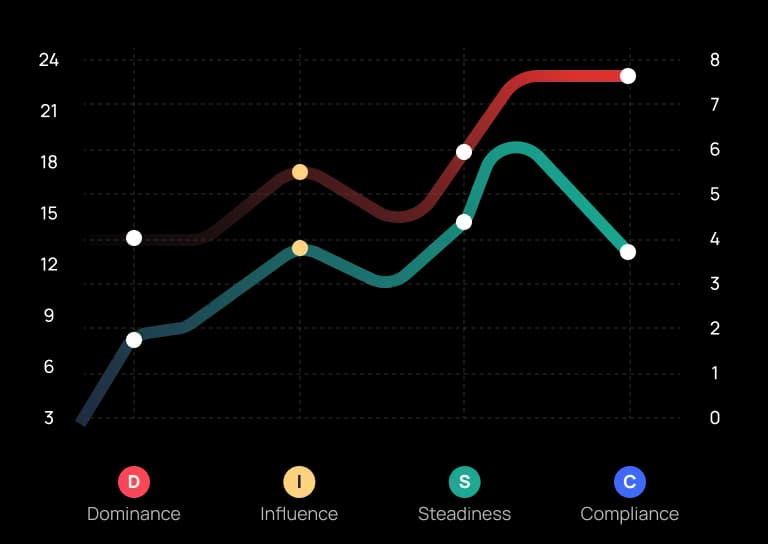
Your DISC results show an IC profile when Influence is your highest score and Conscientiousness is your second highest, with Dominance and Steadiness noticeably lower. On a DISC graph, this usually looks like a peak at I, a dip at S, and a second rise at C. The overall shape matters more than any single number.
Use these steps to read your own results:
- Find your highest score. If it is I, Influence is your primary style.
- Find your second highest score. If it is C, you have an IC blend. If it is D, you are closer to ID, and if it is S, you are closer to IS.
- Check the gap between I and C. If the two are nearly level, read both the IC and CI descriptions, because the order can flip with context.
- Look at your two lowest styles. Lower D and lower S explain why an IC prefers persuasion to command and variety to routine.
- Remember how you answered. Results reflect honest answers and your current state of mind, so a stressful month can shift the shape.
If you have not taken a DISC assessment yet, discpersonalities.com offers a free DISC test that takes about 10 to 15 minutes and shows your basic result right after you finish. According to discpersonalities.com data, the test has been completed more than 109,000 times, and 91.2% of users gave positive feedback on result accuracy. You can take the DISC test and see where your I and C land.
Why Does the IC Blend Pull in Two Directions?
The IC blend pulls in two directions because Influence and Conscientiousness sit in opposite corners of the DISC model. Influence is outgoing and people-focused, while Conscientiousness is reserved and task-focused. An IC carries both, so the urge to share quickly and the urge to verify carefully often compete inside the same person.
DISC is usually drawn as a circle split by two lines. One line describes pace, from outgoing and fast to reserved and careful. The other describes focus, from tasks to people.
| Style | Pace | Focus |
|---|---|---|
| Dominance (D) | Outgoing, fast | Tasks and results |
| Influence (I) | Outgoing, fast | People and ideas |
| Steadiness (S) | Reserved, steady | People and harmony |
| Conscientiousness (C) | Reserved, careful | Tasks and accuracy |
Most blends share one line. DI shares an outgoing pace, and IS shares a people focus. IC shares neither, so it joins two styles that differ on both pace and focus. That is why many ICs describe an inner tug of war between "share it now" and "verify it first."
The tension is also a source of range. An IC can move from a lively pitch to a careful review in the same afternoon. The goal is not to remove either pull. It is to decide which one should lead for a given task.
An IC does not have to choose between being liked and being right. The skill is deciding, task by task, which one matters more today.
What Are the Strengths of an IC at Work?
The main strength of an IC at work is making careful, accurate work engaging for other people. ICs translate complex information into clear stories, catch errors before they reach an audience, and hold a high standard without losing warmth. Teams often rely on them when experts need to explain something to clients, leaders or learners.
Strengths that show up again and again in IC profiles include:
- Turning detailed, accurate work into something people want to read, watch or use
- Explaining complex ideas in a warm, clear voice
- Catching mistakes before they reach a client or a leader
- Pairing creative ideas with a realistic plan
- Raising the quality bar without becoming cold or distant
A strong C on its own might produce work that is correct but dry. A strong I on its own might produce work that is lively but light on detail. An IC tends to deliver both, which is why ICs often end up presenting findings, writing customer-facing material, or training others.

What Are the Blind Spots of an IC Personality?
The main blind spot of an IC personality is getting stuck between speed and accuracy. ICs may polish work past the point where it adds value, reopen tasks that are already finished, and hear criticism of their work as criticism of themselves. These patterns are habits that grow under pressure, not flaws in the type.
Stress tends to amplify whichever pull is winning. When the I side takes over, an IC may overexplain, add one more idea, or look for reassurance. When the C side takes over, they may withdraw, recheck work that is already sound, and become sensitive to how something was received. In disagreements, ICs usually rely on reasoning and persuasion. A quieter S colleague may feel outtalked, and a fast-moving D colleague may lose patience with another round of revisions.
Here is a hypothetical example. An IC on a customer support team is asked to update the help guide before a product release. The first draft is solid by Tuesday, but they keep reworking examples and rechecking every screenshot, and the guide goes live after the release it was meant to support. Next time, they agree with their manager on a fixed edit deadline and a short list of items that must be checked.
How an IC Can Grow
- Sort tasks into "must be flawless" and "ready to share" before you start.
- Set a firm cut-off date for new data or edits.
- Separate feedback on a draft from feedback on yourself.
- Lead with the conclusion when your audience needs a decision rather than the full story.
- Ask a trusted colleague to tell you when a piece is ready.
How Does an IC Work on a Team and as a Leader?
An IC on a team works as a translator between experts and audiences. ICs keep communication flowing, raise quality, and make group output easier to understand. As leaders, they guide through expertise and explanation rather than authority, though they may need a firm deadline to commit when a decision feels uncomfortable or the data keeps changing.
On a Team
On a team, the IC is often the person who turns specialist knowledge into something others can follow. They draft updates, prepare client presentations, and smooth the handoff between technical staff and everyone else. Teams benefit from their mix of energy and care. To keep that mix from slowing things down, agree early on which tasks need speed and which need precision.

As a Leader
IC leaders tend to set clear standards and share the reasoning behind their plans. People follow them because the work is convincing and the explanations make sense. Their growth edge is speed of decision. When a call is uncomfortable or new information keeps arriving, a set decision date helps them commit and move on.

What an IC Needs From a Manager
An IC does well with a manager who sets clear criteria, recognizes the quality of their work, and gives them chances to present it. Explanations matter as much as instructions. ICs commit faster when they understand why a decision was made, and they hear it better when it comes with some warmth. Agreeing on deadlines and the level of detail each task needs settles much of their internal tug of war.

What Careers Suit the IC Personality Type?
Careers that suit the IC personality type usually combine communication with accuracy. Examples include copywriting, marketing communications, UX writing, training and instructional design, teaching, editing, public relations, technical writing, and consulting roles that explain complex products. These are suggestions of fit, not limits, because DISC describes preferences rather than ability.
| Career area | Why it fits an IC | What to watch |
|---|---|---|
| Content and copywriting | Combines voice with accuracy | Over-editing close to deadlines |
| Training and instructional design | Rewards clear explanation and structure | Packing in too much detail |
| Marketing communications and PR | Mixes persuasion with careful messaging | Taking audience reactions personally |
| UX writing and product design | Balances user empathy with precision | Endless iteration |
| Teaching | Uses energy to make detailed material engaging | Grading and admin can drain energy |
| Consulting or sales for complex products | Explains complex offerings clearly | Long cycles with little variety |
Environments matter as much as job titles. ICs tend to do well where expectations are clear, there is room to present ideas, and the work includes some variety. A role built on long, repetitive routines with little contact with people may feel draining. DISC can start a career conversation, but it cannot tell you which job you will succeed in. Skills, interests, values and experience carry just as much weight.
How Do You Communicate With an IC?
The way to communicate with an IC is to be warm and specific at the same time. Praise the quality of their work as well as their friendliness, explain the reasoning behind decisions, and give clear deadlines with the level of accuracy you expect. Blunt, unexplained criticism lands hard because it touches both of their core sensitivities.
| If your style is | When working with an IC, try this |
|---|---|
| Dominance (D) | Be direct but explain your reasons, and set a firm deadline so the work does not stall in revisions |
| Influence (I) | Match their enthusiasm, then turn ideas into a short written plan with owners and dates |
| Steadiness (S) | Speak up early with your view, since ICs move fast and may read silence as agreement |
| Conscientiousness (C) | Bring evidence to the conversation and agree on which details matter, so you both check the right things |
Feedback deserves special care. Start with what works, be specific about what needs to change, and frame the change as making good work better. That keeps the conversation about the work rather than the person, which helps an IC stay open instead of defensive.
How Is IC Different From CI, ID and IS?
IC is different from CI, ID and IS because of which style leads and which style supports it. In IC, Influence leads and Conscientiousness adds precision. In CI, accuracy leads and expression follows. ID adds drive and urgency to Influence, while IS adds patience and support. The lead letter sets the tone for the whole profile.
| Blend | Leads with | Supported by | Typical approach | Key difference from IC |
|---|---|---|---|---|
| IC | Influence | Conscientiousness | Connects first, then verifies | Reference point |
| CI | Conscientiousness | Influence | Verifies first, then explains | Checks before sharing |
| ID | Influence | Dominance | Persuades with energy and push | More urgency, less checking |
| IS | Influence | Steadiness | Persuades with warmth and patience | More harmony, less critique |
| I | Influence | None strong | Leads with enthusiasm and connection | Less attention to detail |
If your I and C scores are close, read both the IC and CI descriptions. The order of your top two styles can shift between assessments or over time, and the description that rings truer is the one worth working with. You can compare the four single styles on the DISC personality types page.
Is the IC Personality Type Rare?
The IC personality type is generally described as less common than neighboring blends, but no single verified percentage exists. DISC publishers use different questions, scoring methods and samples, so their population figures do not match. What many agree on is that blends of opposite corners, such as I with C or D with S, appear less often.
The reason is the two-line structure described above. Holding a strong people focus and a strong task focus at the same time means balancing preferences that usually trade off. Many people lean clearly one way, which makes neighboring blends such as IS or DI easier to land in.
Rarity rankings you see online, such as INFJ being the rarest type, usually come from the Myers-Briggs Type Indicator, a different model with 16 types. Those figures do not transfer to DISC.
Rarity is also not a ranking. An uncommon blend is not more valuable than a common one. Your DISC profile describes how you tend to behave, not how special you are.
Where Does the DISC Model Behind IC Come From?
The DISC model behind IC comes from psychologist William Moulton Marston, who described four behavioral patterns in his 1928 book Emotions of Normal People. Marston did not build a test himself. In 1956, industrial psychologist Walter Clarke created the first self-assessment based on the model, and many versions have followed.
Marston's original names were Dominance, Inducement, Submission and Compliance. Later assessments renamed Inducement to Influence and Submission to Steadiness, while the C style appears as either Compliance or Conscientiousness. That history explains why you may see both C names on different reports. Marston is also known for creating the comic book character Wonder Woman.
Because Marston never patented his work, many organizations have built their own DISC-based tools. One of them, DiSC with a lowercase "i," was developed by John Geier and is now sold as Everything DiSC, a trademark of John Wiley & Sons. This article uses "DISC" for the general model, and discpersonalities.com is not affiliated with Wiley. The variety of tools is one reason the same person can receive slightly different results from different tests.
What Can an IC Result Tell You, and What Can't It?
An IC result can tell you how you tend to communicate, decide and react to pressure, which makes it useful for self-reflection and team conversations. It cannot measure intelligence, diagnose a mental health condition, or decide which career you should pursue. Studies of DISC tools report consistent results over time, while their ability to predict job performance remains debated.
A DISC assessment is a self-report. Your results depend on answering honestly and on your state of mind that day. If you take the test during a stressful stretch or right after a role change, retake it later and compare.
Typing other people from the outside is guesswork. Commentators often assign DISC styles to public figures based on interviews and headlines, and they frequently disagree. A DISC profile is designed to be completed by the person it describes.
For HR teams and managers, DISC works as one input alongside structured interviews and skills assessments. It should not be the sole basis for hiring, promotion or termination decisions, and employers should follow EEOC guidance on employment testing. Business Suite on discpersonalities.com brings team members' DISC styles into one view, which can support conversations about communication and role design.
A DISC result describes how you tend to behave, not who you have to be.
Your Next Step as an IC
Being an IC means your warmth and your standards are partners, not rivals, once you decide which one should lead on each task. The real skill is not choosing between being liked and being right. It is knowing when good enough is genuinely good enough. If this IC personality type description sounds familiar, check it against your own answers. The free DISC test on discpersonalities.com takes about 10 to 15 minutes and shows your basic result as soon as you finish. Take the DISC test to see where your I and C land, then explore the four DISC styles to read your profile in context.
Frequently Asked Questions About the IC Personality Type
What are the top 3 rarest personality types?
In the Myers-Briggs system, the three rarest types in the US sample published in the 1998 MBTI Manual are INFJ at about 1.5% of the population, ENTJ at about 1.8% and INTJ at about 2.1%. These figures apply to MBTI. DISC uses different categories, so the numbers say nothing about IC or other DISC blends.
What is the rarest DISC profile combination?
There is no single agreed answer, because DISC assessments use different questions, scoring and samples. Many publishers report that opposite-corner blends, such as Dominance with Steadiness or Influence with Conscientiousness, are less common than neighboring blends. These pairings combine preferences that usually pull apart, like speed with patience or sociability with caution.
What DISC style is Donald Trump?
Donald Trump's DISC style is an outside interpretation, not a published test result. DISC commentators often describe his public behavior as high Dominance, and some also point to strong Influence because of his persuasive, high-energy communication. Treat any label as a reading of public moments, since DISC is designed to be completed by the person it describes.
What DISC type is Elon Musk?
Elon Musk's DISC type is an outside interpretation, and published readings disagree. Some DISC writers describe him as Dominance-led, others as a Dominance blend with Influence or with Conscientiousness, and at least one places him in the Conscientiousness style. That spread shows how unreliable typing from headlines can be. DISC is meant to be self-completed.
What does IC stand for in DISC?
IC stands for Influence and Conscientiousness, the two highest styles in this DISC blend. The first letter shows the primary style, and the second shows the style that supports it. Some assessments call the C style Compliance, so an IC may also be described as Influence plus Compliance. Both labels describe the same pattern.
What careers suit an IC personality?
Careers that suit an IC personality usually reward both clear communication and careful work. Common fits include copywriting, content strategy, marketing communications, training and instructional design, teaching, editing, UX writing and technical writing. Treat these as starting points for reflection, since your skills, interests and values matter as much as your DISC style.
What is the difference between IC and CI?
The difference between IC and CI is which style leads. An IC leads with Influence, so connecting with people comes first and precision keeps the work accurate. A CI leads with Conscientiousness, so accuracy comes first and expression helps explain it. In short, an IC shares and then checks, while a CI checks and then shares.
How do you work with an IC personality?
To work with an IC personality, combine warmth with clear expectations. Recognize the quality of their work, explain the reasons behind decisions, and agree early on deadlines and the level of detail each task needs. When giving feedback, be specific and focus on the work, which helps an IC hear it as information rather than judgment.
Test results are for self-reflection and educational purposes. They are not a clinical or psychological diagnosis and do not replace advice from a licensed professional.
- Take the test: DISC Test
- Website: DISC Personalities
- Email: admin@discpersonalities.com


DISC Team is a content writing team for tracnghiemtinhcach.vn, focusing on the DISC model, communication styles, and teamwork. The team aims to explain concepts in accessible language, helping readers connect them with situations in their work and everyday lives.
View author profile

Don't Let Your Potential Stay Hidden!
Take the DISC test today and discover your unique 'YOU', with deep insights into your true personality and potential.
 Understand yourself
 Choose the right career
 Suggest effective communication
 Reduce negative emotions
Represents your instinctive behaviors and desires.
Shows the behavioral tendencies you think you should exhibit in specific situations.
Related articles
You may also be interested in
 DISCOct 30, 2026
CI Personality Type: Traits, Strengths and Careers
Learn what the CI personality type means in DISC: Core traits, strengths, blind spots and careers. Take the free DISC test to find your blend.
 DISCOct 30, 2026
DS Personality Type Explained: Drive Meets Patience
Learn what the DS personality type means in DISC: core traits, work strengths, blind spots and careers. Take the free DISC test to see your blend.
 DISCSep 28, 2026
How to Identify Your Strengths and Weaknesses at Work
Understand your strengths and weaknesses at work by reviewing your skills, past achievements, etc. Improve and align your strengths with career goals.
