


Table of content
CI Personality Type: Traits, Strengths and Careers
Learn what the CI personality type means in DISC: Core traits, strengths, blind spots and careers. Take the free DISC test to find your blend.
Table of content
What does it mean when Compliance is the highest point on your DISC graph and Influence sits right behind it? It means you likely have a CI personality type, a DISC blend that pairs a strong need for accuracy with a real talent for explaining what you know. CIs check the facts first, then make those facts clear to everyone else in the room. This guide covers what drives the CI style, why the blend is less common, where it shines at work, where friction shows up, how it differs from IC and from "Type C," and how to confirm your own blend.
What Is the CI Personality Type?
The CI personality type is a DISC blend in which Compliance is your highest style and Influence is your second. In plain terms, a CI wants the work to be correct and wants people to understand it. The C drives accuracy, logic and quality, while the I adds warmth, persuasion and an ease with explaining ideas.
DISC is a behavioral model that traces back to psychologist William Moulton Marston, who described four patterns of emotional and behavioral response in his 1928 book Emotions of Normal People. Modern DISC assessments group behavior into four styles: Dominance (D), Influence (I), Steadiness (S) and Compliance (C). Some providers call the C style Conscientiousness. Both names describe the same careful, quality-focused style.
Few people fit a single style. When one style rises highest and a second sits close behind, the result is a blend such as CI. The first letter is your primary style and the second letter is your secondary style, so the order changes the personality.
| DISC style | Main focus | Typical behavior |
|---|---|---|
| Dominance (D) | Results and challenge | Direct, decisive, fast-moving |
| Influence (I) | People and enthusiasm | Expressive, persuasive, optimistic |
| Steadiness (S) | Stability and support | Patient, loyal, calm |
| Compliance (C) | Accuracy and quality | Careful, analytical, systematic |
What Are the Core Traits of the CI Personality Type?
A CI personality type combines high standards with a natural drive to share what you know. Core CI traits include careful analysis, a strong need to get facts right, clear and engaging explanations, curiosity, and tact in disagreement. On a DISC graph, C sits highest, I comes second, and D and S fall lower.
Common CI traits:
- Analytical: You want evidence before you commit to a view.
- Articulate: You can turn complex material into language people follow.
- Diplomatic: You raise concerns as questions rather than attacks.
- Quality-minded: Sloppy work bothers you, including your own.
- Curious: You enjoy learning and enjoy teaching what you learn.
What Motivates a CI
CIs are motivated by being right and being understood at the same time. A fact that is true but confusing frustrates them, and so does a clear story that turns out to be wrong. They feel rewarded when careful analysis changes someone's mind or helps a group make a sound decision. Intellectual challenge and the chance to deepen expertise keep them engaged.

What a CI Fears
The core fear for many C-led people is making a mistake in public. For a CI, that fear has a second layer: Being dismissed after doing careful work. This is why CIs prepare thoroughly before they present. They would rather be the person who double-checked than the person who sounded confident and got it wrong.

How a CI Shows Up on a DISC Graph
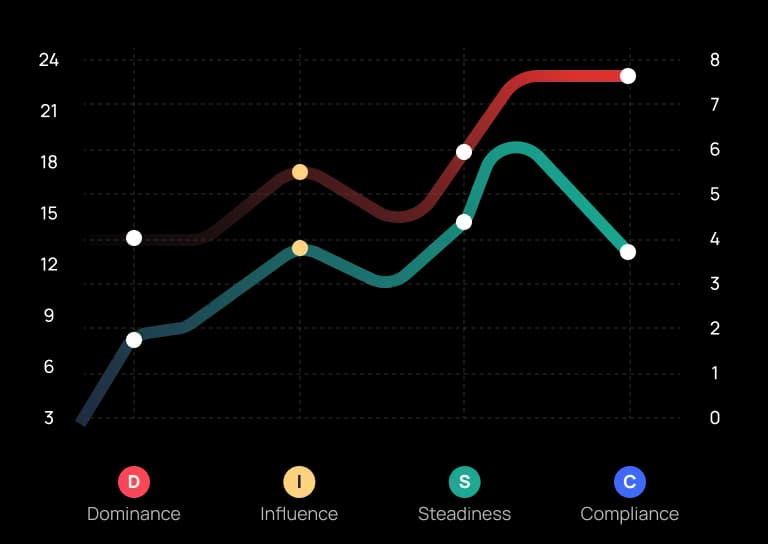
On the graph, Compliance rises highest and Influence comes next. A lower D score usually means a CI prefers to win with a clear case instead of pressure. A lower S score often means a CI enjoys variety and updates an old explanation when better evidence appears.
The CI question is not just "Is this right?" It is "Is this right, and will people understand it?"
Wondering whether this sounds like you? The free DISC test on discpersonalities.com takes about 10 to 15 minutes, and a basic result appears right after you finish.
Why Is the CI Blend Less Common?
The CI blend is less common because it pairs two DISC styles from opposite corners of the model. Compliance is reserved and task-focused, while Influence is outgoing and people-focused. A high score in both means balancing a careful, checking instinct with an expressive, social one, and those pulls do not always sit easily together.
DISC styles are often mapped on two axes. The first is pace: Outgoing and fast-moving versus reserved and measured. The second is priority: Tasks versus people. Each style sits at a different point on these two axes.
| Style | Pace | Priority |
|---|---|---|
| D | Outgoing | Tasks |
| I | Outgoing | People |
| S | Reserved | People |
| C | Reserved | Tasks |
Neighboring blends such as DC, IS or DI share one axis, so the two styles reinforce each other. CI shares neither axis. C is reserved and task-focused, and I is outgoing and people-focused. The same is true of the D and S pairing. These cross-corner blends describe people who hold two different pulls at once, which is part of what makes CIs interesting colleagues.
You may see specific percentages for how rare each blend is. Treat them with caution. Each DISC provider uses its own questions, scoring and user sample, so frequency figures vary from one source to another and are not a population census.
CI vs IC: What Is the Difference?
CI and IC use the same two styles in a different order. In a CI, Compliance comes first, so accuracy leads and communication serves it. In an IC, Influence comes first, so connecting with people leads and precision keeps the message honest. A CI tends to research, then present. An IC tends to connect, then confirm the details.
| Trait | CI (Compliance first) | IC (Influence first) |
|---|---|---|
| Primary drive | Getting it right | Getting people on board |
| First response to a new idea | Asks for evidence | Gets excited and shares it |
| Presentation style | Structured and detailed | Lively and story-driven |
| Main stress trigger | Being wrong in public | Being ignored or left out |
| Growth edge | Deciding with incomplete data | Following through on details |
The difference matters in daily work. Ask a CI and an IC to pitch the same project. The CI will build the case slide by slide and check every number. The IC will open with a story, win the room, then circle back to the data. Both approaches work. Knowing which one is yours helps you choose where to spend effort and where to ask for help.
What Are the Strengths of a CI at Work?
The main strength of a CI at work is translation: Turning complex, accurate work into something other people can follow and act on. CIs bring credibility because they check their claims, and warmth because they care whether the audience understands. That mix makes them natural bridges between specialists and decision-makers.
Plenty of accurate people struggle to teach what they know, and plenty of engaging people skip the details. CIs tend to do both. When a CI presents, the audience leaves with the real picture rather than a simplified version that falls apart under the first follow-up question.
Strengths CIs often bring:
- Clear explanations of dense data, research or technical work
- Documentation and written guides that people actually use
- Thoughtful questions that expose weak assumptions without embarrassing anyone
- Training sessions pitched at the right level for the audience
- Quality checks that catch errors early and explain the fix
- A calm, reasoned voice in heated discussions
CIs also raise the standard of a conversation without taking it over. Their curiosity makes probing questions feel collaborative, and their habit of checking facts tends to spread through a team.

What Are the Blind Spots and Stress Triggers of a CI?
CI blind spots usually grow from the same traits that make CIs strong. The need for accuracy can turn into over-qualifying and slow decisions, while the I side can soften hard feedback until the message gets lost. Common CI stress triggers include rushed deadlines, chaotic environments, and careful work that nobody engages with.
Common CI Blind Spots
- Burying the point: So many caveats that the listener cannot find the recommendation.
- Over-preparing: Spending time on polish when a decision was already needed.
- Softened feedback: Wrapping criticism in so much warmth that it does not land.
- Quiet judgment: Private frustration with less careful communicators that can show on your face.
- Inner tug-of-war: The C side wants to prepare alone, and the I side wants to be out talking with people.
What Stresses a CI
CIs feel stress when decisions are made without data, when their prepared work is ignored, or when the pace leaves no room to verify. A blunt, high-pressure colleague may read a CI's careful framing as stalling, which can feel unfair to the CI. Recognizing these triggers is the first step to managing them.
Growth Tips for CIs
- Lead with the headline: State your recommendation first, then add the caveats that matter.
- Set a decision deadline: Choose a point when you have enough information, then commit.
- Be kind and clear: Direct feedback delivered with care is more respectful than a hidden message.
- Protect two kinds of time: Block hours for deep focus and separate time for connecting with people.
How Does a CI Communicate With Other DISC Styles?
A CI communicates by building a clear, evidence-based case and adjusting the delivery to the listener. With fast D styles, CIs do well by stating the recommendation first. With I styles, they connect through ideas. With S styles, they create space for quieter voices, and with other C styles, they share depth and detail.
| Working with | What they value | How a CI can adapt |
|---|---|---|
| High D | Speed and the bottom line | Open with the recommendation, keep the analysis ready |
| High I | Energy and new ideas | Let them brainstorm, then act as the quality filter |
| High S | Trust and a steady pace | Give time to respond and invite their view directly |
| High C | Logic and detail | Share the data and agree on standards early |
Reading the room also draws on emotional intelligence, the ability to notice and manage emotions in yourself and others. If you want a second lens on how you handle people and feelings, an EQ test looks at emotional awareness and regulation.
How Does a CI Lead and Work on a Team?
A CI leads through explanation and credibility rather than command. People follow a CI because the reasoning is visible and the facts hold up. On a team, CIs often serve as translators between technical specialists and leadership, and they tend to build cultures where data matters and people feel informed.
The CI as a Leader
CI leaders explain the "why" behind each decision, which builds trust and helps people grow. They notice skill gaps and can describe a clear path forward. Their growth edge is speed. Because the C side wants more data and the I side wants more input, CI leaders may delay decisions longer than needed.

The CI in Conflict and Change
In conflict, CIs reason and persuade rather than push, and they usually keep the tone civil. Under change, they adapt well when the reasoning is sound and they are allowed to explain it to others. A change that is communicated badly frustrates them because they can see exactly where people will get confused.

Managing a CI
- Give them problems worth solving and an audience to share the results with.
- Be precise in your own instructions.
- When you need brevity, ask for the headline first instead of cutting off the reasoning.
- Praise specific work, such as a report that got the whole team aligned.
For HR teams and managers, the Business Suite on discpersonalities.com shows the DISC mix across a team. That helps leaders see where a CI's clarity fits next to faster or steadier styles. DISC results work as one input alongside structured interviews and skills assessments, not as the sole basis for hiring decisions. Employers should also follow EEOC guidance on employment testing.
What Careers Fit the CI Personality Type?
Careers that fit the CI personality type reward both accuracy and communication. Common fits include technical writing, teaching and training, research analysis with a presentation component, instructional design, user research, data journalism, science communication, and solutions consulting. These are patterns of fit, not limits: CIs succeed in many fields.
| Career area | Example roles | Why it fits a CI |
|---|---|---|
| Education | Teacher, corporate trainer, instructional designer | Explaining complex ideas at the right level |
| Research and data | Research analyst, user researcher, data journalist | Finding the facts and presenting them clearly |
| Communication | Technical writer, science communicator, policy analyst | Precise language for a real audience |
| Business | Solutions consultant, product marketer, quality lead | Credible expertise that persuades clients |
When you weigh a role, ask two questions. Does it reward getting things right? Does it let you share what you know with people who need it? A job of pure solo analysis with no audience can feel flat to a CI. A job of constant performance with no time to verify can feel draining.
A DISC result does not predict which career will suit you or how well you will perform. It helps you notice which environments energize you, so you can ask better questions before you take a role.
Is the DISC "C" the Same as a Type C Personality?
No, the DISC C style and the Type C personality are separate ideas. DISC C stands for Compliance, a behavioral style focused on accuracy and quality at work. Type C comes from the Type A, B, C and D labels in health psychology, which grew out of research on stress and health rather than everyday work behavior.
The Type A label started with cardiologists Meyer Friedman and Ray Rosenman in the 1950s. They described a competitive, time-pressured behavior pattern and contrasted it with the more relaxed Type B. Type C appeared later as a label for people who tend to suppress emotions and avoid conflict. Type D, proposed by psychologist Johan Denollet in the 1990s, describes a mix of frequent worry and social inhibition.
| Label | Rough origin | What it describes |
|---|---|---|
| Type A | Cardiology research, 1950s | Competitive, impatient, time-pressured |
| Type B | Contrast to Type A | Relaxed, patient, even-paced |
| Type C | Later health psychology | Emotionally restrained, cooperative |
| Type D | Johan Denollet, 1990s | Worry combined with social inhibition |
These labels do not come from one unified test, and researchers still debate their links to health outcomes. A high C on a DISC graph says nothing about your health. Researchers who study personality traits more broadly often use the Big Five personality traits model instead.
How Can You Find Out if You Are a CI?
You can find out if you are a CI by taking a DISC test and checking whether Compliance is your highest score and Influence your second. A single result is a snapshot of how you see yourself now, so honest answers matter, and the secondary style can shift with role, stress or life stage.
- Pick a calm moment: Answer when you are not rushed or upset, since mood can color self-report.
- Answer as you act: Choose the option that matches your usual behavior at work, not the person you want to be.
- Take a DISC test: Set aside about 10 to 15 minutes for the DISC test.
- Read your graph: Your highest style is your primary letter, and the second highest is your secondary letter.
- Check the gap: If C is highest and I is close behind, you are likely a CI. If I is higher, you may be an IC.
- Compare with real life: Ask a trusted colleague whether the description matches how you come across.
According to discpersonalities.com data, the test has been completed more than 109,000 times by users worldwide, and 91.2% of user feedback on result accuracy is positive. The free basic result shows your style blend, and a detailed report is available if you want to go deeper.
Many people find their primary style stays fairly similar over time, while the secondary style moves as their job or circumstances change. If your result surprises you, retake the test on a different day and compare.
A DISC blend describes how you tend to behave, not how capable you are.
Frequently Asked Questions
What is the rarest DISC profile combination?
There is no single official answer, because each DISC provider uses its own questions, scoring and sample. Blends that pair styles from opposite corners of the model, such as D with S or C with I, are generally reported as less common, since they combine opposite preferences for pace and priority.
What DISC type is Elon Musk?
No verified DISC result for Elon Musk has been published. Commentators often describe his public behavior as D-leaning because he appears direct, fast and comfortable with risk, but typing someone from the outside is a guess. DISC measures how people describe their own behavior, so a real profile requires taking the test.
What are Type A, B, C and D personalities?
Type A, B, C and D are labels from health psychology, not DISC. Type A describes competitive, time-pressured behavior, and Type B describes a relaxed pace. Type C describes emotional restraint, and Type D combines worry with social inhibition. They come from separate research traditions rather than one unified test.
What is a CI personality type?
A CI personality type is a DISC blend where Compliance is the primary style and Influence is secondary. CIs care about getting facts right and about helping others understand them. They tend to be analytical, articulate and diplomatic, and they often act as bridges between experts and the people who need the information.
What is the difference between CI and IC?
CI and IC share the same two styles in reverse order. A CI puts accuracy first and uses communication to share it. An IC puts connection first and uses precision to keep the message honest. In practice, a CI researches before presenting, while an IC engages people first and checks details afterward.
What careers suit a CI personality type?
Roles that reward both correctness and clear communication tend to suit CIs. Examples include technical writing, teaching, corporate training, instructional design, research analysis, user research, data journalism, science communication and solutions consulting. These are patterns of fit rather than limits, and a DISC result does not predict career success.
How does a CI handle stress?
Under stress, a CI may over-prepare, add more caveats, or withdraw to double-check the work. Common triggers include rushed decisions, chaos and having careful work ignored. Stating the headline first, setting decision deadlines and making time for both focus and connection can help a CI stay effective under pressure.
Can your DISC type change over time?
Your DISC result can shift, especially the secondary style. Role changes, stress and life stage all affect how you describe your behavior on a self-report test. Many people see a fairly stable primary style over time. Retaking the test after a major change can show which parts of your profile have moved.
How do I know if I am a CI or a pure C?
Look at your second-highest score. If Compliance is highest and Influence is clearly raised above Dominance and Steadiness, you are likely a CI. If Compliance stands well above all three other styles, your profile reads closer to a pure C, with less emphasis on persuasion and expression.
Putting Your CI Strengths to Work
The CI personality type sits where rigor meets voice, and that pairing is less common than many people expect. If you recognize the urge to double-check the numbers and then explain them until the room finally understands, your DISC graph may confirm what you already sense. Knowing your blend will not tell you what you can achieve. It shows where your energy flows and which habits deserve a second look. Take the free DISC test on discpersonalities.com, compare your result with this guide, and see where your own story fits.


DISC Team is a content writing team for tracnghiemtinhcach.vn, focusing on the DISC model, communication styles, and teamwork. The team aims to explain concepts in accessible language, helping readers connect them with situations in their work and everyday lives.
View author profile

Don't Let Your Potential Stay Hidden!
Take the DISC test today and discover your unique 'YOU', with deep insights into your true personality and potential.
 Understand yourself
 Choose the right career
 Suggest effective communication
 Reduce negative emotions
Represents your instinctive behaviors and desires.
Shows the behavioral tendencies you think you should exhibit in specific situations.
Related articles
You may also be interested in
 DISCOct 30, 2026
DS Personality Type Explained: Drive Meets Patience
Learn what the DS personality type means in DISC: core traits, work strengths, blind spots and careers. Take the free DISC test to see your blend.
 DISCOct 29, 2026
IC Personality Type in DISC: Warmth Meets Precision
Learn what the IC personality type means in DISC: core traits, strengths, blind spots and careers. Take the free DISC test to find your blend.
 DISCSep 28, 2026
How to Identify Your Strengths and Weaknesses at Work
Understand your strengths and weaknesses at work by reviewing your skills, past achievements, etc. Improve and align your strengths with career goals.
