


Table of content
DS Personality Type Explained: Drive Meets Patience
Learn what the DS personality type means in DISC: core traits, work strengths, blind spots and careers. Take the free DISC test to see your blend.
Table of content
What does it mean when your DISC results come back as a DS? The DS personality type is a DISC blend where Dominance (D) leads and Steadiness (S) follows close behind. In plain terms, a DS pushes hard toward results but does it with patience, calm and staying power instead of speed and noise. This guide covers the core traits of the DS personality type, how to spot the pattern on your own graph, the strengths and blind spots that come with it, how a DS acts on a team and where the blend comes from in the history of the DISC model.
What Is a DS Personality Type?
A DS personality type is a DISC blend in which Dominance is your highest score and Steadiness is your second highest. The D side brings drive, directness and a focus on results. The S side adds patience, loyalty and a steady pace. Together they describe someone who sets a goal and keeps working toward it long after others slow down.
The DISC model scores four behavior styles: Dominance, Influence, Steadiness and Compliance. Few people show just one. Most results combine a primary style and a secondary style, and the order of the letters matters. In a DS, drive sets the direction and steadiness supplies the stamina. You can read short profiles of each of the four styles on the DISC personality types page.
The letters are shorthand for behavior, not a fixed label. A DS result describes how you tend to act at work and in daily life, based on how you answered the questions on the day you took the test. It says nothing about your worth, your intelligence or your potential.
A DS is drive built for distance: The goal sets the direction, and steadiness supplies the stamina to reach it.

What Are the Core Traits of the DS Personality Type?
The core traits of the DS personality type are durable drive, calm under pressure, loyalty, quiet resolve and a preference for steady, planned change. A DS wants results like other D-led styles but values stability and trust more than speed or attention. Lower Influence and Compliance scores often make a DS private with words and flexible about details.
Each trait traces back to one of the four DISC scales. The table below shows where each part of the pattern comes from and how it tends to look in daily work.
| Trait | Comes from | How it shows up |
|---|---|---|
| Results focus | High Dominance | Sets clear goals and tracks progress toward them |
| Directness | High Dominance | Says what needs to happen, briefly and plainly |
| Patience | High Steadiness | Keeps working through long, slow stretches of a project |
| Loyalty | High Steadiness | Sticks with people, teams and commitments |
| Composure | High Steadiness | Stays even when deadlines tighten |
| Reserved communication | Lower Influence | Prefers action to speeches and keeps feelings private |
| Comfort with loose ends | Lower Compliance | Moves forward before every detail is settled |
A DS is usually motivated by meaningful goals, ownership of a long project, reliable teammates and a stable setting where effort adds up over time. Common stress triggers include being micromanaged, sudden reversals with no explanation and people who don't follow through. A DS rarely makes a scene about these frustrations. Instead, they tend to go quiet and dig in, which can surprise people who mistook their calm for easy agreement.
How Do You Know If Your DISC Result Is DS?
Your DISC result is DS when Dominance is the highest point on your graph and Steadiness is the second highest, with Influence and Compliance lower. If D and S sit within a few points of each other, read the profile as a close DS or SD blend and check which description fits your daily behavior better.
Use these steps to read your graph:
- Find your highest point. The tallest bar or highest dot is your primary style. For a DS, that is Dominance.
- Find your second-highest point. This is your secondary style. For a DS, it is Steadiness.
- Check the gap. A large gap between D and S means drive clearly leads. A small gap means the two styles share the lead, so read the SD description too.
- Look at the low scores. Lower Influence and Compliance shape the blend just as much. They explain why a DS tends to be reserved and flexible about details.
- Compare with real life. Ask a trusted colleague or friend whether the description matches how you act. Your own sense of fit matters more than any single number.
If all four scores sit close together, your profile may be fairly balanced, and no single blend describes you strongly. Retaking the test on a calm day, without overthinking each answer, often gives a clearer picture.
If you haven't taken a DISC assessment yet, discpersonalities.com offers a free DISC test that takes about 10 to 15 minutes, with your basic result shown right after you finish. According to discpersonalities.com data, the test has been completed more than 109,000 times.
What Are the Strengths of a DS at Work?
The main strengths of a DS at work are sustained effort, reliability and composure. A DS keeps a project moving through the slow middle stretch where many efforts stall, follows through on commitments and stays calm when deadlines tighten. Colleagues often come to rely on a DS because their output stays consistent week after week.
These strengths tend to cluster in six areas:
- Stamina on long projects: A DS can push toward a goal for months without burning out.
- Follow-through: Commitments turn into finished work, so people learn they can count on a DS.
- Composure: A calm DS steadies a team when pressure rises.
- Quiet authority: A DS earns respect by doing the work, not by talking about it.
- Loyalty: Trust builds over time because a DS sticks with people and plans.
- Practical decisions: A DS decides firmly but rarely rushes, which avoids many costly reversals.
The combination is what makes the blend useful. Plenty of people are driven, and plenty are steady. A DS brings both at once, which means the drive lasts and the steadiness has a direction. On teams that face long timelines, such as a multi-year product build or a large operations rollout, that mix often decides whether the work gets finished.

What Are the Blind Spots of a DS Personality Type?
The blind spots of a DS personality type usually come from strengths used too heavily. Patience can turn into holding a plan too long, calm can hide frustration until it builds up, and a preference for steady progress can slow acceptance of sudden change. These are patterns a DS can learn to notice early, not fixed flaws.
Different colleagues feel these patterns in different ways. A fast, social teammate may see a DS as slow to try new ideas. A quick-pivoting manager may grow impatient while a DS thinks a change through. Because a DS holds frustration quietly, problems can stay hidden until they are larger than anyone expected.
A DS rarely resists change because change is wrong. A DS resists change that hasn't been explained yet.
A few habits help a DS keep the strengths and lose most of the friction:
- Name concerns early, while they are still small.
- Build review points into long plans, so changing course feels like an option rather than a defeat.
- Ask for the reason behind a change before deciding how you feel about it.
- Share progress out loud, since quiet work can go unnoticed.
- Pair with a detail-focused colleague on tasks where precision matters most.
How Does a DS Act on a Team, in Conflict and Under Stress?
On a team, a DS usually acts as the steady engine, setting a sustainable pace, finishing what they start and earning respect through consistency rather than volume. In conflict, a DS avoids drama but holds firm on issues that matter. Under heavy stress, a DS tends to go quiet and dig in instead of arguing out loud.
As a Leader
A DS leads by example and endurance. They set clear goals, keep a steady rhythm and stay visible when the work gets hard. People tend to trust a DS leader because the direction doesn't swing from week to week. The growth area is communication: A DS leader may need to explain plans and give praise more often than feels natural.

As a Teammate
As a teammate, a DS is loyal, consistent and willing to carry heavy work without complaint. They do their best work for a leader who has earned their respect and who doesn't change direction without warning.

In Conflict and Under Stress
A DS would rather work a disagreement through calmly than fight. On a point that matters, though, a DS holds firm with a quiet resolve that can surprise people. Under stress, the D side may show up as stubbornness and the S side as withdrawal. A short check-in, such as asking "What's getting in the way?", often brings the real issue to the surface.

Which Careers Suit a DS Personality Type?
Careers that suit a DS personality type tend to reward persistence, ownership and a calm hand over long timelines. Common examples include operations management, project management, logistics, skilled trades, construction management, healthcare administration and small-business ownership. These are directions to explore, not predictions. A DS can succeed in many fields that look nothing like this list.
| Career area | Why the DS pattern can fit |
|---|---|
| Operations and project management | Rewards driving long efforts to completion without burning out |
| Logistics and supply chain | Values reliable systems and calm problem solving under time pressure |
| Skilled trades and construction management | Combines practical results with steady, careful progress |
| Healthcare administration | Needs firm decisions plus patience with people and process |
| Small-business ownership | Rewards someone who can carry a venture through slow years |
| Emergency management and public safety | Calls for composure and clear action when stakes are high |
Work environment matters as much as job title. A DS often feels drained by constant reprioritizing, roles built around performing for a crowd and tight micromanagement. They tend to thrive with clear goals, real ownership and a pace that rewards consistency. Keep in mind that skills, interests, values and the job market shape career fit at least as much as a behavior style does.
How Do You Work With or Manage a DS?
Working with a DS goes smoothly when you stay consistent, explain changes early and give them ownership of meaningful work. A DS trusts people who do what they say. They respond well to clear goals, room to run with them and enough time to think a change through before committing to it.
Working Alongside a DS
- Keep your commitments. A DS quietly tracks reliability and values it highly.
- Give notice before a change instead of asking for an instant yes.
- Check in directly, since a DS may not mention a problem until it has grown.
- Take it seriously when a DS holds firm. They rarely dig in over small things.
Managing a DS
- Assign work with a long arc, where their endurance pays off.
- Explain the reason behind a change and give them a moment to absorb it.
- Recognize their contribution out loud, because a DS rarely asks for credit.
- On remote teams, share written updates on priorities so a DS isn't caught off guard by changes made in meetings they missed.
Using DISC Results in Hiring and Team Building
DISC results can help a manager understand how a new hire prefers to work, but they should be one input alongside structured interviews, work samples and skills assessments. Research has not shown that DISC predicts job performance, so a DS result, or any DISC result, should never be the sole basis for hiring, promotion or termination decisions. Employers should also follow EEOC guidance on employment testing. For team development, the Business Suite on discpersonalities.com helps HR managers and team leads see how DISC styles are spread across a team, which can guide conversations about roles and communication.
How Is DS Different From SD, DI and DC?
DS differs from SD, DI and DC in what sits behind the lead letter. A DS leads with drive and backs it with patience. An SD leads with steadiness and backs it with resolve. A DI pairs drive with social energy and speed, while a DC pairs drive with precision and high standards.
| Blend | Leads with | Second style adds | Typical pace | Main focus |
|---|---|---|---|---|
| DS | Dominance | Steadiness: Patience, loyalty | Steady and sustained | Long-term results |
| SD | Steadiness | Dominance: Firmness, resolve | Calm and deliberate | Stability that holds its ground |
| DI | Dominance | Influence: Enthusiasm, persuasion | Fast | Momentum and people |
| DC | Dominance | Compliance: Accuracy, standards | Measured and exact | Quality results |
The DS and SD comparison causes the most confusion because both blends use the same two letters. The difference is which need comes first. A DS feels the pull of the goal and uses patience to reach it. An SD feels the pull of stability and uses firmness to protect it. In a meeting, a DS asks, "How do we get there?" while an SD asks, "What will this change for the team?"
Is the DS Personality Type Rare?
The DS personality type is often described as one of the less common DISC blends, but no single public dataset gives a reliable population percentage. Figures differ by assessment provider, question format and sample. One likely reason for the pattern is that Dominance and Steadiness pull in opposite directions on pace.
Some published data supports the idea that D-led blends are less common in general. A 2015 report from Extended DISC, a commercial assessment provider, found that Dominance was the least common primary style in a sample of about 239,000 people, at roughly 12 percent. Steadiness accounted for about 31 percent, the largest share in that sample.
The deeper reason relates to how DISC is built. Marston organized his four styles along two dimensions, and many modern DISC reports place the styles around a circle. On that circle, D and S sit across from each other: D is fast and assertive, while S is calm and accommodating. Scoring high on both at once means holding two opposite tendencies together, and fewer people answer that way. Rare does not mean better or worse. It simply means the DS combination shows up less often in typical samples.
Where Does the DS Profile Come From?
The DS profile comes from the DISC model that psychologist William Moulton Marston described in his 1928 book Emotions of Normal People. Marston named four behavior patterns: Dominance, Inducement, Submission and Compliance. Later test makers renamed two of them, and modern DISC reports combine a person's two highest scores into blends such as DS.
Marston never built a test himself. Industrial psychologist Walter Clarke created the first self-assessment based on the model in 1956. In the 1970s, John Geier developed the Personal Profile System, which used the spelling DiSC with a lowercase i. That product line became Everything DiSC, now a trademark of John Wiley & Sons. Today, "DISC" in all capitals refers to the general model behind many different DISC assessments, including the test on discpersonalities.com, which is not affiliated with Wiley.
DISC Letters vs Type A, B, C and D Personalities
DISC letters are often mixed up with Type A, B, C and D personalities, but the two systems are unrelated. Cardiologists Meyer Friedman and Ray Rosenman described the competitive Type A and relaxed Type B patterns in the 1950s while studying heart disease, which is covered in Type A and Type B personality theory. Type C later became a label for emotionally restrained, detail-focused people. Belgian psychologist Johan Denollet described Type D, or "distressed," personality in the 1990s. The D in DISC stands for Dominance and has nothing to do with Type D.
What Can a DISC Result Tell You, and What Can It Not?
A DISC result can tell you how you tend to communicate, make decisions and respond to pressure, which makes it useful for self-reflection and team conversations. It cannot diagnose anything, measure ability or predict job success. Researchers still debate DISC's scientific validity, so treat a DS result as a helpful lens, not a verdict.
Keep these limits in mind when you read your profile:
- Results depend on honest answers and your state of mind on the day you take the test.
- Self-report tests capture how you see yourself, which may differ from how others see you.
- Behavior shifts with context, so your work profile may differ from your home profile.
- DISC describes behavior, not skill or intelligence. Reasoning ability is a separate question that an IQ test approaches in a different way.
Academic personality research relies more often on trait models such as the Big Five personality traits, which score people along continuous scales instead of sorting them into types. DISC remains popular in workplaces because its four styles are easy to remember and easy to discuss as a team.
What Should a DS Do With Their Result?
A practical way for a DS to use their result is to treat it as a conversation starter. Share it with the people you work with, ask whether the description matches what they see and pay attention to the gap between the two. For a DS, the payoff is rarely in finding a new strength. It is in noticing when steadiness has quietly turned into a plan held too long, and speaking up sooner. If you're not yet sure the DS personality type fits you, take the DISC Test and compare your graph with what you've read here.
Frequently Asked Questions About the DS Personality Type
What is a DS personality type?
A DS personality type is a DISC blend where Dominance is the highest score and Steadiness is second. People with this pattern pursue results with patience instead of urgency. They tend to be direct but calm, loyal to their team and willing to keep working on long projects after faster styles lose interest.
What are type A, B, C, D personalities?
Type A, B, C and D are labels from health psychology, not DISC. Cardiologists Meyer Friedman and Ray Rosenman described driven Type A and relaxed Type B in the 1950s. Type C describes emotionally restrained, detail-focused people, and Type D describes a distressed pattern of worry plus social inhibition. These types do not map onto DISC letters.
What is the rarest DISC profile combination?
No single public dataset settles which DISC blend is rarest, because results vary by provider and sample. Blends that pair opposite styles, such as DS and SD, are often reported as less common, and one 2015 provider report found Dominance was the least common primary style. Rare does not mean better or worse.
What DISC type is Elon Musk?
Elon Musk has not publicly shared DISC results, so any label is an outside guess. Commentators often describe his public style as high Dominance, sometimes with Influence or Compliance traits. Judging a stranger from interviews is unreliable, because a DISC profile reflects how a person answers the questions about themselves.
What is the difference between DS and SD?
DS and SD use the same two styles in a different order. A DS leads with Dominance, so results come first and patience supports the push. An SD leads with Steadiness, so stability comes first and firmness protects it. In practice, a DS sets the goal, while an SD guards the team's footing.
What careers suit a DS personality type?
Careers that reward persistence and calm ownership often suit a DS, such as operations, project management, logistics, skilled trades, construction management, healthcare administration and small-business ownership. Treat these as directions to explore. Your skills, interests, values and the local job market matter as much as your DISC style.
Can your DISC type change over time?
Your DISC blend can shift over time, though many people see a similar pattern across retests. Results reflect how you answer on a given day, so a new role, stress or a major life change can move your scores. Taking the test when you feel relaxed gives a clearer read of your usual style.
How does a DS lead a team?
A DS usually leads by example and endurance rather than speeches. They set a steady pace, follow through visibly and earn trust by staying the course when work gets hard. Teams led by a DS often value the stability, while the DS may need to share plans and praise out loud more often.
How can I find out if I am a DS?
Take a DISC assessment and check whether Dominance is your highest score and Steadiness your second. The free DISC test on discpersonalities.com takes about 10 to 15 minutes, and your basic result appears right after you finish. Then compare the result with how you actually behave at work and at home.
- Take the test: DISC Test
- Website: DISC Personalities
- Email: admin@discpersonalities.com


DISC Team is a content writing team for tracnghiemtinhcach.vn, focusing on the DISC model, communication styles, and teamwork. The team aims to explain concepts in accessible language, helping readers connect them with situations in their work and everyday lives.
View author profile

Don't Let Your Potential Stay Hidden!
Take the DISC test today and discover your unique 'YOU', with deep insights into your true personality and potential.
 Understand yourself
 Choose the right career
 Suggest effective communication
 Reduce negative emotions
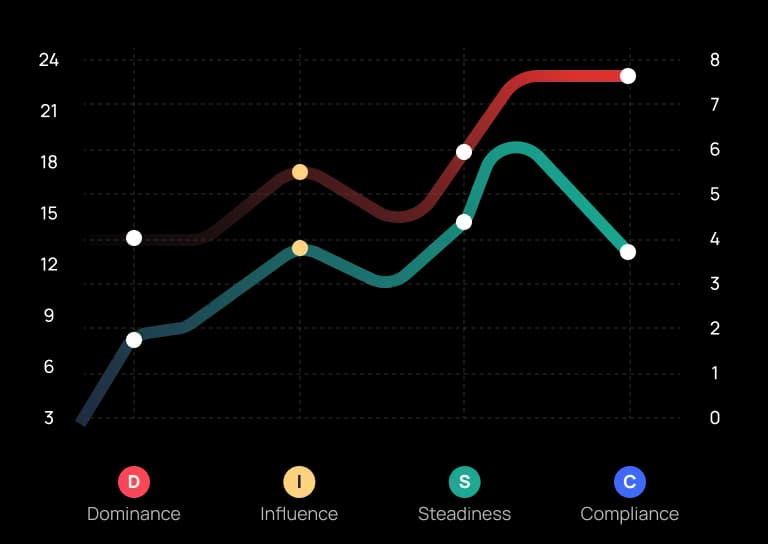
Represents your instinctive behaviors and desires.
Shows the behavioral tendencies you think you should exhibit in specific situations.
Related articles
You may also be interested in
 DISCOct 30, 2026
CI Personality Type: Traits, Strengths and Careers
Learn what the CI personality type means in DISC: Core traits, strengths, blind spots and careers. Take the free DISC test to find your blend.
 DISCOct 29, 2026
IC Personality Type in DISC: Warmth Meets Precision
Learn what the IC personality type means in DISC: core traits, strengths, blind spots and careers. Take the free DISC test to find your blend.
 DISCSep 28, 2026
How to Identify Your Strengths and Weaknesses at Work
Understand your strengths and weaknesses at work by reviewing your skills, past achievements, etc. Improve and align your strengths with career goals.
