


Table of content
What to Expect on the Predictive Index Behavioral Assessment
Learn how the Predictive Index Behavioral Assessment works: the two-part adjective checklist, four drives, and how to read your results.

Table of content
The Predictive Index Behavioral Assessment is a short, untimed survey in which you pick adjectives from a list to show how you naturally behave at work. Employers use it in hiring, coaching and team design. You may have an invitation in your inbox, or you may be a manager deciding whether to use it. Either way, this guide covers the format, the drives it measures, the 17 Reference Profiles, how results are read, and how it compares with a DISC assessment.
What is the Predictive Index Behavioural Assessment?
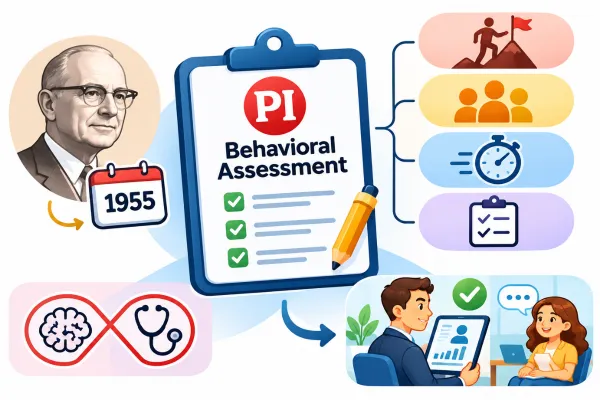
The PI Behavioural Assessment (often shortened to BA or PIBA) is a self-report questionnaire that measures workplace behavioural drives. It was created by Arnold Daniels, and The Predictive Index has developed it since 1955. The company built it for work settings only, not for clinical diagnosis or general personality typing.
It does not test knowledge or skill. It describes how you tend to act when nothing is forcing you to act differently: how much you like to take charge, how much you seek out people, how fast you like to move, and how much you rely on rules. Employers then use that picture to judge how naturally a role suits you, or to manage and coach you once you join.
How does the PI Behavioral Assessment work?
The assessment is a free-choice adjective checklist. You see the same list of 86 adjectives twice and tick as many or as few as you feel are accurate. You don't rank words or rate yourself on a scale, and there is no clock.
- Open the invitation. Use the link the employer sent and pick a quiet moment. The Predictive Index puts the average completion time at about six minutes.
- Answer the first question. Select the adjectives that describe how others expect you to act.
- Answer the second question. Go through the same list again and select the adjectives that really describe you.
- Submit. The software turns your choices into a behavioral pattern, scores each drive, and assigns the closest Reference Profile.
Self, Self-Concept and Synthesis
Your two answers produce three views of your behavior:
- Self comes from the second question. It shows your most natural workplace behavior.
- Self-Concept comes from the first question. It shows how you believe you need to adapt to what your environment expects.
- Synthesis combines the two. It is a picture of how you are likely to behave at work day to day.
A large gap between Self and Self-Concept suggests you are stretching to meet the demands of your current role. People in that position often say the job feels draining, even when they do it well.
What does the PI Behavioral Assessment measure?
Each adjective links to one of five factors. Four are primary drives that shape your pattern. The fifth, Objectivity, is secondary and describes how you make decisions. No score is good or bad. Each drive runs on a spectrum, and both ends have strengths.
[IMAGE: Original illustration of the five factor scales (A–E) with labelled ends. Alt: "PI Behavioral Assessment factor scales: Dominance, Extraversion, Patience, Formality and Objectivity"]
| Factor | What it measures | Higher scores tend to be | Lower scores tend to be |
|---|---|---|---|
| Dominance (A) | Drive to exert influence on people or events | Independent, assertive, comfortable taking charge | Collaborative, accommodating, happy to share credit |
| Extraversion (B) | Drive for social interaction | Sociable, persuasive, think out loud | Reserved, reflective, prefer to work ideas through alone |
| Patience (C) | Drive for consistency and stability | Steady, consistent, finish one task before the next | Driving, fast-paced, comfortable with frequent change |
| Formality (D) | Drive to conform to rules and structure | Precise, careful, process-minded | Flexible, informal, tolerant of risk |
| Objectivity (E, secondary) | How you process information and make decisions | Objective, data-led reasoning | Subjective, intuition and feelings play a larger part |
Dominance
Dominance is the drive to influence people and outcomes. High-Dominance people push for results and like control over how work gets done. Low-Dominance people cooperate easily and do well where decisions are shared.
Extraversion
Extraversion is the drive for social interaction. Higher scores point to someone who builds networks and persuades. Lower scores point to someone who prefers depth over breadth and is comfortable working alone for long stretches.
Patience
Patience is the drive for a steady, predictable pace. A high score suggests someone loyal to routine who dislikes being pulled between tasks. A low score suggests someone who wants variety and works best under a sense of urgency.
Formality
Formality is the drive to follow rules and get details right. People high in Formality value accuracy and clear process. People low in it improvise, delegate details, and accept more risk.
Objectivity
Objectivity does not change your Reference Profile. It adds context about whether you lean on facts and logic or on instinct and feelings when you make decisions.
The 17 Predictive Index Reference Profiles
After you finish, your factor scores work like coordinates, and the software assigns the Reference Profile whose standard pattern sits closest to yours. The Predictive Index compares a profile to a neighbourhood and your exact pattern to a street address. Two people with the same profile can still behave quite differently, so the full pattern matters more than the label.
The 17 profiles fall into four groups. The one-line descriptions below are summarised from The Predictive Index's documentation.
Analytical profiles
Logical, mission-driven and introspective, with a preference for fast-paced work. They are usually more dominant than extraverted and more focused on tasks than on people.
- Analyzer: intense and disciplined, with high standards and a reserved manner.
- Controller: detail-oriented and cautious, values quality and technical expertise.
- Specialist: very precise, skeptical, but respects authority.
- Strategist: results-oriented, analytical and keen to drive change.
- Venturer: self-starting, goal-oriented and willing to take risks.
Social profiles
Highly extraverted and focused on building relationships.
- Altruist: friendly and cooperative, with an efficient and precise work ethic.
- Captain: a problem solver who likes change and wants control of the big picture.
- Collaborator: a friendly, understanding and patient team player.
- Maverick: an unconventional, innovative thinker who is not put off by failure.
- Persuader: socially confident, motivating and comfortable with risk.
- Promoter: casual, persuasive and informal, with plenty of social energy.
Stabilizing profiles
Steady and detail-oriented, with a preference for structure, rules and processes.
- Adapter: a bridge-builder who handles changing situations comfortably.
- Artisan: accommodating and analytical, produces highly accurate work. Some third-party guides list this profile as "Craftsman," but PI's current documentation uses Artisan.
- Guardian: unselfish and approachable, prefers detailed, skill-based work.
- Operator: patient, conscientious and cooperative in a team.
Persistent profiles
Task-oriented and deliberate, and they like having control over their own work.
- Individualist: very independent and persistent, focused on results.
- Scholar: accurate, reserved and imaginative; seeks deep technical expertise.
Which profiles are most common, and which is rarest?
In a sample of 10 million profiles published by The Predictive Index, the most common profiles were Collaborator (10.0%), Promoter (9.8%), Operator (9.4%), Altruist (8.4%) and Guardian (8.2%). The Analyzer is widely cited by PI consultancies as the rarest, at roughly 3% of assessments. Rarity says nothing about value. It only means fewer people show that combination of drives.
How do you read PI Behavioral Assessment results?
Your report plots each drive to the left or right of a midline. The midline is the population average, not a target. What matters most is the distance between drives. A pattern with Dominance far to the right of Extraversion describes a different person from one where those two sit close together, even if the individual numbers look similar.
Read your results in three steps:
- Find your highest and lowest drives. These are the behaviours you show most strongly and most consistently.
- Check your Reference Profile as a quick summary, then go back to the pattern for nuance.
- Compare Self with Self-Concept to see where you may be adapting.
What is a good PI Behavioral Assessment score?
There isn't one. A result is only "strong" in relation to a specific role. Before hiring, an employer sets a Behavioral Job Target: an ideal range for each drive, based on what the job demands. The PI software then compares each candidate against that target.
- Fit rating: drives inside the target range count as a strong fit. The further a drive falls outside the range, the lower the rating.
- Match Score: the software ranks candidates on a scale of 1 to 10, where 10 is the strongest match. It can combine behavioral and cognitive results into an overall score.
The Predictive Index advises against treating these numbers as cutoff scores. Its Match Score guidance says the score narrows a shortlist and should sit alongside experience, education and interviews. A sales role may favour high Dominance and Extraversion, while an accounting role may favour Patience and Formality. The same pattern can be a strong fit for one job and a weak fit for another.
How to complete the PI Behavioral Assessment: tips
You can't study for the right answers, because there aren't any. Good preparation means knowing the format and answering honestly.
- Answer candidly. Pick the adjectives that clearly fit and skip the rest. Choosing words to match a guessed job target usually produces a pattern that doesn't reflect you, and that can lead to a role that wears you out.
- Go with your first instinct. The test is untimed, but overthinking each word adds noise. Work at a steady pace.
- Think about work, not your mood today. The assessment describes how you naturally work over time.
- Use the employer's link. If an employer invited you, complete their version. A free version you take elsewhere won't be attached to your application.
- Prepare for the interview instead. If you see your report, review your strengths and caution areas and have examples ready of how you work under pressure or in a team.
Does a PI Behavioral Assessment practice test help?
A practice run helps you understand the two-question format, so there are no surprises on the day. It won't improve a "score," because the behavioral assessment has nothing to get right. Practice matters much more for the cognitive test, which is covered next.
PI Behavioral Assessment vs PI Cognitive Assessment
Your invitation may list both. They measure different things and work in very different ways.
| PI Behavioral Assessment | PI Cognitive Assessment | |
|---|---|---|
| Measures | Natural workplace drives | General mental ability and reasoning |
| Format | Two questions, 86 adjectives, free choice | 50 multiple-choice questions: verbal, numerical and abstract reasoning |
| Time | Untimed, about 6 minutes | 12 minutes, strictly timed |
| Right answers? | No | Yes |
| Result | Pattern and Reference Profile | Scaled score; PI reports an average of 250, about 20 correct answers |
| Does practice help? | Only to learn the format | Yes. Pacing and familiarity matter. |
Predictive Index vs DISC: what's the difference?
Both tools describe workplace behavior with four main factors, but they are built for different jobs. The Predictive Index is a hiring and management platform that measures people against role requirements. DISC gives teams a simple shared vocabulary for communication and self-awareness.
| The Predictive Index | DISC | |
|---|---|---|
| Factors | Dominance, Extraversion, Patience, Formality (+ Objectivity) | Dominance, Influence, Steadiness, Conscientiousness |
| Format | Untimed two-part adjective checklist, about 6 minutes | Questionnaire of statements or word choices; length varies by publisher |
| Result | Behavioral pattern and one of 17 Reference Profiles | Primary style and style blend |
| Benchmarking | Compares candidates against Behavioral Job Targets with fit ratings | Usually no built-in job-target scoring |
| Who gives it | Mostly employers on the PI platform; a free self-version exists | Many publishers; widely available online, including free versions |
| Main use | Hiring, team design, management coaching | Team communication, self-awareness, coaching |
Frequently Asked Questions
Can you fail the PI Behavioral Assessment?
No. The PI Behavioral Assessment has no right or wrong answers and no pass mark. An employer may compare your pattern with a Behavioral Job Target, so a weaker fit means the role asks for behaviors that may take more effort for you, not that you failed.
How long does the PI Behavioral Assessment take?
The Predictive Index says it takes about six minutes on average, and it is untimed. Some people take a few extra minutes to read the 86 adjectives carefully, which is fine.
Can you take the PI Behavioral Assessment for free?
Yes. The Predictive Index offers a free version on its website, and you receive your Reference Profile by email afterward. If an employer invited you, complete the link they sent, because the free version is not attached to your application.
What is the rarest Predictive Index profile?
The Analyzer is widely cited as the rarest, at about 3% of assessments according to PI consultancies. In The Predictive Index's own sample of 10 million profiles, the most common are Collaborator (10.0%), Promoter (9.8%) and Operator (9.4%).
Is the PI Behavioral Assessment accurate?
The Predictive Index reports that in a 2019 study of 3,535 respondents, people rated how well their results described them at 4.4 out of 5 on average. This is vendor research, so treat results as one input alongside interviews, work samples and references.
Can you retake the PI Behavioral Assessment?
Retakes depend on the employer or organization that sent the invitation. Because the assessment describes fairly stable tendencies, honest results taken a short time apart usually look similar. If something went wrong, ask the hiring contact.
Is the PI Behavioral Assessment the same as the PI Cognitive Assessment?
No. The Behavioral Assessment is an untimed adjective checklist with no right answers. The PI Cognitive Assessment is a separate, timed reasoning test of 50 questions in 12 minutes. Employers may send one or both.
Final thoughts
The PI Behavioral Assessment is a six-minute look at how you naturally work. Answer honestly, read your full pattern rather than only the profile name, and treat any fit rating as a starting point for conversation, not a verdict. For another view of how you communicate, decide and handle pace, take our free DISC personality test.
Test results are for reference only. They help you understand yourself better and do not replace an assessment by a qualified psychologist. Predictive Index, PI Behavioral Assessment and related names are trademarks of The Predictive Index. This site is not affiliated with The Predictive Index.


DISC Team is a content writing team for tracnghiemtinhcach.vn, focusing on the DISC model, communication styles, and teamwork. The team aims to explain concepts in accessible language, helping readers connect them with situations in their work and everyday lives.
View author profile

Don't Let Your Potential Stay Hidden!
Take the DISC test today and discover your unique 'YOU', with deep insights into your true personality and potential.
 Understand yourself
 Choose the right career
 Suggest effective communication
 Reduce negative emotions
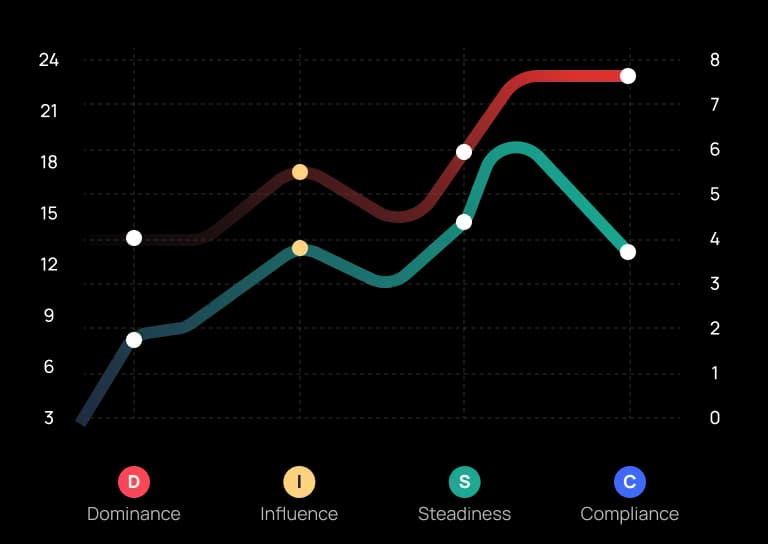
Represents your instinctive behaviors and desires.
Shows the behavioral tendencies you think you should exhibit in specific situations.
Related articles
You may also be interested in
 Self ExplorationNov 19, 2026
How to Use the Holland Code to Choose Your Career
Learn what the Holland code is, how the six RIASEC types and three-letter codes work, and how to use your results to choose a career that fits.
 Self ExplorationNov 19, 2026
The Four Temperaments Explained: Traits, Origins & Science
Learn the four temperaments: sanguine, choleric, melancholic, and phlegmatic, with traits, pitfalls, and a simple way to find your own type.
 Self ExplorationNov 14, 2026
Conscientiousness: Meaning, Facets, and Test Guide
Conscientiousness explained: what the personality trait means, how high and low scorers differ, and ways to improve it. Start with the free test.
