


Table of content
The Four Temperaments Explained: Traits, Origins & Science
Learn the four temperaments: sanguine, choleric, melancholic, and phlegmatic, with traits, pitfalls, and a simple way to find your own type.
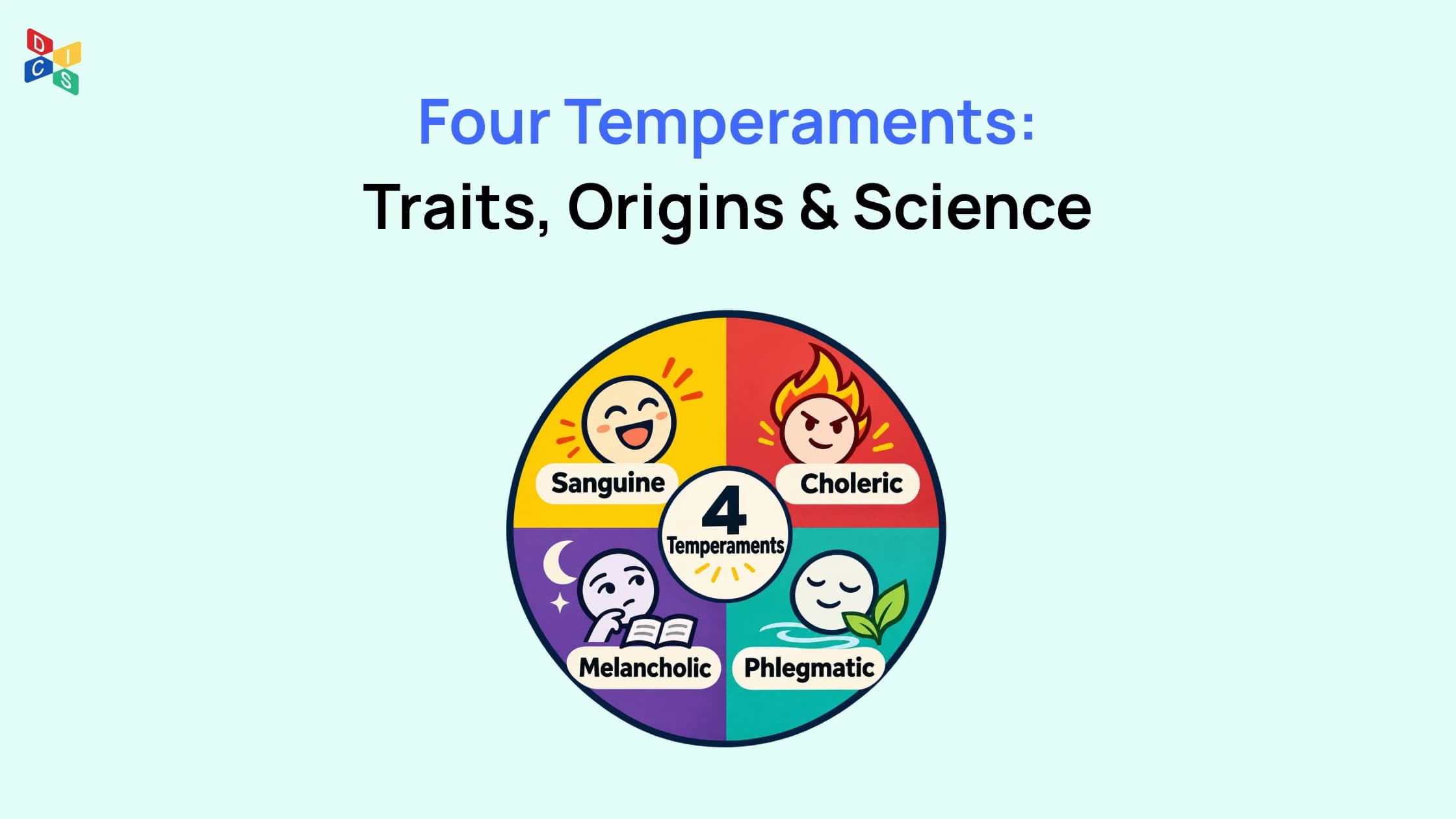
Table of content
The four temperaments are one of the oldest ways to explain why people behave so differently. Why does one coworker jump into every debate while another quietly checks every number twice? For more than 2,000 years, people have answered that with four types: sanguine, choleric, melancholic and phlegmatic.
This guide covers what each temperament looks like, how to find yours, and how the types work together at work. It also covers where the idea came from and how it holds up against modern personality science, including DISC, the workplace model built on the same two questions.
What Are the Four Temperaments?
The four temperaments are four basic behaviour styles: sanguine (sociable and upbeat), choleric (driven and decisive), melancholic (thoughtful and precise) and phlegmatic (calm and steady). Each describes how you tend to act and react, not what you're capable of.
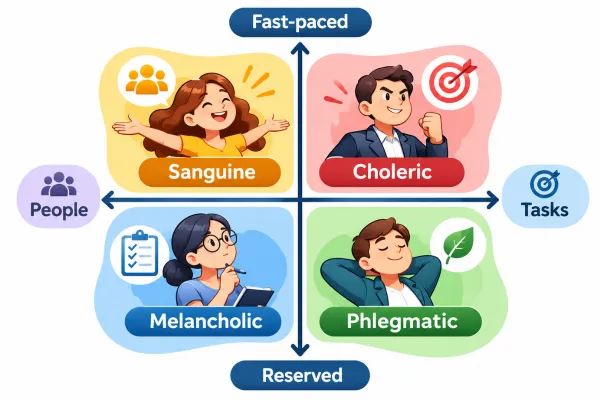
Two questions sort the whole system. Are you fast-paced or reserved? Do you focus on tasks or on people?
- Fast and people-focused: sanguine
- Fast and task-focused: choleric
- Reserved and task-focused: melancholic
- Reserved and people-focused: phlegmatic
Four temperaments diagram: sanguine, choleric, melancholic and phlegmatic plotted by pace and focus.
The same two axes sit behind many modern frameworks, including the DISC personality styles. That's why the old types still feel familiar.
The Four Temperament Types
Each type is named after one of the four bodily fluids, or "humours," of ancient medicine. Each humour was also linked to an element and a season.
Sanguine (blood · air · spring)
Sanguine people are sociable, lively and optimistic. The name comes from sanguis, Latin for blood. They warm up a room quickly, love new ideas and bounce back from setbacks fast.
- Strengths: enthusiasm, charm, persuasion, quick recovery from setbacks
- Watch out for: impulsiveness, distraction, and dropping projects once the excitement fades
- At work: the person who brings energy to a kickoff and fires off ten ideas in a minute
Choleric (yellow bile · fire · summer)
Choleric people are ambitious, decisive and comfortable taking control. They often shine in a crisis because they make fast calls and push for results.
- Strengths: drive, decisiveness, leading under pressure
- Watch out for: impatience, bluntness that comes across as rude, and a short temper with slower colleagues
- At work: the person who decides while others are still discussing. Many of these traits overlap with the popular idea of a Type A personality.
Melancholic (black bile · earth · autumn)
Melancholic people are analytical, detail-oriented and often deeply creative. They notice what others miss and hold high standards for their work. Despite the name, melancholic here doesn't mean sad. It describes depth and care.
- Strengths: analysis, accuracy, planning, creative depth
- Watch out for: perfectionism, overthinking and harsh self-criticism
- At work: the first person to flag the risk everyone else overlooked
Phlegmatic (phlegm · water · winter)
Phlegmatic people are calm, diplomatic and steady. They listen well, keep groups stable and rarely escalate conflict.
- Strengths: patience, reliability, diplomacy, defusing tension
- Watch out for: avoiding change, delaying decisions, and staying quiet when speaking up would help
- At work: the colleague who never looks stressed and always meets the deadline
The four temperaments at a glance
| Temperament | Pace and focus | Typical strengths | Common pitfalls | Closest DISC style |
|---|---|---|---|---|
| Sanguine | Fast, people-focused | Enthusiasm, charm, optimism | Impulsiveness, weak follow-through | Influence |
| Choleric | Fast, task-focused | Drive, decisiveness, crisis leadership | Impatience, short temper | Dominance |
| Melancholic | Reserved, task-focused | Analysis, accuracy, creative depth | Overthinking, self-criticism | Conscientiousness |
| Phlegmatic | Reserved, people-focused | Patience, diplomacy, stability | Inertia, passivity | Steadiness |
Most people are a blend
Pure types are rare. Most people have one dominant temperament and a secondary one, and the mix changes how the main type shows up:
- Sanguine-choleric: outgoing and driven. Persuasive, but can get impatient when blocked.
- Choleric-melancholic: ambitious and exacting. Sets very high standards for themselves and others.
- Melancholic-phlegmatic: thorough and steady. Reliable, but can stall over getting things perfect.
- Phlegmatic-sanguine: warm and easygoing. Great with people, less keen on conflict or pressure.
How to Find Your Temperament Type
To find your temperament, look at how you react without thinking, especially under stress, then pick a dominant type and a secondary one. Pressure strips away habits and shows your default style.
Stress is the clearest clue:
- You take charge and confront the problem: lean choleric.
- You talk it out and look for connection: lean sanguine.
- You pull back to analyse every flaw: lean melancholic.
- You smooth things over to avoid friction: lean phlegmatic.
Work through it step by step:
- Recall a recent stressful moment. Pick a real situation from work or home. Write down what you did first, not what you wish you'd done.
- Rate your pace. Do you usually act quickly and speak up, or pause, watch and think first?
- Rate your focus. Did your attention go to the task and the facts, or to the people and the mood in the room?
- Check your energy. Do variety and socialising recharge you, or do quiet time and a few close relationships?
- Name your dominant type. Combine pace and focus to find the temperament that matches your first reaction most of the time.
- Add a secondary type. Note the style you switch to when your first approach fails. It often explains your mixed traits.
Judge yourself by how you behave over months, not by one great or terrible day. Then ask a friend or colleague to check your answers, since other people often read our reactions better than we do.
How the Four Temperaments Work Together
Most team friction comes from two types that are opposite on pace or on focus. Knowing which axis you differ on turns "they're difficult" into "we work at different speeds."
| Pairing | Where it rubs | What helps |
|---|---|---|
| Choleric + phlegmatic | Pace. One pushes for a decision now; the other wants time and agreement first. | Choleric gives notice before big changes. Phlegmatics state concerns early instead of going along quietly. |
| Sanguine + melancholic | Focus. One sells the big idea; the other spots every gap in it. | Split the roles: the sanguine leads the pitch, the melancholic checks the plan before it goes out. |
| Choleric + melancholic | Speed vs accuracy. Both care about the task but disagree on when "done" is done. | Agree on the quality bar and the deadline before work starts. |
| Sanguine + phlegmatic | Energy. One wants variety and buzz; the other wants calm and routine. | Give the sanguine the client-facing work and let the phlegmatic run the steady process. |
Working with each temperament
- With a sanguine: keep things varied, give public credit, and put follow-up steps in writing.
- With a choleric: lead with the bottom line, offer options rather than problems, and don't take bluntness personally.
- With a melancholic: share details and timelines early, give time to think, and make criticism specific.
- With a phlegmatic: ask for their view directly, avoid sudden changes, and give them space to disagree.
Roles where each type tends to do well
No temperament limits what you can do, but environment affects how energised you feel. Sanguines often enjoy people-facing roles like sales, PR and events. Cholerics often like roles with autonomy and challenge, such as management or entrepreneurship. Melancholics tend to do well in work that rewards precision, like research, finance or engineering. Phlegmatics often thrive where patience counts, such as operations, HR or counselling.
Where Did the Four Temperaments Come From?
The four temperaments come from ancient Greek medicine. The physician Hippocrates (c. 460–370 BC) taught that health depended on a balance of four bodily fluids, or humours: blood, yellow bile, black bile and phlegm. About six centuries later, the physician Galen (AD 129–c. 200) turned that medical idea into a theory of temperament
In De temperamentis, Galen paired each humour with qualities (hot, cold, wet or dry), and later writers tied them to the four elements.
| Humor | Temperament | Qualities | Element | Season |
|---|---|---|---|---|
| Blood | Sanguine | Hot and wet | Air | Spring |
| Yellow bile | Choleric | Hot and dry | Fire | Summer |
| Black bile | Melancholic | Cold and dry | Earth | Autumn |
| Phlegm | Phlegmatic | Cold and wet | Water | Winter |
Galen's system was more detailed than the four types we use today. He counted nine temperaments: one perfectly balanced, four where one quality dominates, and four where two qualities combine. The word itself comes from the Latin temperare, "to mix."
The four labels long outlived the medicine behind them. The Persian physician Avicenna built on the theory in his Canon of Medicine, a standard text in medieval universities. The philosopher Immanuel Kant still described all four types in his Anthropology from a Pragmatic Point of View (1798).
Does Modern Science Support the Four Temperaments?
No, not as biology: no evidence links blood, bile or phlegm to personality, and medicine dropped humoral theory by the mid-1800s. But research does confirm several patterns the old model described, especially differences in sociability and emotional reactivity.
Eysenck mapped the four quadrants
Psychologist Hans Eysenck found two broad personality dimensions: extraversion and neuroticism (emotional instability). Crossing them gives a two-factor model of personality with four quadrants that look a lot like the classic types.
- Stable extravert: sanguine
- Unstable extravert: choleric
- Unstable introvert: melancholic
- Stable introvert: phlegmatic
The Big Five replaced boxes with scales
The Big Five personality traits model scores everyone on five continuous traits: openness, conscientiousness, extraversion, agreeableness and neuroticism. Extraversion and neuroticism appear there too, which is why the old quadrants still feel familiar. The difference is precision: you get a score on every trait instead of one of four labels.
Traits can also shift. Research on adult development suggests people tend to become more agreeable and emotionally stable with age.
Temperament is a real research field
In modern psychology, "temperament" means something narrower than the four types: the inborn tendencies you can see from infancy. MedlinePlus lists sociability, emotionality, activity level, attention and persistence. It estimates that 20 to 60 per cent of temperament is determined by genetics, with environment shaping the rest. Temperament also stays fairly stable, especially in adulthood.
Temperament vs personality
Temperament is the foundation; personality is what you build on it. Temperament covers your inborn reactions, such as how quickly you react and how much stimulation you seek. Personality is broader. It adds the habits, values and thinking patterns you develop through experience. That's why two people with the same temperament can still turn out very different.
DISC uses the same two axes
DISC comes from psychologist William Moulton Marston, who described four behaviour types in his 1928 book Emotions of Normal People. Industrial psychologist Walter Clarke built the first DISC self-assessment in 1956.
Like the temperaments, DISC sorts behaviour by pace and by task or people focus. Most publishers pair Dominance with choleric, Influence with sanguine, Steadiness with phlegmatic and Conscientiousness with melancholic, though some swap the last two. The key difference: DISC describes observable behaviour at work, not anything about your body.
Modern psychology confirms personality dimensions like extraversion and emotional reactivity. It rejects the idea that people fit neatly into four fixed, biological boxes.
Frequently Asked Questions
Can you have two temperaments at once?
Yes. Most versions of the model allow a dominant temperament plus a secondary one. For example, someone might lead with choleric drive and show melancholic attention to detail when working alone. Thinking in blends describes real behaviour far better than forcing yourself into one box.
What is the fifth temperament?
The fifth temperament is usually called Supine. Richard and Phyllis Arno of the National Christian Counsellors Association added it in 1981 as part of their Christian counselling model. It describes a people-pleasing, service-minded type who needs to feel included. It belongs to that one framework and isn't part of the classical four or of mainstream psychology.
Which temperament is the rarest?
No reliable data shows that any temperament is the rarest. Claims online usually come from informal quizzes, not research with representative samples. Because the types are loose descriptions rather than measured traits, focus on your own pattern instead.
How do the four temperaments relate to MBTI?
The link runs through David Keirsey, who grouped the 16 Myers-Briggs types into four temperaments: Artisan (SP), Guardian (SJ), Idealist (NF) and Rational (NT). Sources usually pair sanguine with Artisan and melancholic with Idealist. They disagree on choleric and phlegmatic, so treat any one-to-one mapping as a rough guide.
Is there a reliable four temperaments test?
Most quizzes built on the old model are informal, with little research behind their scoring. They can still prompt useful self-reflection. For a structured view of the same behaviour patterns, a DISC assessment or a Big Five inventory gives clearer scales and is more widely used in workplaces and research.
Are the Severance four tempers the same as the four temperaments?
No. The show's four tempers (Woe, Frolic, Dread and Malice) are fictional. They borrow the old idea of a few basic emotional types, but they aren't the classical four, and the show doesn't use the classical names.
What is the best temperament?
None. Each comes with built-in strengths and built-in pitfalls. The more useful question is whether your role and team suit your natural pace and focus.
Should You Still Use the Four Temperaments?
Yes, as a starting point. The four temperaments give you a simple shared language for pace, focus and stress reactions, which is often enough to explain why two colleagues keep talking past each other. Use them for self-reflection, not as fixed labels.
For a more precise picture of your work style, take the free DISC test. It builds on the same two questions and gives you clearer scoring.
Test results are for reference only. They help you understand yourself better and don't replace an assessment by a qualified psychologist.



DISC Team is a content writing team for tracnghiemtinhcach.vn, focusing on the DISC model, communication styles, and teamwork. The team aims to explain concepts in accessible language, helping readers connect them with situations in their work and everyday lives.
View author profile

Don't Let Your Potential Stay Hidden!
Take the DISC test today and discover your unique 'YOU', with deep insights into your true personality and potential.
 Understand yourself
 Choose the right career
 Suggest effective communication
 Reduce negative emotions
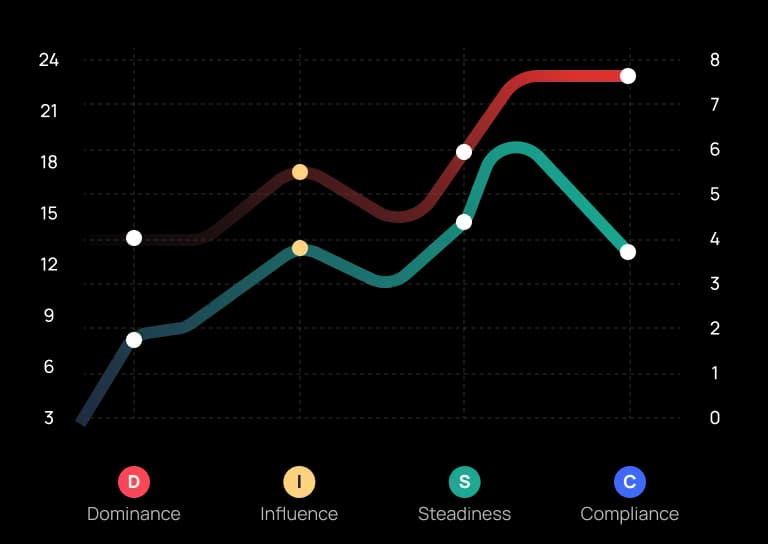
Represents your instinctive behaviors and desires.
Shows the behavioral tendencies you think you should exhibit in specific situations.
Related articles
You may also be interested in
 Self ExplorationNov 19, 2026
What to Expect on the Predictive Index Behavioral Assessment
Learn how the Predictive Index Behavioral Assessment works: the two-part adjective checklist, four drives, and how to read your results.
 Self ExplorationNov 19, 2026
How to Use the Holland Code to Choose Your Career
Learn what the Holland code is, how the six RIASEC types and three-letter codes work, and how to use your results to choose a career that fits.
 Self ExplorationNov 14, 2026
Conscientiousness: Meaning, Facets, and Test Guide
Conscientiousness explained: what the personality trait means, how high and low scorers differ, and ways to improve it. Start with the free test.
