


Table of content
How to Use the Holland Code to Choose Your Career
Learn what the Holland code is, how the six RIASEC types and three-letter codes work, and how to use your results to choose a career that fits.
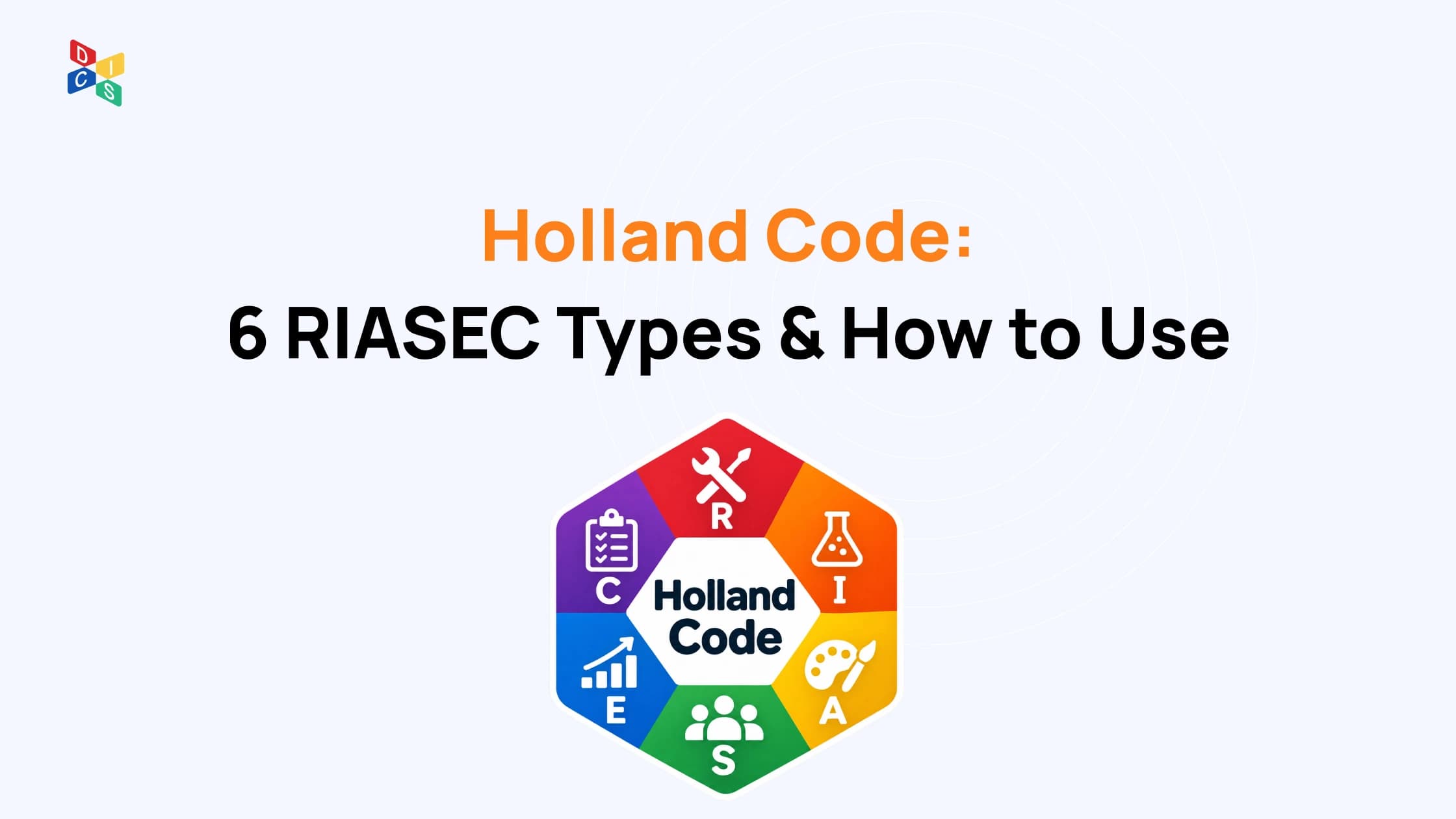
Table of content
Some people light up when they fix an engine, while others feel most alive when they untangle a spreadsheet or coach a nervous colleague. A Holland code is a two- or three-letter summary of your strongest career interests, based on psychologist John L. Holland's RIASEC model. The six types are Realistic, Investigative, Artistic, Social, Enterprising and Conventional, and your code lists your top three in order, such as SAE or RIC.
This guide explains how the model works, what each type looks like, how to read your code, which careers fit each type, three ways to find your own code and how the framework compares with DISC.
What Is a Holland Code?
The Holland Code model is a theory of career choice that describes people and work environments using the same six interest types. Its central idea is simple. People tend to feel more satisfied and stay longer in jobs whose daily tasks match what they genuinely enjoy doing.
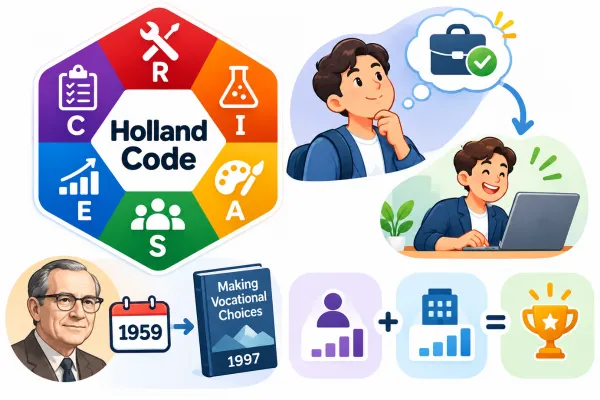
American psychologist John L. Holland first published the theory in 1959 and refined it over four decades, most fully in the third edition of his book Making Vocational Choices (1997). The framework is also known as RIASEC, after the first letter of each type, or as the Holland Occupational Themes. Three ideas hold the model together:
- People have interest profiles: Every person has some degree of interest in all six types, but two or three usually stand out.
- Work environments have profiles too: A hospital ward, a law firm and a construction site each reward a different mix of activities, and the same six labels describe them.
- Congruence matters: When your interest profile matches the profile of your environment, work tends to feel more energising, and you are more likely to persist through the hard parts.
A simple way to view the model: It does not measure what you are capable of doing, but rather which everyday work tasks energize you versus drain you.
That distinction is worth holding on to. Interest is not the same as talent, and a strong interest does not promise success. Still, interest shapes where you invest effort, and effort over time is what builds skill.
Why Your Holland Code Matters
A Holland code is useful because it turns a vague sense of "what I like" into something you can act on:
- It points you toward environments that fit: People whose interests match their work environment tend to be more engaged and more likely to stay, although the effect is moderate rather than guaranteed.
- It makes career research searchable: The U.S. Department of Labour's O*NET OnLine database tags occupations with RIASEC interest codes, so you can look up careers that share your letters.
- It widens your options instead of narrowing them: A code describes a family of daily activities found across dozens of industries. Seeing several compatible paths can make a career or college-major decision feel less like a single, high-stakes bet.
The Six RIASEC Types Explained
RIASEC hexagon showing the six Holland code interest types: Realistic, Investigative, Artistic, Social, Enterprising and Conventional Image brief: hexagon diagram with R, I, A, S, E, C at the corners in that order. Adjacent types are labelled "more similar" and opposite pairs (R–S, I–E, A–C) "most different."
Holland arranged the six types on a hexagon in the order Realistic, Investigative, Artistic, Social, Enterprising and Conventional. Types that sit next to each other share more in common, such as Social and Enterprising. Types on opposite corners describe contrasting preferences: Realistic and Social, Investigative and Enterprising, and Artistic and Conventional.
Realistic (R): The Doers
Realistic people prefer practical, hands-on work with clear, visible results.
- Enjoys: Building, repairing and operating tools or machinery, working outdoors in fieldwork, agriculture or construction, and solving mechanical problems.
- May find draining: Long stretches of meetings, abstract discussion with no tangible output and work that is mostly talking about a task rather than doing it.
- Example careers: Electrician, mechanic, carpenter, civil engineering technician, park ranger.
Quick self-check: Would you rather fix the broken thing than write the report about it? Do you learn a skill best by doing it with your hands? Does a day outdoors or in a workshop sound better than a day at a desk?
Investigative (I): The Thinkers
Investigative people are drawn to ideas, data and questions that need careful analysis.
- Enjoys: Breaking complex issues into parts, testing explanations, working with evidence and measurement, and following a research question wherever it leads.
- May find draining: Heavy selling or persuading, rules that discourage questions and pressure to decide quickly without evidence.
- Example careers: Data scientist, biologist, pharmacist, economist, software engineer.
Quick self-check: Do you keep reading after you have found the answer? Do you enjoy figuring out why something went wrong, not just fixing it? Would you rather work alone on a hard problem than lead a group through an easy one?
Artistic (A): The Creators
Artistic people value originality and room to express themselves.
- Enjoys: Projects without a rigid script, design, music, writing or performance, and work that carries their own voice or point of view.
- May find draining: Rigid procedures, repetitive tasks and work judged only on accuracy rather than originality.
- Example careers: Graphic designer, writer, architect, musician, UX designer.
Quick self-check: Do you keep reworking something until it feels right, even after it is "good enough"? Does a blank page excite you more than a template? Do you notice design, sound or wording that others overlook?
Social (S): The Helpers
Social people find meaning in supporting, teaching or caring for others.
- Enjoys: Explaining ideas and watching someone grow in understanding, helping people through health problems, stress or life transitions, and roles where cooperation and empathy are part of the daily routine.
- May find draining: Isolated work with machines or data, cutthroat competition and roles with no visible effect on people.
- Example careers: Teacher, nurse, school counsellor, social worker, physical therapist.
Quick self-check: Do friends come to you when they have a problem? Do you feel energised after explaining something and seeing it click? Would you choose a job that helps people over one that pays slightly more?
Enterprising (E): The Persuaders
Enterprising people like to lead, influence and move things forward.
- Enjoys: Setting direction and taking responsibility for results, pitching ideas and negotiating outcomes, competing, starting ventures and acting on opportunities quickly.
- May find draining: Slow, detail-heavy work with no decisions to make and roles with no influence over the outcome.
- Example careers: Sales manager, entrepreneur, lawyer, marketing manager, real estate agent.
Quick self-check: Do you naturally take the lead when a group stalls? Do you enjoy changing someone's mind? Does competition motivate you more than it stresses you?
Conventional (C): The Organisers
Conventional people prefer clear structure and work that rewards precision. Despite the name, this type is not about conformity. It describes an interest in standards, records and systems that make work run smoothly.
- Enjoys: Checking figures, maintaining records, catching errors, working within defined roles and schedules, and following and improving procedures.
- May find draining: Shifting priorities with no clear process, vague briefs and constant improvisation.
- Example careers: Accountant, bookkeeper, payroll specialist, logistics coordinator, compliance officer.
Quick self-check: Do you enjoy catching an error before anyone else does? Does a clean, well-organised file give you real satisfaction? Do you prefer clear expectations to open-ended freedom?
How Three-Letter Codes Work
A three-letter code lists your three strongest interest types in order, such as SAE or IRC. The first letter is your dominant interest, the second adds a strong secondary flavour, and the third rounds out the picture. Some tools and counsellors report only two letters, which works well enough for an early career search.
Because order matters, six types produce 120 possible three-letter codes (6 × 5 × 4). Each one describes a slightly different working style.
Think of the six types like colors on a color wheel: Your primary letter is your dominant shade, while your second and third letters blend in to create your specific working style.
Reading a code well means paying attention to three things:
- Hierarchy: Your first letter usually carries the most weight when you compare careers. An SIA and an ISA share the same letters, yet the first leans toward helping people and the second toward analyzing problems.
- Consistency: Letters that sit close together on the hexagon, such as RI or SE, form a consistent profile that fits many existing job families. Letters far apart, such as AC, can be harder to satisfy in a single role.
- Differentiation: Some profiles have one clear peak, while others are fairly flat across several types. A flat profile is not a problem. It often means you can adapt to a wider range of environments.
Researchers have tested the hexagon for decades. Dale Prediger (1982) showed that the six types can be placed on two underlying dimensions: working with data versus ideas, and working with people versus things. Later work, such as Terence Tracey and James Rounds' spherical model, proposed adding more dimensions. For everyday career planning, though, the hexagon remains a practical map for seeing which interests naturally sit together.
Common Holland Code Examples and What They Mean
The table below shows how a few common codes translate into working styles. The careers are starting points to explore, not a fixed list. Look up any job's exact interest code on O*NET OnLine before you rely on it.
| Code | What it suggests | Careers to explore |
|---|---|---|
| RIC | Hands-on technical work with a strong analytical side and respect for precision | Engineering technician, surveyor, laboratory technician |
| IRA | Research and problem solving, often with a technical or creative twist | Environmental scientist, software engineer, biologist |
| IAS | Curiosity about people and ideas, expressed through research and writing | Research psychologist, sociologist, UX researcher |
| ASE | Creative work that connects with and influences people | Art teacher, communications specialist, content strategist |
| SAE | Helping people through creative, expressive methods | Drama or art therapist, career counsellor, creative-arts teacher |
| SEC | Supporting people within organized systems, often with some leadership | HR specialist, school administrator, healthcare administrator |
| ESC | Leading and persuading people, backed by structure and follow-through | Sales manager, recruiter, operations manager |
| CEI | Accuracy and systems, with responsibility for decisions and analysis | Auditor, compliance officer, financial analyst |
Holland Code Careers List for Every Type
This Holland Code careers list groups example occupations under each RIASEC type. Treat it as a starting point: each job draws on several interests, and your second and third letters help you narrow the options. Use the examples to spot patterns in the daily tasks you enjoy, not to pick a single title.
| Type | Typical work activities | Example careers |
|---|---|---|
| Realistic | Building, repairing, operating equipment, working outdoors | Electrician, mechanic, civil engineering technician, carpenter, park ranger |
| Investigative | Researching, analysing data, testing ideas | Data scientist, biologist, pharmacist, economist, software engineer |
| Artistic | Designing, writing, performing, creating | Graphic designer, writer, architect, musician, UX designer |
| Social | Teaching, counselling, caring, coaching | Teacher, nurse, school counsellor, social worker, physical therapist |
| Enterprising | Directing teams, selling, negotiating, managing | Sales manager, entrepreneur, lawyer, marketing manager, real estate agent |
| Conventional | Organising records, processing data, following procedures | Accountant, bookkeeper, payroll specialist, logistics coordinator, compliance officer |
How Your Second Letter Changes the Picture
Two people with the same first letter can end up in very different jobs. Your second letter often decides which corner of a career family suits you best:
- Realistic: With Investigative second, you may lean toward engineering. With Conventional second, quality control or equipment inspection may suit you better.
- Investigative: With Artistic second, research in design or the social sciences is a natural fit. With Social second, medical and health roles are common.
- Artistic: With Enterprising second, marketing, content and product design let creative work meet business goals.
- Social: With Enterprising second, training, management and nonprofit leadership often appear.
- Enterprising: With Conventional second, operations or finance management combines persuasion with structure.
- Conventional: With Investigative second, audit, data governance and analysis roles stand out.
A frequent mistake is assuming a three-letter code points to a single dream job title. In reality it describes a broad family of daily activities found across dozens of industries.
How to Find Your Holland Code (3 Ways)
You can find your Holland code by taking an interest assessment, by ranking the six types yourself or by working through the results with a career counselor. Most people get the clearest answer by combining at least two of these.
1. Take a Free Interest Assessment
If you want a free Holland code test, the O*NET Interest Profiler is the most widely used option. It was developed as one of the U.S. Department of Labour's O*NET career exploration tools. The short form asks you to rate 60 work activities; a 30-question Mini-IP version is also available, and your results link to matching occupations in the O*NET database. Open Psychometrics also offers a free RIASEC test. Paid instruments, such as the Strong Interest Inventory and the Self-Directed Search, report results using the same six themes.
To get a useful result:
- Rate genuine attraction: For each activity, ask whether you would enjoy doing it, not whether it sounds prestigious, pays well or matches skills you already have.
- Record your three highest scores: Write down your code in order and note how close the scores are, because near ties suggest you could read the code either way.
- Explore matching occupations: Look up careers linked to your code and its close variations, and read about their daily tasks, training paths and work settings.
2. Rank the Six Types Yourself
A self-ranking exercise is quicker and surprisingly informative. Read the six type descriptions above, then pick the one that sounds most like you, followed by your second and third choices. The University of Missouri's Career Interests Game uses this approach: you read about six groups of people and choose the three you would most like to join. The first letters of those groups form your code.
Self-ranking is less precise than a scored assessment, so use it as a first draft rather than a final answer.
3. Check Your Code With a Counsellor or Real Experience
Scores and rankings are only a hypothesis until you test them. Talk with people in roles that match your code, shadow someone for a day or take on a small project to see whether the work feels as engaging as the results suggest. A career counsellor can also administer instruments like the Strong Interest Inventory and help you interpret close scores or an unusual combination.
A common situation is a student who scores highest on Artistic but feels pressure to choose a field because of family expectations or salary charts. Answering honestly gives a more useful result than answering the way you think you should.
Holland Code vs. DISC: How They Compare
The Holland code (RIASEC) and DISC answer different questions. Holland describes what kinds of work activities interest you, which helps with choosing a field or role. DISC describes how you tend to behave and communicate, which helps with teamwork, leadership and daily collaboration.
Rule of thumb: If you want to know what tasks and career fields will genuinely interest you, consult your RIASEC profile. If you want to understand how you communicate and collaborate with teammates day to day, consult DISC.
| Aspect | RIASEC interests | DISC |
|---|---|---|
| Main question | What work do you enjoy? | How do you tend to act and communicate? |
| Categories | Six interest types | Four behavioural styles: Dominance, Influence, Steadiness, Conscientiousness |
| Typical use | Choosing a field, major or career change | Team communication, leadership, conflict and collaboration |
| Result format | Two- or three-letter code | Primary style and blend |
Here is how the two can work together. Two people might share the code SEC, and both enjoy organising and supporting others. One may have a high Dominance style and prefer to take charge and decide quickly. The other may have a high Steadiness style and prefer a calm, supportive role on a stable team. Both could thrive in human resources, but in different positions and with different managers.
Conventional (RIASEC) vs. Conscientiousness (DISC): Same Letter, Different Things
Both models use the letter C, and people often assume they mean the same thing. They do not.
- Conventional (RIASEC C) is an interest. It describes the kind of work you want to do: structured, accurate work with records, data and procedures.
- Conscientiousness (DISC C) is a behavioural style. It describes how you tend to act in any job: carefully, analytically and with high standards for quality.
The two often overlap, but not always. A high-C DISC architect may bring careful, quality-focused behaviour to deeply Artistic work. A Conventional-interest accountant may have an outgoing Influence style that makes them the person who explains the numbers to everyone else. The useful question is not "Am I organised?" but "Do I find structured, checkable work satisfying in itself, or do I just do everything carefully?" The first points to a Conventional interest; the second points to a Conscientious style.
Frequently Asked Questions
Can your Holland code change over time?
Core interests are fairly stable once you reach adulthood. Vocational interests become increasingly stable through adolescence and early adulthood. Your first letter often stays the same for years, while your second and third letters can shift as you gain experience, discover new fields or change priorities. Retaking an interest inventory after a major life or career change is a reasonable way to check where you stand.
Does your Holland code show what you are good at?
No. A high score shows preference, not ability. It means you are likely to enjoy those activities, which can motivate you to practice and improve, but it says nothing directly about current skill.
Does matching your Holland code guarantee job satisfaction?
No. Research finds a positive but modest link between interest congruence and job satisfaction, and a meta-analysis of more than 60 years of studies found that interests also relate to job performance and persistence. Company culture, management quality, pay, workload, colleagues and life circumstances still shape satisfaction strongly. A good interest match makes a role more likely to feel meaningful, but it cannot make up for a poor workplace or a role that clashes with your values.
What happens if your top types are opposites on the hexagon?
Opposite types, such as Artistic and Conventional or Realistic and Social, simply suggest a hybrid profile. You may enjoy cross-disciplinary roles that blend both sides, such as design operations, occupational therapy or technical training. You can also satisfy one interest at work and the other through side projects, volunteering or hobbies.
Is a Holland code the same as a personality type?
Not exactly. Holland himself described the six types as vocational personalities, and they overlap with broader personality traits, but a Holland code measures interests: the work activities you are drawn to. Personality models such as the Big Five or DISC describe how you think, feel and behave across situations. That is why the same Holland code can show up in people with very different personalities.
Is there a free Holland code test?
Yes. The O*NET Interest Profiler, available for free through My Next Move, is the most widely used option and links your results directly to matching occupations. Open Psychometrics also offers a free RIASEC test. Paid tools such as the Strong Interest Inventory and the Self-Directed Search give more detailed reports and are often available through school or university career centres.
Next Steps: How to Use Your Holland Code
Your Holland code is a practical lens for choosing work you will actually want to do each day. Find your code with an assessment or a self-ranking exercise, explore careers that share your letters and test those options in real settings before making a big decision. Then pair the result with a behavioural tool such as DISC to see both what you enjoy and how you work with others.
Test results are for reference only. They help you understand yourself better and do not replace an assessment by a qualified psychologist or career counsellor.
Take the test: Free DISC Personality Test



DISC Team is a content writing team for tracnghiemtinhcach.vn, focusing on the DISC model, communication styles, and teamwork. The team aims to explain concepts in accessible language, helping readers connect them with situations in their work and everyday lives.
View author profile

Don't Let Your Potential Stay Hidden!
Take the DISC test today and discover your unique 'YOU', with deep insights into your true personality and potential.
 Understand yourself
 Choose the right career
 Suggest effective communication
 Reduce negative emotions
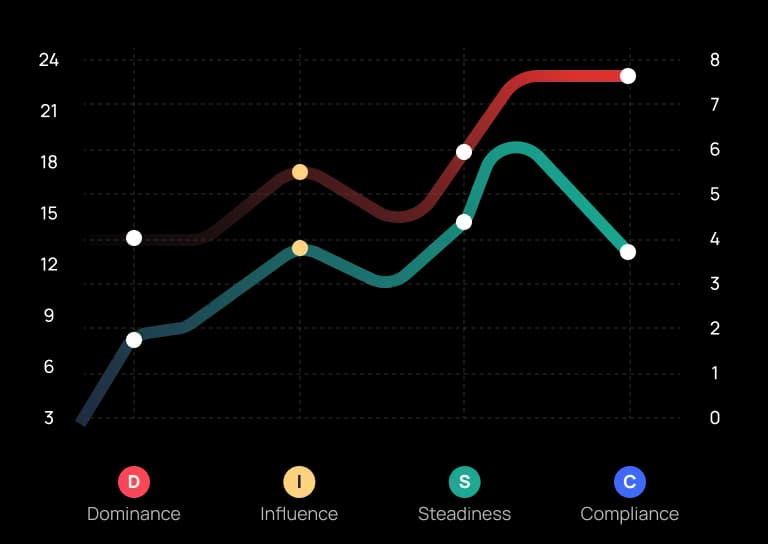
Represents your instinctive behaviors and desires.
Shows the behavioral tendencies you think you should exhibit in specific situations.
Related articles
You may also be interested in
 Self ExplorationNov 19, 2026
What to Expect on the Predictive Index Behavioral Assessment
Learn how the Predictive Index Behavioral Assessment works: the two-part adjective checklist, four drives, and how to read your results.
 Self ExplorationNov 19, 2026
The Four Temperaments Explained: Traits, Origins & Science
Learn the four temperaments: sanguine, choleric, melancholic, and phlegmatic, with traits, pitfalls, and a simple way to find your own type.
 Self ExplorationNov 14, 2026
Conscientiousness: Meaning, Facets, and Test Guide
Conscientiousness explained: what the personality trait means, how high and low scorers differ, and ways to improve it. Start with the free test.
