


Table of content
What Is a Low IQ Score? Meaning, Ranges, and What It Indicates
Learn what a low IQ score means, where different IQ ranges fall, and why IQ alone cannot determine intelligence, ability, or everyday functioning.
An IQ score can attract judgment and influence how a person views themselves.
A low IQ score can't map out your whole life. Low IQ scores don't rule out meaningful careers, strong relationships, or fulfilling lives. Look at everyday life as well. Many people with low IQs live independently and work regular jobs. The score may point to some challenges with mental capacity, but cognitive ability covers only part of daily life. A score remains a score.
A test score can seem like a verdict on an individual's potential and limits.
That figure won't determine the shape of your life. People with low IQ scores can still build meaningful careers, strong relationships, and fulfilling lives. Pay attention to everyday routines, too. Many people with low IQs live independently and hold regular jobs. The number may describe certain cognitive challenges, but cognitive ability is only one part of daily life. It remains a score.
Defining a Low IQ Score
To read a low IQ score, start with the scale. IQ testing measures cognitive ability, and 100 marks the median level in the general population. That number sits at the center.
Key facts about IQ can be useful in certain contexts, but they don't capture emotional intelligence, resilience, social insight, or creative thinking.
What is considered a low IQ depends on context, but an IQ below 70 usually falls into the low IQ range, sitting two standard deviations below the mean. About 2.5% of the population scores there.
Scores below 85 are below average, and scores of 70 and 75 are often described as borderline. Still, one score can't establish a diagnosis or show whether someone can live independently.
Age affects how an IQ score should be read. Mental age compares someone's performance with the ability level usually expected at their chronological age. Check the age closely. A child's result is judged differently from an adult's, even when the scoring system stays unchanged. Developmental stages can also change how cognitive ability shows up in daily life.
The Bell Curve and Low IQ Percentile
About 68% of people score between 85 and 115.
One standard deviation above or below the mean includes this span, leaving most people near the center of the IQ bell curve.
A score around 115 is considered above average.
This part of the scale often reflects strong analytical and problem-solving skills. Roughly 16% of the population falls within it. IQ scores cluster much like adult height, while results become less common toward either end.

The high IQ score range covers the other end of that distribution.
Understanding a Below Average IQ
A score around 85 is often described as a low average IQ score and is slightly below average.
About 16% of people fall around this level, and some tasks may take more effort than they do for peers. Look for trouble with abstract thinking, logical reasoning, and quick information processing. School, work, and everyday decision-making may all feel harder.
IQ 70-85: Below Average but Functional
High school may take more effort to finish, but finishing remains possible.
The average IQ range offers a reference point for scores just under the population median.
Borderline Intellectual Functioning
Borderline intellectual functioning: 70-79
Scores between 70 and 75 are commonly classified as borderline.
Low IQ scores can reflect different levels of difficulty. Psychologists break the range below 70 into smaller groups to describe those cognitive challenges.
Clinical and educational settings use this IQ score classification when deciding what support someone may need.
Mild Intellectual Disability
Mild intellectual disability: 55-69
Someone can have a low IQ without having an intellectual disability. A formal diagnosis requires a low IQ together with substantial problems in everyday adaptive functioning. Those problems may affect both communication and social skills and daily living, and they must begin before the age of 18. The condition was previously called “mental retardation” (the older term).
Moderate Intellectual Disability
Moderate intellectual disability: 40-54
Severe Intellectual Disability
Severe intellectual disability: 25-39
Profound Intellectual Disability
Profound intellectual disability: Below 25
A low score doesn't automatically mean lifelong care. The greater difficulty may show up in reasoning, tackling tasks, or academic learning.
Professional Assessment
Seek a professional evaluation if you’re worried about your cognitive abilities, one that examines several abilities.
A browser quiz or free IQ test isn’t an official evaluation or clinical diagnosis. Proper clinical assessment is extensive, supervised, and covers several distinct skill areas. I wouldn’t call a short quiz an evaluation. A test that examines your abilities should take time because a careful assessment costs substantial time and money.
Standardized tools still have limits, even when professionals use them. Modern IQ is a calculated measure based on how your score compares with the population, where the average is 100, rather than a raw test score. A result below 85 isn’t, by itself, definitive.

Many qualified experts disagree about whether IQ tests measure intelligence well or in full. We don’t have strong agreement on what intelligence actually means, which makes it hard to pin down. Intelligence is abstract and difficult to observe directly, not something tangible that you can easily measure.
A valid result gives you one data point, not a final measure of intelligence. A low score doesn’t prove that someone is lazy or clueless, nor that they lack value, and it doesn’t decide their potential or life outcomes. Read the result carefully, and don’t use it to predict those outcomes. Real-world success rests on more than abstract reasoning. People with low scores can build meaningful careers and strong relationships while leading fulfilling lives. The result doesn’t settle a person’s broader prospects.
Everyday Implications of the Low IQ Range
School, choices, household routines, and tasks with several steps may become harder with a low IQ. Goals can still be reached, though success may look different.
Consistently Low Academic Performance
Classroom learning can be hard for people with low IQ, particularly in math and science, as well as reading comprehension. Even with steady effort, some basic ideas may take longer to grasp.
Statistically, lower IQ scores go with a lower chance of completing high school, often due to lasting academic problems and too little support. Still, many people graduate when they receive suitable accommodations and encouragement.
Trouble Understanding Consequences
Connecting today’s choices with future results may take more work. Someone with lower practical intelligence or a low IQ might mishandle money and avoid responsibilities, or take risks without weighing the results. Impulsive decisions can follow.
Difficulty with Daily Tasks

Everyday duties may feel like too much at once. Managing time and money, along with home routines, can be hard, especially when several demands arrive together. Missed appointments and household disorganization, including forgotten chores, can bring avoidable stress or strain with other people.
Struggles with Multi-Step or Complex Tasks
Multi-step work may leave people with low IQ unsure of what to do next. A trip, a project, or detailed instructions can require memory and sequencing, plus critical thinking. Lower cognitive functioning often makes these areas harder.
Personal and work goals can still be reached, although success won’t look the same for everyone. Many people with lower IQ scores do well in hands-on jobs and creative work, or entrepreneurial ventures that depend less on academic testing. Some who struggled at school later build careers and raise families. Their contributions can strengthen the communities around them.
Misconceptions About Low Cognitive Ability
Still, old labels and familiar stereotypes keep shaping views of low cognitive ability. A score may conceal effort, background, personality, and potential. The label never contains the whole person.
Equating Low Scores with Stupidity
People reach for “dumb” and “stupid” far too quickly after seeing a low result or some other surface trait. Those judgments usually rest on stereotypes rather than careful knowledge. They erase effort, background, personality, and potential, then make one score stand for a whole person.
Confusing Score Brackets with Formal Disability
IQ terms can make diagnosis seem more straightforward than it really is. That happens when someone treats a score bracket as proof of a formal disability diagnosis. Understanding the low IQ meaning requires more than a score; it gives you only one piece of the picture.
- Outdated label: “Mentally retarded” was once used as a catch-all label for anyone with a low IQ, but it is no longer medically accurate and has caused harm by oversimplifying a complex issue.
- IQ score alone: A low IQ score does not by itself establish an intellectual disability.
- Broader assessment: Formal disability diagnosis requires more than a score and must include the difficulties a person has in daily life.
Conflating Learning Differences with Low General Intelligence
Learning differences affect specific types of information
Dyslexia, ADHD, and dyscalculia can affect a person's reading, attention, or handling of certain kinds of information. They are learning disabilities, and they don't describe a person's overall intelligence.
Different learning needs do not define IQ
Learning disabilities can occur alongside average or even high IQ scores. Someone may learn through nontraditional methods, with support needs appearing at school or work and across At least eight different settings and tasks.
Assuming Homogeneity Among Low-Scoring Individuals
People with low scores don't all turn out alike. Personality, talent, interests, and emotional life still differ from person to person, and those differences belong in the picture.
When everyone with a low IQ gets treated as though they think and act alike, human experience gets flattened. Cognitive ability is one part of identity; character, interests, and daily life still vary widely.
Assuming Low Scores Guarantee Career Failure
A low IQ score doesn't guarantee that someone's career will fail. Determination, emotional intelligence, creativity, and resilience can shape how someone works and what they manage to do.
Linking Cognitive Scores to Inherent Criminality
Risk factors are not caused by IQ

Some studies report a statistical link between lower IQ scores and risk factors such as poverty, trauma, or limited education. Look at those conditions themselves, and don't make the score their cause. IQ doesn't create poverty.
Moral character varies from person to person
A low IQ doesn't tell you whether someone is kind, law-abiding, or deeply moral. Crime grows out of social, environmental, and psychological factors, and those factors differ across people and situations.
Attributing Psychiatric Illness Directly to Test Scores
Mental health and IQ belong to different parts of the picture. A low IQ may make some cognitive tasks harder, but it doesn't automatically signal depression, anxiety, or another psychiatric condition; those experiences can sometimes bring emotional challenges. IQ itself doesn't cause psychiatric illness.
Dismissing Street Smarts
Practical intelligence is different from test performance
Test performance and practical, real-world intelligence don't always match neatly. Someone with a low IQ can still read social situations, solve everyday problems, and find useful ways forward. Psychologists call those abilities practical intelligence, and traditional IQ tests don't always catch them.
A high IQ can sit beside poor common sense or weak everyday judgment. Someone with a lower IQ may instead have sharp instincts, strong people skills, or hands-on expertise. Those strengths appear beyond the testing room.
Viewing General Intelligence as the Sole Measure of Capability
Robert Sternberg and Howard Gardner have both argued for wider views of intelligence. Their models offer broader measures, including abilities that a standard IQ test leaves out of its single, one-dimensional measure, which widens the list.
- Sternberg
- Gardner
| Theoretical Model | Core Dimensions | Key Distinction from Standard IQ |
|---|---|---|
| Sternberg | Analytical, creative, and practical | Intelligence includes creative and practical abilities as well as analytical ability. |
| Gardner | At least eight types of intelligence, including linguistic, spatial, musical, intrapersonal, and others | Intelligence is not one-dimensional or one-size-fits-all. |
As a child, Mike Tyson received a reportedly low IQ test score and struggled in school. Yet boxing showed his exceptional bodily-kinesthetic intelligence, while self-reflection and public speaking revealed later interpersonal intelligence. The score captured only a narrow part of him.
Someone who tests poorly may still excel at reading people, building things, making music, or solving practical problems. An IQ exam measures some abilities and leaves others outside the score.
Score Permanence
When practice, learning, or life circumstances affect cognitive performance, a new result does not necessarily show that baseline intelligence has changed permanently.
Research finds that people who see abilities as fixed tend to avoid challenges and improve less over time. A growth mindset keeps learning going and helps people get better.

Your IQ score can move noticeably with sleep, stress, and education. Cognitive exercises generally make specific puzzle types more familiar, rather than drastically altering your brain's baseline wiring.
Results may move, while baseline intelligence remains. Learn more about how to improve IQ.
Cognitive Enhancement Strategies
Choosing these activities gives you ways to engage your cognitive faculties and support steady mental performance.
- Start a new hobby, Choose a hobby that engages your cognitive faculties.
- Try an instrument, chess, or a language course, Playing an instrument, learning to play chess, or taking a language course are examples you could try.
- Read books frequently, If the other activities do not appeal to you, frequent reading could be beneficial.
- Use a diverse reading list, Include both fiction and nonfiction in your reading list.
- Practice with mental exercises and puzzles, You could boost your IQ score with brain exercises for cognitive skills, brain teasers, and puzzles. Do a few every day to keep your brain in tip-top shape.
- Start a new hobby:
Choose a hobby that engages your cognitive faculties.
- Try an instrument, chess, or a language course:
Playing an instrument, learning to play chess, or taking a language course are examples you could try.
- Read books frequently:
If the other activities do not appeal to you, frequent reading could be beneficial.
- Use a diverse reading list:
Include both fiction and nonfiction in your reading list.
- Practice with mental exercises and puzzles:
You could boost your IQ score with mental exercises, brain teasers, and puzzles. Do a few every day to keep your brain in tip-top shape.

Causes of Lower Cognitive Performance
During childhood, cognitive abilities are still developing, so a child’s IQ hasn’t reached the full potential an adult’s IQ has.
In the earliest months of life, differences in intelligence may already appear, and signs of low IQ may be visible before a child takes an official IQ test.
Motor development may lag behind that of other children. Between six and eight months old, babies typically manage sitting up and crawling without support, then begin to stand soon after. If an older child still struggles to sit, low IQ could be one possible cause. That timing is one sign.
Speech can also take longer to emerge than expected in some children. A child’s first word usually comes between 12 and 18 months of age. If it hasn’t arrived by then, delayed development or low IQ may explain the absence.

Some children may find logical thinking hard to develop. Children aren't always rational, yet they can understand logical ideas when those ideas are presented in an appropriate way. Trouble with those ideas, or with reasoning more broadly, could be caused by a low IQ.
A child with a low IQ may have trouble linking an action to what happens afterward. The child may experience actions as though they stand alone, which can make it hard to explain why those actions lead to particular consequences.
Still, a low IQ isn't always behind these challenges. Learning differences and trauma can also cause many people to experience the same challenges, as can mental health conditions.
A low IQ score captures a narrow, age-normed view of performance at one point in development. Read that snapshot with the child’s adaptive functioning, daily skills, and practical strengths. Look at the full pattern before treating the score as a statement of what the child can do. The number is one piece of the picture.


Don't Let Your Potential Stay Hidden!
Take the DISC test today and discover your unique 'YOU', with deep insights into your true personality and potential.
 Understand yourself
 Choose the right career
 Suggest effective communication
 Reduce negative emotions
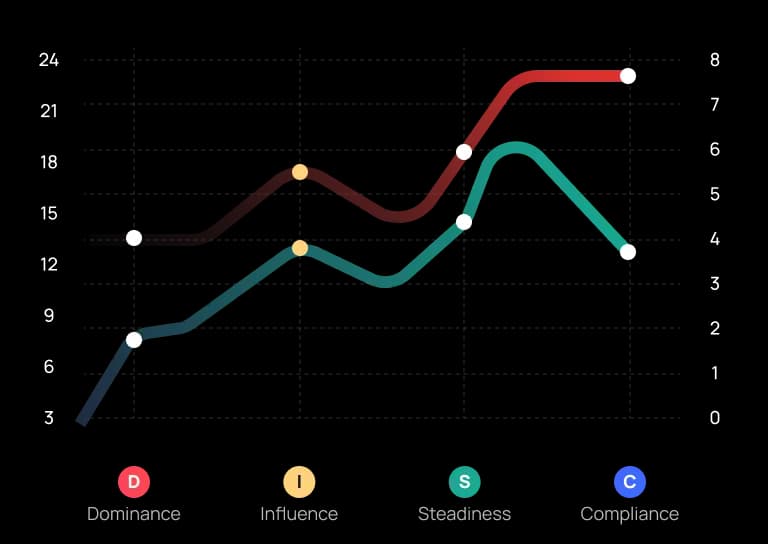
Represents your instinctive behaviors and desires.
Shows the behavioral tendencies you think you should exhibit in specific situations.
Related articles
You may also be interested in
 IQ, EQSep 25, 2026
Why Emotional Intelligence in the Workplace Matters for Leaders
Emotional intelligence in the workplace helps leaders handle difficult conversations, organizational change, employee concerns, collaboration, and conflict.
 IQ, EQSep 22, 2026
Emotional Intelligence and Conflict Resolution: A Practical Guide
Learn how emotional intelligence supports conflict resolution through self-regulation, active listening, empathy, and clear communication.
 IQ, EQSep 21, 2026
15 Daily Signs of High Intelligence You Might Have
Discover 15 daily signs of high intelligence, from pattern recognition and curiosity to metacognition, creativity, adaptability, and more.
