


Table of content
IQ Score: Ranges, Its Accuracy and What It Can Show
See the IQ chart, what 100, 115 and 130 really mean, and how to read an online result as an indicator. Take the free IQ test.
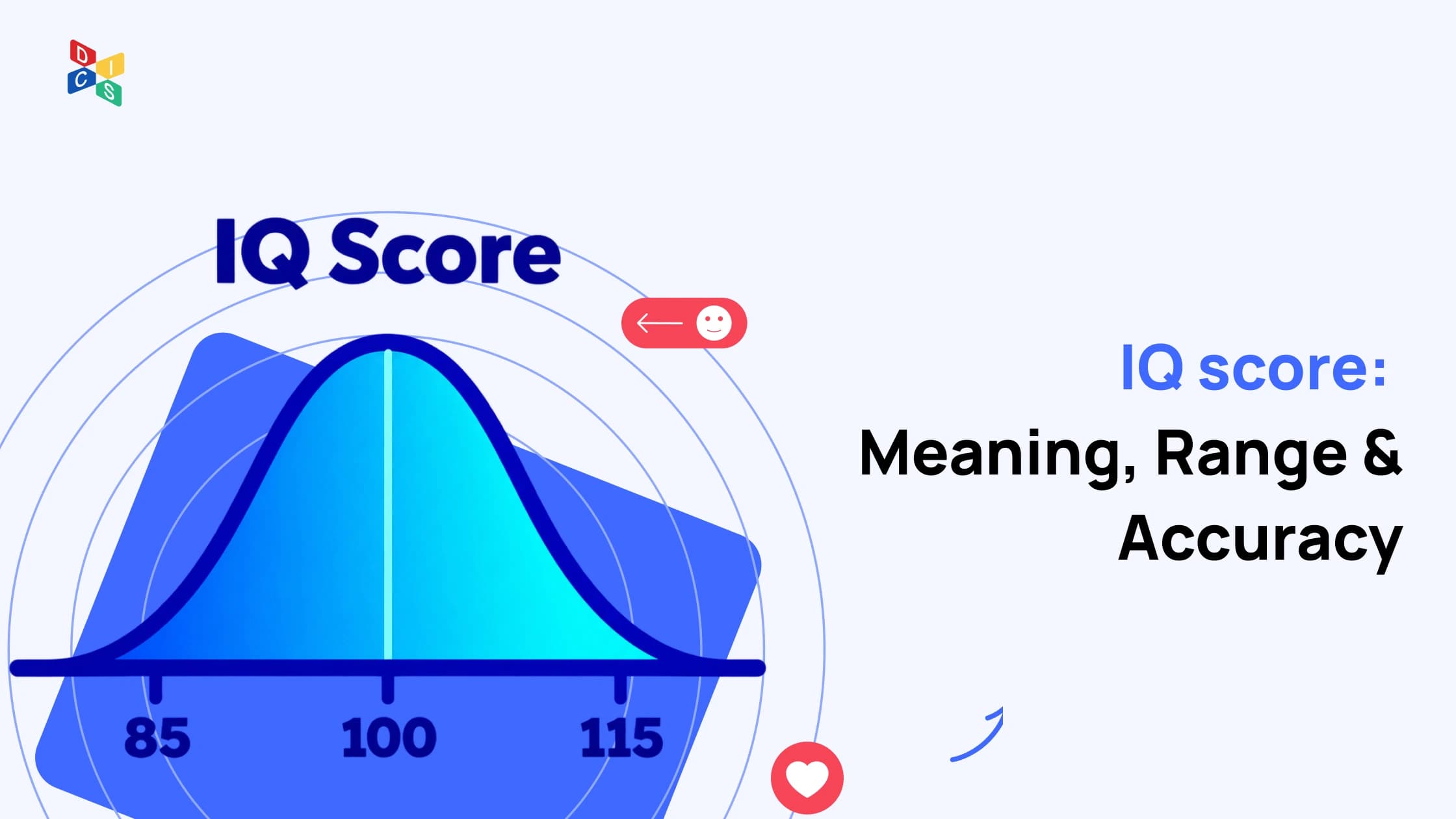
Table of content
What does a number like 112 or 127 actually say about your mind? The short answer to IQ score meaning is that your score places your reasoning performance on a curve next to people your age, where 100 is the average and about two out of three people land between 85 and 115. The number also depends on which test produced it, how old its norms are and how you felt on test day. This guide walks through score ranges, what IQ tests measure and miss, how much error sits around every result and how to read an online score without overreading it.
What Is an IQ Score?
An IQ score is a standardized number that compares your performance on reasoning tasks with a large reference group of people your age. Most modern tests set the average at 100 and the standard deviation at 15, so the score describes your relative standing in that group rather than a fixed amount of intelligence.
The term intelligence quotient comes from early 20th century testing. French psychologist Alfred Binet and his colleague Théodore Simon published the first practical intelligence scale in 1905 to identify children who needed extra support at school. German psychologist William Stern proposed the "quotient" idea in 1912: mental age divided by chronological age. Lewis Terman at Stanford multiplied that ratio by 100 in 1916, which is where the familiar three-digit number comes from.
Modern tests no longer use the mental age formula. In 1939, David Wechsler introduced the deviation IQ, which converts your raw answers into a position on a bell curve built from people your age. That shift matters for IQ score meaning today: a score of 115 does not mean you have "15% more intelligence" than average. It means you scored one standard deviation above the mean of your age group.
A helpful way to picture it: An IQ score works more like a finishing position in a race than a stopwatch time. It tells you where you placed relative to a particular field of runners, not how fast you would run on every track.

What Does Your IQ Score Mean?
Your IQ score means how far your result sits from the average of 100 for your age group. On a scale with a standard deviation of 15, about 68% of people score between 85 and 115, about 95% score between 70 and 130, and roughly 2% score 130 or higher.
Those percentages come from the normal distribution, the bell-shaped curve that IQ tests are designed to follow. The middle of the curve holds most people, and the tails get thinner the farther you move from 100. An IQ chart is simply a way of labeling sections of that curve.

IQ Score Meaning by Range
The table below shows common IQ score ranges, the approximate share of people in each band and descriptive labels similar to those used on modern Wechsler scales. Labels are descriptions of relative standing, not judgments of a person.
| Score range | Approximate share of people | Descriptive label |
|---|---|---|
| 130 and above | About 2% | Extremely high |
| 120 to 129 | About 7% | Very high |
| 110 to 119 | About 16% | High average |
| 90 to 109 | About 50% | Average |
| 80 to 89 | About 16% | Low average |
| 70 to 79 | About 7% | Very low |
| 69 and below | About 2% | Extremely low |
Two people with scores of 108 and 92 sit in the same "average" band, even though their numbers look far apart. That is a useful reminder that small differences inside a band carry little practical meaning.
How Percentiles Work
A percentile tells you what share of your age group scored below you. It is not the percentage of questions you answered correctly. A score of 100 sits at the 50th percentile, 115 sits near the 84th percentile and 130 sits near the 98th percentile. If your report says "75th percentile," you outscored about three out of four people in the comparison sample.
What Counts as a High IQ?
A high IQ usually refers to a score at or above the 98th percentile, which is the cutoff that Mensa International uses for membership. The exact number depends on the scale's standard deviation:
| Standard deviation of the scale | Score at about the 98th percentile |
|---|---|
| 15 (Wechsler scales and most modern tests) | 130 |
| 16 (older Stanford-Binet editions) | 132 |
| 24 (Cattell scale) | 148 |
This is why two websites can report "your IQ is 132" and "your IQ is 148" for the same level of performance. Always check which scale a test uses before comparing numbers. Keep in mind that a test built to find the top 2% does that job well but separates scores in the middle of the range less finely.
If you want a starting point for your own number, the IQ test on discpersonalities.com includes 25 questions with a 30-minute time limit and shows a basic result as soon as you finish.
An IQ score is a position on a curve compared with one group of people on one day. It is not a measure of your worth or a ceiling on what you can learn.
How Are IQ Scores Calculated?
IQ scores are calculated by converting your raw answers into a standard score based on a norm group, which is a sample of people your age who took the same test. The quality of that norm group, how recently it was collected and the scale's standard deviation all shape the final number you see.
Representative Norms vs Self-Selected Norms
Clinical tests spend years building their norm groups. The Wechsler Adult Intelligence Scale, Fourth Edition (WAIS-IV), released in 2008, was normed on 2,200 adults ages 16 to 90, matched to US census data on factors such as age, sex, education level and region. That design lets a psychologist say with reasonable confidence how your score compares with the general adult population.
Many online tests build their norms from whoever happens to take the test. People who choose to take an IQ test online are not a random slice of the population, so the "average" in that group may sit above or below the true population average. Your result is still a comparison, but the comparison group is less clearly defined.
Why Older Norms Can Inflate Scores
Raw performance on IQ tests rose across the 20th century, a pattern known as the Flynn effect. A 2015 meta-analysis by Jakob Pietschnig and Martin Voracek, covering close to 4 million participants from 31 countries, estimated full-scale gains of about 0.28 points per year, or roughly 3 points per decade. The same study found those gains have slowed in recent decades.
In practical terms, a test normed 20 years ago compares you with people who scored lower on average than people do today. That can push your score up by several points. This is one reason test publishers renorm their instruments every 10 to 20 years.
How IQ Scoring Turns Raw Answers Into a Number
IQ scoring follows the same basic steps on most well-built tests:
- You answer a set of timed or untimed reasoning items.
- The test counts your raw score, sometimes weighting harder items.
- Your raw score is compared with the raw scores of your age group in the norm sample.
- That position is converted to the standard IQ scale, usually with a mean of 100 and a standard deviation of 15.
If any of those steps is weak, such as a small or unusual norm group, the final number becomes less trustworthy even if the questions themselves are well designed.
What Does an IQ Test Actually Measure?
An IQ test measures general reasoning ability, often called g, through tasks such as verbal reasoning, working memory, processing speed and visual-spatial problem solving. A well-built test samples several of these domains, while a narrower test may lean on one or two and produce a score that reflects less of your overall reasoning.

General Intelligence, or g
British psychologist Charles Spearman noticed in 1904 that people who do well on one type of mental test tend to do well on others. He called the shared factor behind those results the g factor. A full-scale IQ is designed to be a good estimate of g.
Think of g like cardiovascular fitness in an athlete. Good fitness supports performance in running, swimming and cycling, but it does not guarantee skill in any one sport or good decisions during a game.
Core Cognitive Domains
The WAIS-IV reports four index scores alongside the full-scale IQ. Many other tests sample similar areas:
- Verbal comprehension: Vocabulary, general knowledge and verbal analogies.
- Perceptual or visual-spatial reasoning: Matrix puzzles, block designs and pattern completion.
- Working memory: Holding and manipulating information, such as repeating digit sequences in reverse.
- Processing speed: Completing simple visual tasks quickly and accurately.
Two tests can both be called "IQ tests" and still measure different mixes of these abilities. A test that relies heavily on vocabulary will favor people with strong reading backgrounds, while a test built mostly on matrix puzzles will favor visual pattern spotting. Neither number is wrong, but each answers a slightly different question about what IQ measures.
What Brain and Genetic Research Shows
Research links IQ scores to brain structure and to both genetic and environmental influences. In a 2004 study, Richard Haier and colleagues used voxel-based morphometry to find associations between IQ and gray matter in several regions across the frontal, temporal, parietal and occipital lobes. The pattern suggests intelligence draws on networks spread across the brain rather than one "intelligence center."
A 2018 study by Jakob Kaminski and colleagues examined 1,475 healthy adolescents from the IMAGEN project. It found general IQ was associated with polygenic scores for intelligence, epigenetic changes to a dopamine receptor gene and patterns of brain activation. The authors pointed to these findings as signs that IQ test performance is shaped by both genes and environment and can change.
What Doesn't an IQ Score Measure?
An IQ score does not measure creativity, emotional intelligence, social skill, motivation or practical judgment. Psychologist Robert Sternberg and other researchers argue that these abilities shape real-world success alongside reasoning, so a single number leaves out much of what makes a person capable at school, work and home.
A useful comparison is a thermometer. It measures temperature well, but it cannot tell you the humidity or the wind speed. IQ tests work the same way: They are narrow, not useless.
Creativity and Divergent Thinking
Most IQ items have one correct answer. Creative thinking often means producing many possible answers, such as listing unusual uses for a paperclip. Sternberg's work on creative and practical intelligence describes these as abilities that standard IQ tests largely leave out.
Emotional and Social Skills
Reading other people's feelings, managing your own reactions and handling conflict rely on different skills from solving a matrix puzzle. Psychologist Daniel Goleman popularized the idea of emotional intelligence in his 1995 book of the same name. If you want to explore that side of yourself, the EQ test (https://discpersonalities.com/eq-test) looks at emotional awareness and regulation.
Practical Judgment and Persistence
Long-term outcomes also depend on habits, patience, curiosity and the stamina to finish what you start. Sternberg describes wise intelligence as using your abilities to adapt to your surroundings in ways that serve the common good. None of these qualities shows up in a timed puzzle score. Some people also like to reflect on how they prefer to approach problems, and the Left/Right Brain Test offers one way to think about your thinking style.
A high IQ can help you solve a defined problem. Deciding which problems are worth solving, and sticking with them, draws on much more than reasoning speed.
What Can an IQ Score Predict?
An IQ score predicts group-level trends in school results, education level, job level and income, with the strongest link to academic achievement. These correlations describe averages across many people, so they cannot tell you how far any one person will go in school, work or life.
School Achievement
A 2007 study by Ian Deary and colleagues followed more than 70,000 English children. Intelligence measured at age 11 correlated 0.81 with a general achievement factor built from national exam results at age 16, and it contributed to performance in all 25 subjects studied. That figure compares underlying factors rather than single test scores, so it overstates how well one child's score predicts one child's grades. The direction of the link, however, is clear.
Education, Career and Income
A 2007 meta-analysis by Tarmo Strenze pooled longitudinal studies that measured intelligence first and outcomes years later. Squaring each correlation shows roughly how much of the difference between people goes along with IQ:
| Outcome | Correlation with IQ | Share of variation linked to IQ |
|---|---|---|
| Educational attainment | 0.56 | About 31% |
| Occupational level | 0.43 | About 18% |
| Income | 0.20 | About 4% |
The income figure is the clearest lesson. About 96% of the variation in income between people is linked to factors other than measured IQ, such as education, opportunity, effort, health and luck.
Job Performance and Hiring
The link between IQ and job performance is more debated. A widely cited 1998 review by Frank Schmidt and John Hunter, covering 85 years of selection research, put the validity of general mental ability at 0.51. In 2022, Paul Sackett and colleagues argued in the Journal of Applied Psychology that earlier meta-analyses overcorrected for range restriction. Their revised estimates fell by roughly 0.10 to 0.20 for many selection methods, with general mental ability landing near 0.31.
For employers, the takeaway is to treat cognitive results as one input alongside structured interviews and skills assessments, never as the sole basis for a hiring decision. Employers in the US should also follow EEOC guidance on employment testing. Teams that want a structured way to look at assessment results can explore the Business Suite, a tool that helps HR teams understand candidate and team fit.
How Precise Is Your IQ Score?
Your IQ score is precise to within a few points, not to the exact number. Every test has a standard error of measurement, and on a well-built clinical battery a 95% confidence band usually spans about 4 to 5 points on each side, so a reported 100 should be read as roughly 95 to 105.
Standard Error of Measurement
The standard error of measurement (SEM) is the typical distance between the score you received and the score you would average over many sittings. It is calculated by multiplying the standard deviation by the square root of 1 minus the test's reliability. The more reliable the test, the narrower the band around your score:
| Test reliability | Standard error of measurement | 95% band around a reported score |
|---|---|---|
| 0.90 | 4.7 points | Plus or minus 9 points |
| 0.95 | 3.4 points | Plus or minus 7 points |
| 0.97 | 2.6 points | Plus or minus 5 points |
| 0.98 | 2.1 points | Plus or minus 4 points |
Full-scale scores on major clinical batteries tend to sit near the bottom of this table, with manuals reporting standard errors of about 2 to 3 points. Shorter tests usually have lower reliability and wider bands. Think of your score as a zone on a map rather than an exact coordinate.
This has a practical consequence. If you score 104 one month and 109 the next, that gap is likely within measurement error. Comparing the bands around two scores gives you a safer read than comparing the two numbers.
Why Your Score Profile Matters
Clinical evaluations break your result into separate index scores, such as verbal comprehension and processing speed. Someone with a full-scale IQ of 105 might score 120 on verbal comprehension and 90 on processing speed. That profile says far more about how the person learns than the single composite does.
Index and subtest scores rely on fewer items than the full-scale score, so they are less reliable on their own. They are still useful for spotting patterns. Many online tests give you one composite number, which hides this kind of variation.
Can Your IQ Score Change Over Time?
Your IQ score can change by several points over time, though your relative standing tends to stay fairly stable in adulthood. Sleep, stress, practice with similar puzzles and the age of the test's norms can all move a result, which is why one sitting gives a snapshot rather than a final verdict.
Stability Across the Lifespan
A 2024 meta-analysis by Moritz Breit and colleagues in Psychological Bulletin combined 205 longitudinal studies with 87,408 participants. Stability was low in preschool children, rose quickly through childhood and stayed high from late adolescence into late adulthood. For a 20-year-old retested after 5 years, the estimated rank-order stability was about 0.76. General intelligence was among the most stable abilities they examined, but stability declined as the gap between tests grew.
Is There an Average IQ by Age?
The average IQ is 100 at every age, because each age group is scored against its own norms. What changes with age is raw performance. Speed-based and fluid reasoning tasks tend to peak in early adulthood, while vocabulary and general knowledge often keep growing into middle age. An age-normed score already accounts for those shifts, so a 70-year-old and a 25-year-old who both score 100 are each average for their own age group.
Practice Effects
Retaking a cognitive test usually raises your score. A 2007 meta-analysis by John Hausknecht and colleagues found average retest gains of about 0.26 standard deviations, roughly 4 IQ points, with larger gains when people received coaching or saw the same test form again. Research by Jan te Nijenhuis and colleagues in 2007 found these gains are not linked to the g component, which suggests they reflect familiarity with the format rather than a real change in reasoning ability.
Test Anxiety and Testing Conditions
Feeling anxious during a test tends to lower scores. A 2018 meta-analysis by Nathaniel von der Embse and colleagues, which pooled 238 studies, found a small to moderate negative relationship between test anxiety and performance on standardized tests. Fatigue, hunger, a noisy room and a slow internet connection can also drag a result down.
Language and Cultural Familiarity
Test items assume a certain vocabulary and background knowledge. Taking a test in your second language, or meeting puzzle formats you have never seen, can lower your score even when your reasoning is strong. Well-built clinical tests check their items for statistical bias, but familiarity with content still helps.
Where Can You Take an IQ Test?
You can take an IQ test through a licensed psychologist, a high-IQ society session, an employer or military program, a university research study or an online platform. Each option serves a different purpose, and the right choice depends on whether you need a formal record or simply want insight into your reasoning.
| Option | Who runs it | What you get | Good fit for |
|---|---|---|---|
| Clinical evaluation | Licensed psychologist or neuropsychologist | Full-scale IQ, index scores, written report | Diagnosis, school or workplace accommodations, formal records |
| High-IQ society test | Society proctor at a supervised session | Pass or fail against the 98th percentile cutoff | Joining a society such as Mensa |
| Workplace or military test | Employer or the US military | Score compared with applicants or recruits | Job applications, ASVAB placement |
| University research study | Psychology research team | Varies; sometimes scores, sometimes none | Low-cost testing if you meet study criteria |
| Online IQ test | Website you choose | Instant estimate; detail varies by site | Curiosity, self-reflection, practice with formats |
Clinical Psychological Evaluations
A clinical evaluation is the right choice when the stakes are high, such as assessing ADHD, a learning disability, giftedness for school placement or disability accommodations. A licensed psychologist gives a test such as the WAIS-IV in person. The core battery usually takes about 60 to 90 minutes, and a full evaluation with interviews and other tests can take several hours. The examiner also watches how you work, which helps separate a low score caused by anxiety from one caused by genuine difficulty. Evaluations can be expensive, and insurance coverage often depends on a clinical referral.
Supervised High-IQ Society Tests
Mensa groups in each country offer proctored admission tests, usually in group sessions for a fee. Many national Mensa groups also accept qualifying scores from approved tests taken elsewhere. A society test tells you whether you meet the cutoff, but it does not provide the detailed cognitive profile a psychologist would use for educational or workplace planning.
Workplace and Military Assessments
Some employers use cognitive ability tests such as the Wonderlic or the Criteria Cognitive Aptitude Test (CCAT) during hiring, and the US military uses the ASVAB. These tests compare you with applicants or recruits rather than the general public, and they aim to predict training or job performance, not to give a full cognitive profile.
University Research Studies
Psychology departments sometimes recruit participants for studies that include cognitive testing, often with a small payment or course credit. The testing can be rigorous, but you need to live nearby and meet the study's criteria, and the research team decides whether to share your scores.
Online IQ Tests
Online tests are the easiest option to access: You can take one at home without an appointment. The trade-off is less control over conditions and norms, so the result works as an indicator rather than a clinical score. discpersonalities.com offers a free IQ test with 25 questions and a 30-minute limit that shows a basic result right away, with a detailed report available as a paid option. The site also offers DISC, EQ and Left/Right Brain tests, and its tests have been completed more than 109,000 times, according to discpersonalities.com data.
How Should You Read an Online IQ Test Result?
You should read an online IQ test result as a rough indicator of your reasoning, not a clinical score. Check what the test measured, think about your testing conditions, picture a band of several points around the number and use the result as a prompt for reflection rather than a label.
These six steps help you get more from an online result:
- Check the test details. Note the number of questions, the time limit and the types of items. A 25-question test gives a quicker estimate than a multi-hour clinical battery.
- Think about your conditions. Were you tired, rushed or distracted? Write that down next to your score.
- Read the score as a range. Picture a band of several points on either side, and wider for shorter tests.
- Notice which items felt easy or hard. Patterns in number sequences, word problems or visual puzzles say more about you than the single number.
- Avoid retaking the same test to chase a higher score. Practice effects can add points without any change in your reasoning ability.
- Know when you need a professional. Diagnosis, school accommodations and legal or educational records all require a licensed psychologist.
Read this way, IQ score meaning becomes less about a verdict and more about useful information you can act on, such as which kinds of problems you enjoy and which ones you want to practice.
Frequently Asked Questions About IQ Scores
What is considered a normal or good IQ score?
A normal IQ score falls between about 85 and 115, the range where roughly 68% of people score on a test with a standard deviation of 15. Scores from 90 to 109 are usually labeled average. No score is good or bad in itself, because a score simply shows your relative standing on reasoning tasks.
Can you raise your IQ score with practice?
Practice can raise your IQ score by a few points, mostly because familiar puzzle formats feel easier the second time. A 2007 meta-analysis by Hausknecht and colleagues found retest gains of about a quarter of a standard deviation, roughly 4 points. Those gains do not appear to reflect a change in general reasoning ability.
Are online IQ tests accurate?
Online IQ tests give a rough estimate rather than a precise measurement. Most use self-selected norm groups and run in uncontrolled settings, so results can differ by several points from a clinical score. A well-designed online test is useful for curiosity and self-reflection, but treat the result as an indicator, not an official score.
Can an online test score be used for educational accommodations?
No, an online test score cannot be used for educational accommodations. Schools and testing agencies typically require a comprehensive evaluation from a licensed psychologist or neuropsychologist. That evaluation includes a standardized test such as the WAIS-IV or WISC-V, a clinical interview and a written report explaining the results.
What IQ score is required to qualify for Mensa?
Mensa requires a score at or above the 98th percentile on an approved, supervised intelligence test. That works out to about 130 on a scale with a standard deviation of 15, 132 on a scale with 16 and 148 on a scale with 24. Each national Mensa group sets its own list of accepted tests.
Putting IQ Score Meaning Into Perspective
Understanding IQ score meaning gives you something more useful than a number: A sense of proportion. A score describes how you handled one set of reasoning tasks on one day, compared with one group of people. It says nothing about your creativity, your kindness or how hard you will work for what matters to you. Used that way, an IQ result becomes a starting point for curiosity instead of a label. If you want a fresh data point, take the IQ test on discpersonalities.com, then pair it with the EQ test to see the emotional side of how you solve problems.
Test results are for self-reflection and educational purposes. They are not a clinical or psychological diagnosis and do not replace advice from a licensed professional.
- Website: DISC Personalities
- Email: admin@discpersonalities.com


DISC Team is a content writing team for tracnghiemtinhcach.vn, focusing on the DISC model, communication styles, and teamwork. The team aims to explain concepts in accessible language, helping readers connect them with situations in their work and everyday lives.
View author profile

Don't Let Your Potential Stay Hidden!
Take the DISC test today and discover your unique 'YOU', with deep insights into your true personality and potential.
 Understand yourself
 Choose the right career
 Suggest effective communication
 Reduce negative emotions
Represents your instinctive behaviors and desires.
Shows the behavioral tendencies you think you should exhibit in specific situations.
Related articles
You may also be interested in
 IQ, EQNov 08, 2026
Mensa IQ Test: Qualifying Score, Cost, and How It Works
How high is the Mensa IQ test cutoff? See scores by test scale, US costs, and age rules, then take our IQ practice test to check your pace.
 IQ, EQNov 08, 2026
IQ Test for Kids: How to Choose the Right One by Age
Learn which IQ test for kids fits ages 2 to 16, how scores work and when testing helps. Take the IQ test on discpersonalities.com as a parent.
 IQ, EQNov 08, 2026
Famous People IQ Scores: Which Are Documented?
See which famous people IQ scores come from real tests, which are estimates, and how to check any claim. Take the IQ test to see your own.
